
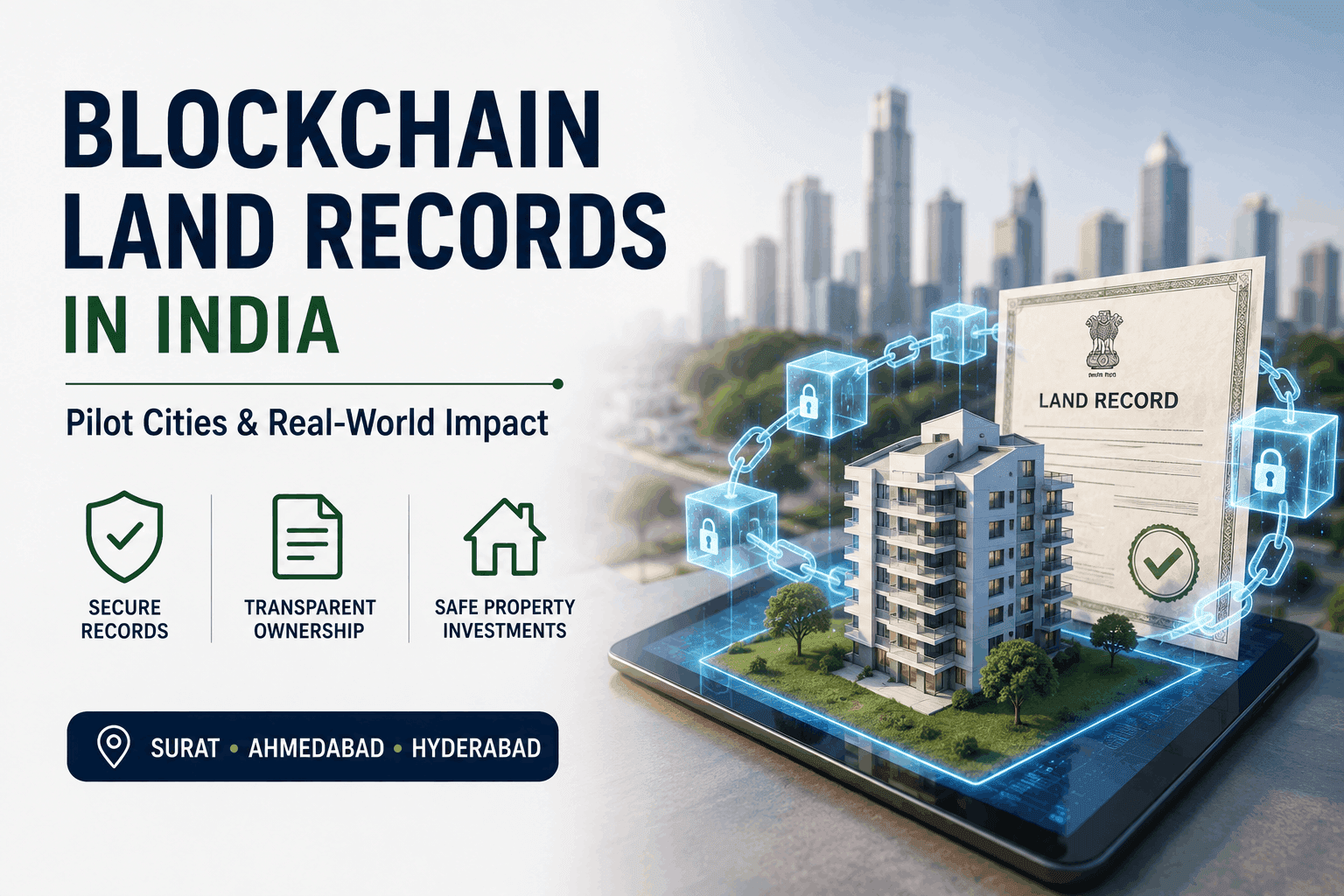
Blockchain Land Records in India: Pilot Cities and Real-World Impact
Imagine buying a flat in Ahmedabad's SG Highway area and never having to worry about title fraud. No more sleepless nights wondering if the seller actually owns the property. That is exactly what blockchain land records promise. But here is the thing—India is still in pilot mode. The government has launched blockchain-based land registry projects in several cities, and the results are mixed but promising. In this blog, I will break down the pilot cities, the real-world impact, and what this means for you as a homebuyer or investor.
What Are Blockchain Land Records and Why Should You Care?
Let us start with the basics. Blockchain is a digital ledger that records transactions in a secure, transparent, and tamper-proof way. When applied to land records, it means every property transaction—sale, purchase, mortgage, inheritance—is recorded on a chain that cannot be altered retroactively. No more duplicate land titles, forged documents, or disputes over ownership.
In my experience, the biggest headache for homebuyers in Gujarat is title verification. You pay a lawyer Rs 10,000 to 20,000 to check the chain of ownership, and even then, there is no guarantee. With blockchain, the entire history is visible in real-time. The truth is, this technology could save buyers lakhs of rupees in legal fees and years of court battles.
The Pilot Cities: Where Is Blockchain Land Records Being Tested?
The Government of India, through the Department of Land Resources, has selected several cities for pilot projects. Here are the key ones:
Andhra Pradesh: The Pioneer
Andhra Pradesh was the first state to pilot blockchain land records in 2017. The project covered the capital region of Amaravati and parts of Visakhapatnam. The results were impressive—reduced fraud, faster registration, and improved transparency. However, the project faced challenges like lack of digital literacy and integration with existing systems.
Telangana: The Tech Hub
Telangana launched its pilot in Hyderabad and surrounding districts in 2019. The state partnered with a private blockchain firm to create a system where buyers can verify property titles instantly. What many buyers overlook is that Telangana also integrated this with its Dharani portal, making it easier to cross-check data.
Maharashtra: The Mumbai Experiment
Maharashtra started a pilot in Mumbai's suburban areas and Pune in 2020. The focus was on preventing duplicate sale deeds. Interestingly, the pilot revealed that over 15% of property records had discrepancies. This shows how badly we need blockchain.
Gujarat: The Surat and Ahmedabad Story
Gujarat is not far behind. The state government has piloted blockchain land records in Surat and parts of Ahmedabad, particularly in the Gota and Chandkheda areas. These are fast-growing suburbs where property prices have shot up by 20-30% in the last two years. A 2BHK flat in Gota now costs Rs 45-55 lakhs, and buyers are increasingly asking for blockchain-verified titles. In my view, Gujarat's pilot is a model for other states because it integrates with the existing e-Dhara system.
Other Cities: Delhi, Haryana, and Karnataka
Delhi piloted blockchain for land records in 2021, focusing on the Lutyens' Delhi area. Haryana tested it in Gurugram, a hotspot for real estate investment. Karnataka launched a pilot in Bengaluru's Whitefield and Electronic City areas. The common thread? All these pilots faced issues with data migration and legacy records.
Real-World Impact: What Has Changed?
Now, let us talk about the real-world impact. Is blockchain just a buzzword, or is it actually making a difference?
Reduced Fraud and Disputes
In Andhra Pradesh, property dispute cases dropped by 30% in pilot areas. That is huge. For a buyer in Ahmedabad, this means fewer court cases and faster possession. Take Ramesh, a first-time buyer from Ahmedabad. He was looking at a flat in Bopal but was worried about title fraud. The builder showed him a blockchain-verified title on the government portal. Ramesh closed the deal in 45 days—half the usual time.
Faster Registration and Lower Costs
In Surat, registration time for a property dropped from 15 days to 3 days. Why? Because blockchain eliminates the need for manual verification. The cost? A buyer saves around Rs 5,000 to 10,000 in document verification fees. Not a life-changing amount, but every rupee counts.
Improved Transparency
Here is the thing—blockchain makes corruption harder. In Telangana, officials cannot alter records without leaving a digital trail. This has reduced instances of bribes for title clearance. For investors in Gujarat's GIFT City, this transparency is a game-changer. A commercial property there costs Rs 1.5-2 crores, and buyers want zero ambiguity.
Challenges Remain
But let us be honest. The pilots have not been perfect. Data migration from paper records to blockchain is slow. Many old records are missing or incomplete. Also, not all states have adopted it uniformly. In Gujarat, for example, only 30% of land records are on blockchain. The rest are still on the old system. So, do not assume every property is covered.
What This Means for Gujarat Homebuyers
If you are buying property in Gujarat, here is what you should know:
- Check if the property is on blockchain: Ask your builder or seller for the blockchain ID. In Ahmedabad, you can verify this on the e-Dhara portal.
- Focus on pilot areas: Properties in Gota, Chandkheda, and Surat are more likely to have blockchain records. In contrast, older areas like Naroda or Vastral may still have paper records.
- Legal due diligence is still needed: Blockchain reduces fraud but does not eliminate it. Always hire a lawyer to verify the chain of ownership.
- RERA compliance is separate: Remember, RERA registration and blockchain land records are different. RERA ensures project completion, while blockchain ensures title authenticity. Both are important.
Key Takeaways: Quick Tips for Buyers
- Verify the title: Use the state land records portal to check if the property is on blockchain.
- Ask for blockchain ID: If the builder cannot provide one, be cautious.
- Cross-check with RERA: Ensure the project is RERA registered (look for RERA number on the Gujarat RERA website).
- Budget for legal fees: Even with blockchain, set aside Rs 10,000-15,000 for a lawyer.
- Focus on emerging hotspots: Areas like Shela, Gota, and Chandkheda are likely to have better records due to new developments.
The Road Ahead: Will Blockchain Become the Norm?
The government plans to expand blockchain land records to all districts by 2026. But that is optimistic. In my view, it will take 5-7 years for full implementation. Why? Because digitizing old records is a massive task. Also, states need to train officials and integrate systems.
But here is the good news—once adopted, it will transform real estate. Imagine buying a flat in Surat's Vesu area and getting instant title verification on your phone. No more running to government offices. No more bribes. No more disputes.
Conclusion: Your Next Step
Blockchain land records are not a distant dream—they are already here in pilot cities. As a buyer, you should leverage this technology. When you shortlist a property, ask the builder or seller for a blockchain-verified title. If they cannot provide it, consider it a red flag.
In Gujarat, the pilot is live in Surat and parts of Ahmedabad. If you are looking at a flat in Gota or Chandkheda, you are in luck. But even if your property is not on blockchain, do not worry. Just do your due diligence—hire a lawyer, check RERA, and verify the title.
Real estate is a big investment. Do not leave anything to chance. Start with blockchain land records.
*Got questions? Drop a comment below or reach out. I am here to help.*