
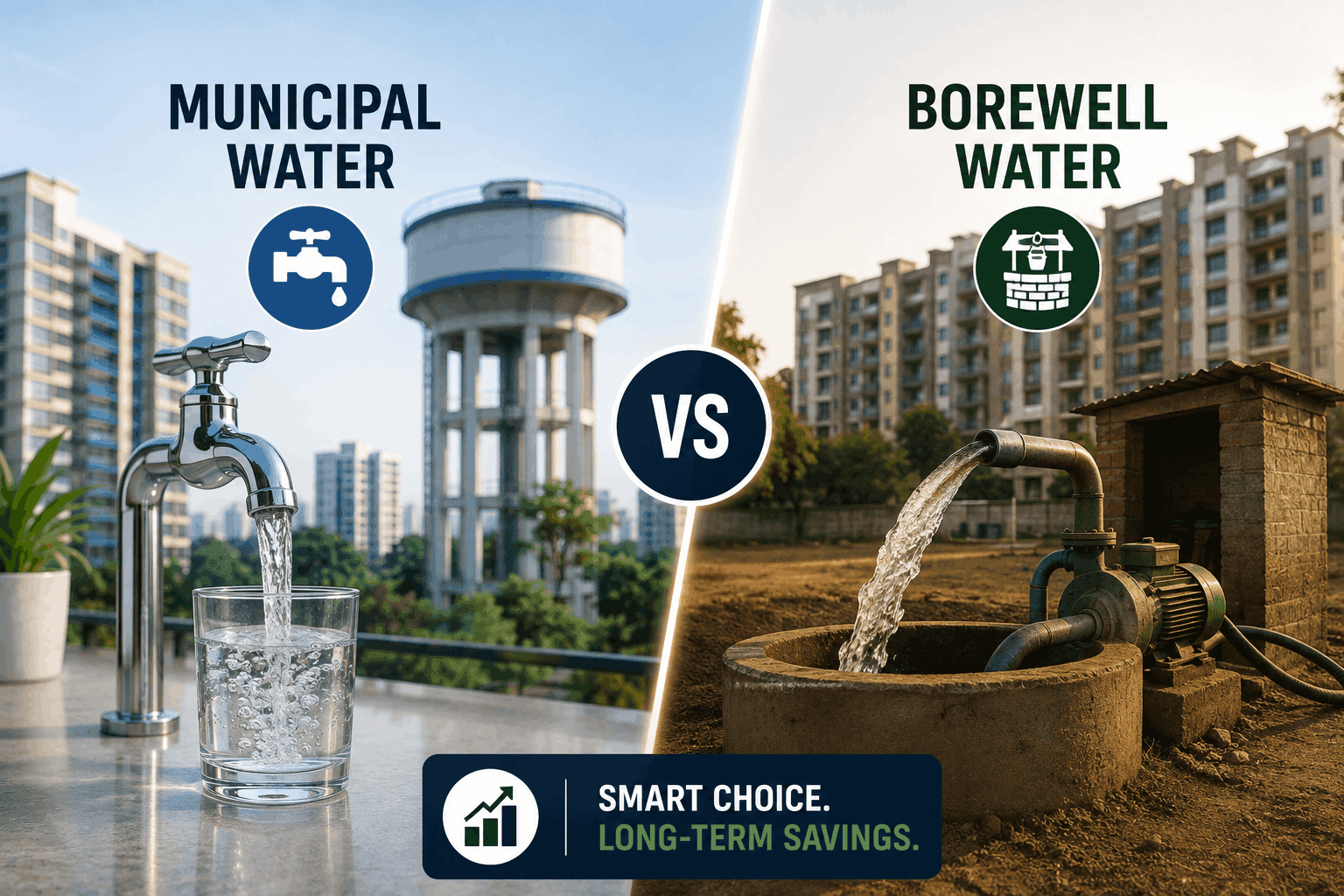
Water. It is the one resource no home can function without. Yet, when you are buying a flat in Ahmedabad's SG Highway or a villa in Surat's Vesu, how often do you truly pause to ask: where will my water come from? Most buyers obsess over carpet area, location, and RERA approvals. But here is the thing—your monthly water bill, or worse, a dry borewell, can make or break your living experience. Welcome to the deep dive on Borewell vs Municipal Water in Indian Homes: Long-term Cost Analysis. In this guide, I will break down the real numbers, the hidden pitfalls, and what you, as a Gujarat homebuyer, must know before signing that agreement.
The Ground Reality: Why This Matters More Than You Think
Look, Gujarat is a water-stressed state. We all know that. But what does it mean for your home? In areas like Bopal and Shela in Ahmedabad, where new high-rises are sprouting like mushrooms, municipal water supply is often erratic. Many societies there rely on borewells. Meanwhile, in well-planned sectors of Gandhinagar or GIFT City, municipal water is more reliable. The choice between these two sources isn't just about convenience—it is a long-term financial decision that can cost you lakhs over a decade.
Consider this: A typical household of four uses about 1,000 to 1,500 litres of water daily. Now, multiply that by 365 days, and then by 10 years. That is a lot of water. And the cost of sourcing that water varies dramatically. In my experience, most buyers do not factor in the recurring expenses of borewell maintenance, electricity for pumps, or the risk of the well running dry. On the flip side, municipal water comes with its own set of charges and reliability issues. So, which one wins?
The Ahmedabad Example: A Tale of Two Societies
Let me give you a real example. I recently visited two societies in Ahmedabad's Chandkheda area. One, a 5-year-old project called "Green Valley," relies entirely on a borewell. The other, "Satyam Residency," is connected to the municipal supply. Both have similar number of flats (around 40 each). Green Valley's residents pay a monthly maintenance of Rs 2,500, of which roughly Rs 800 goes to water—electricity for the pump, periodic maintenance, and occasional water tanker refills when the borewell level drops in summer. Satyam Residency pays Rs 1,800 maintenance, with only Rs 300 going to water. That is a difference of Rs 500 per month per flat. Over five years, that is Rs 30,000 per flat. For a society of 40 flats, that is Rs 12 lakhs. And this is just the direct cost. The borewell society also faced a situation last year when the pump motor burned out—replacement cost Rs 25,000, split among residents.
Now, imagine this in a larger society of 100 flats on SG Highway. The numbers scale up quickly. Borewell vs Municipal Water in Indian Homes: Long-term Cost Analysis is not an academic exercise; it is about real money coming out of your pocket every month.
Breaking Down the Costs: Borewell vs Municipal Water
Upfront Costs: The First Hit
When a builder installs a borewell, the cost is usually passed on to buyers. A typical borewell in Gujarat (depth: 200-400 feet) costs between Rs 1.5 lakhs to Rs 3.5 lakhs, depending on the area and water table. Add a submersible pump (Rs 30,000 to Rs 60,000), piping, and a storage tank (Rs 50,000 to Rs 1 lakh). Total upfront: Rs 2.5 to Rs 5 lakhs per borewell. For a society with multiple borewells, this can run into crores.
Municipal water connection, on the other hand, has a one-time fee. In Ahmedabad, for a standard residential connection, the AMC (Ahmedabad Municipal Corporation) charges around Rs 5,000 to Rs 15,000 as a connection fee, plus a refundable security deposit of Rs 2,000 to Rs 5,000. That is it. The builder may have already paid this, but sometimes it is an extra charge in the agreement.
Winner on upfront cost: Municipal water. No contest.
Recurring Costs: The Monthly Drain
Here is where it gets interesting. For borewell water, your monthly cost includes:
- Electricity for the pump: A 2 HP pump running 4-6 hours daily consumes about 150-200 units per month. At Rs 6-7 per unit (Gujarat domestic tariff), that is Rs 900 to Rs 1,400 per month for the society. Divided among 40 flats, that is Rs 22 to Rs 35 per flat.
- Maintenance: Annual servicing of pump, motor, and pipes: Rs 5,000 to Rs 10,000 per year. Plus, every 3-5 years, you may need to replace the pump (Rs 30,000 to Rs 50,000).
- Water tanker refills: In summer, when the borewell dries up, societies often order tankers. One tanker (10,000 litres) costs Rs 1,000 to Rs 2,000 in Gujarat. A society may need 10-20 tankers per month in peak summer. That adds up fast.
For municipal water:
- Monthly water bill: In Ahmedabad, for a typical flat, the AMC charges about Rs 200 to Rs 500 per month based on consumption (Rs 5-7 per 1,000 litres).
- No electricity cost for pumping (unless you have a booster pump, which is rare).
- No tanker costs.
Winner on recurring cost: Municipal water, by a significant margin.
Hidden Costs and Risks: The Silent Killers
Now, let me tell you what many buyers overlook. Borewells have a lifespan. In Gujarat, due to depleting groundwater levels, a borewell may last only 5-10 years before the yield drops significantly. Then you need to deepen it (Rs 50,000 to Rs 1 lakh) or drill a new one (Rs 2-3 lakhs). This is a lump-sum cost that hits the society's sinking fund. I have seen societies in Vastral and Naroda struggle with this. One society I know of had to spend Rs 8 lakhs on a new borewell because the old one went dry. That was Rs 8,000 per flat—an unexpected burden.
Municipal water, however, has its own risks: supply cuts, low pressure, and sometimes poor water quality (though AMC water is generally treated). But you are not responsible for infrastructure failures—the municipality is. And in Gujarat, AMC and other municipal bodies have been improving supply. In areas like Satellite and Prahlad Nagar, municipal water is available 24/7 with good pressure.
Winner on hidden costs: Municipal water, unless you live in an area with chronic supply issues.
Quality and Health Considerations
Borewell water in Gujarat is often hard (high TDS). I have tested water in Shela—TDS levels of 800-1,200 ppm, which is not ideal for drinking without an RO system. Installing a whole-house RO or water softener costs Rs 30,000 to Rs 1 lakh, plus annual maintenance of Rs 5,000. Municipal water in Ahmedabad typically has TDS under 300 ppm and is chlorinated, making it safer for drinking without additional treatment. However, some people dislike the taste of chlorine. Your call.
Long-term Cost Projection: 10-Year View
Let me project costs for a typical 2BHK flat (1,000 sq ft) in a 40-flat society in Ahmedabad over 10 years.
Borewell scenario:
- Upfront (your share of borewell installation): Rs 10,000 to Rs 15,000 (assuming Rs 4 lakhs total cost divided by 40 flats)
- Monthly water cost in maintenance: Rs 800 (as seen in Chandkheda example)
- Additional tanker costs in summer (3 months): Rs 200 per month extra = Rs 600 per year
- Pump replacement once in 10 years: Rs 1,250 per flat (Rs 50,000/40)
- Deepening or new borewell once in 10 years: Rs 5,000 per flat (Rs 2 lakhs/40)
- Total over 10 years: Rs 15,000 (upfront) + (Rs 800 x 120 months) + (Rs 600 x 10 years) + Rs 1,250 + Rs 5,000 = Rs 15,000 + Rs 96,000 + Rs 6,000 + Rs 6,250 = Rs 1,23,250
Municipal water scenario:
- Upfront connection fee: Rs 5,000 (one-time)
- Monthly water bill: Rs 350 (average)
- No tanker costs, no pump costs
- Total over 10 years: Rs 5,000 + (Rs 350 x 120 months) = Rs 5,000 + Rs 42,000 = Rs 47,000
Difference: Rs 76,250 over 10 years. That is a significant amount. And for larger flats or societies with more consumption, the gap widens.
What About Surat and Vadodara?
In Surat, areas like Vesu and Piplod have decent municipal supply, but many new projects still offer borewells as backup. The SMC (Surat Municipal Corporation) charges around Rs 300-500 per month for water. Borewell costs are similar to Ahmedabad. In Vadodara's Alkapuri and Akota, municipal water is reliable, but in newer extensions like Gotri and Sama, borewells are common. The Vadodara Municipal Corporation (VMC) has a good track record. My advice? Always check the water source before buying. Ask the builder: Is there a municipal connection? What is the borewell depth? Has it ever dried up?
RERA and Legal Tips: What to Check in Your Agreement
Here is a practical tip. Under RERA Gujarat, the builder must disclose all amenities, including water source, in the project brochure and agreement. If the project promises municipal water but delivers borewell, you have a case. I recommend checking the RERA registration number (available on gujaratrera.gov.in) and reading the project details. Also, look at the maintenance agreement—some societies charge extra for water in the sinking fund. A friend of mine in Bopal found that his society's maintenance fee had a hidden "water charge" of Rs 500 per month, which was not disclosed initially. He could have negotiated this during purchase.
Actionable tip: Before buying, ask the builder for a written undertaking on water source, and check with the local municipal corporation if the area has a water supply line. If it is a resale flat, ask the society for the last 12 months of water bills and maintenance records.
Key Takeaways: Your Quick Guide
- Borewell is cheaper upfront but costs more over 10 years (by Rs 70,000+ for a typical flat).
- Municipal water is more reliable and predictable in most Gujarat cities.
- Check the water table in your area. In Shela and Bopal, groundwater is depleting fast. In Gota and Chandkheda, it is relatively stable.
- Always verify the water source in the RERA agreement.
- If buying in a society with borewell, ask about the sinking fund for future borewell maintenance or replacement.
- Consider installing a water purifier regardless of source—hard water can damage pipes and appliances.
The Final Verdict: Which One Should You Choose?
In my view, municipal water is the clear winner for long-term cost savings and peace of mind. The upfront savings of a borewell are eaten up by higher monthly expenses and unexpected repair costs. However, if you are buying in a remote area where municipal supply is absent, a borewell is your only option. In that case, ensure the society has a good maintenance plan and a reserve fund for emergencies.
But here is the real question: Are you willing to pay an extra Rs 76,000 over 10 years just for the convenience of not worrying about water? For most families, the answer is no. So, do your homework. Ask the right questions. And remember, water is not just a utility—it is an investment in your quality of life.
What is your experience? Have you faced borewell issues in your society? Drop a comment below or reach out—I would love to hear your story. And if you are currently house-hunting in Gujarat, use this guide to negotiate better terms with your builder. After all, every rupee saved on water is a rupee earned for your dream home.