
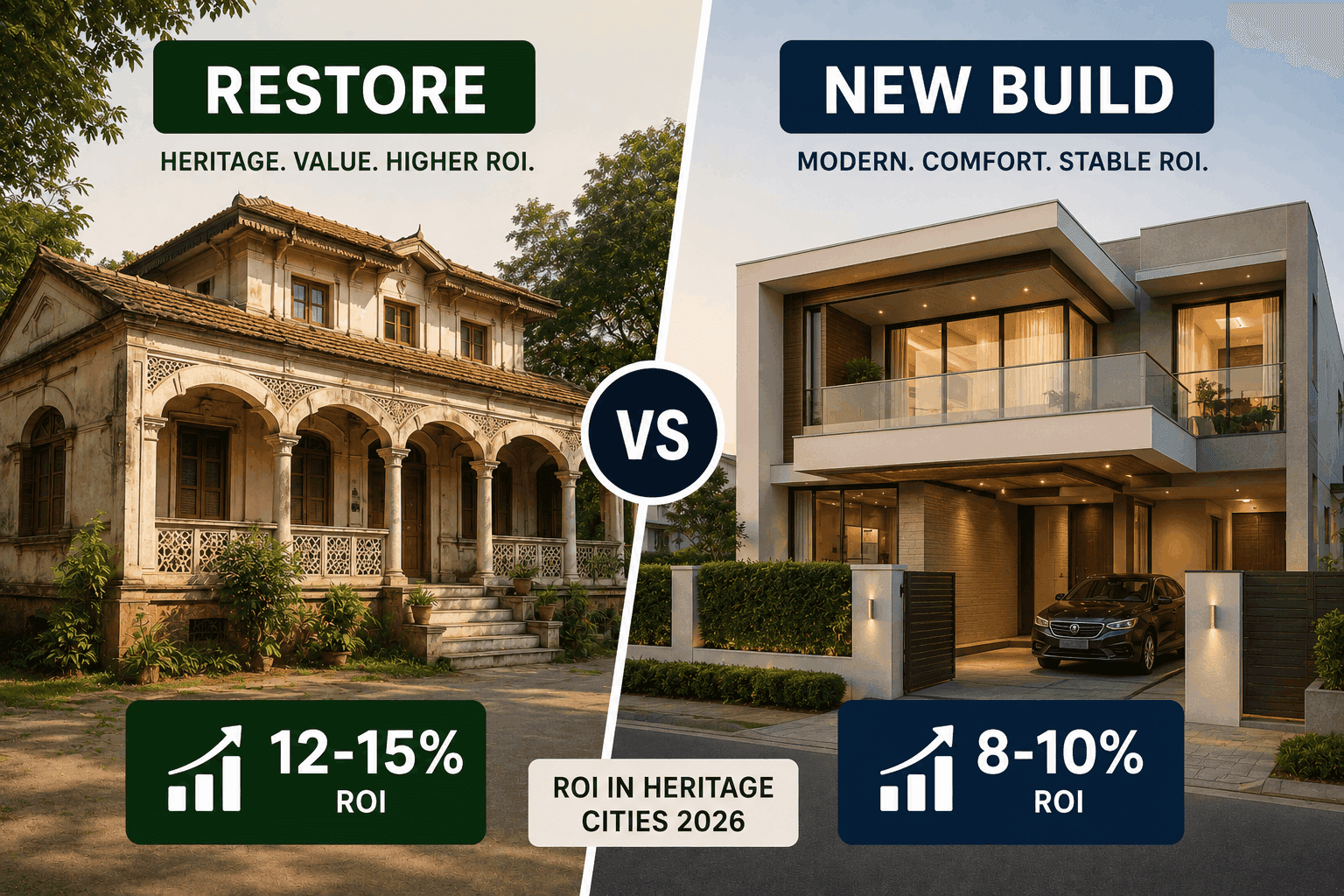
So, you are thinking about investing in a heritage city. Maybe Ahmedabad's old Pol houses, or a charming bungalow in Vadodara's Alkapuri. The romantic pull is undeniable. But here is the million-rupee question: should you restore an old bungalow or build new? Let me tell you, this decision is not just about aesthetics. It is about cold, hard returns. In this post, I break down Bungalow Restoration vs New Build: ROI in Heritage Cities (2026), with specific numbers and Gujarat insights. Because the truth is, one path can give you a 20-25% higher ROI over five years. And no, it is not always the shiny new one.
The Heritage City Premium: Why 2026 Matters
Look, heritage cities like Ahmedabad (a UNESCO World Heritage City), Vadodara, and Surat are seeing a unique trend. The government is incentivizing restoration. For example, the Ahmedabad Municipal Corporation offers up to 50% subsidy on facade restoration for Pol houses. But more than subsidies, there is a demand surge. Young professionals and NRIs are craving character. They want a home that tells a story. A new build in Bopal or Gota? It is nice, but it is everywhere. A restored bungalow in Satellite or Ambawadi? That is a status symbol.
The year 2026 is pivotal because of the Metro Phase 2 completion. It will connect old city areas to new hubs. That means properties in heritage zones will become more accessible. Prices are expected to jump 15-20% in these pockets. So, if you buy a restoration project now, you are riding that wave.
The Numbers Game: Restoration Costs vs New Build
Let me give you a real example. Take a 2000 sq ft bungalow in Vastrapur, Ahmedabad. A new build on a similar plot (if available) would cost you around Rs 1.2-1.5 crore for construction alone. Plus land cost? Easily Rs 3-4 crore total. Now, an old bungalow in the same area might cost Rs 1.8-2.2 crore. Restoration cost? Typically Rs 50-70 lakhs for structural repairs, plumbing, electrical, and modern amenities. Total investment: Rs 2.5-3 crore.
Here is the kicker. That restored bungalow, with its high ceilings, thick walls, and original details, can sell for Rs 4.5-5 crore after 3-4 years. A new build in the same locality? Maybe Rs 4-4.5 crore. Why? Because there is a limited supply of such heritage properties. In my experience, the ROI on restoration in prime heritage zones is 12-15% annually, while new builds average 8-10%.
Bungalow Restoration vs New Build: ROI in Heritage Cities (2026) – The Breakdown
Restoration: The Hidden Goldmine
Restoration is not for the faint-hearted. You need patience. But the rewards are significant. Here is what you get:
- Unique Selling Point: No two restored bungalows are alike. Buyers pay a premium for that.
- Tax Benefits: Under Section 80C, you can claim deductions on home loan principal. Plus, restoration costs can be added to the cost of acquisition, reducing capital gains tax when you sell.
- Rental Yield: A restored bungalow in Alkapuri, Vadodara, can fetch Rs 40,000-60,000 monthly rent. A new flat in the same area? Rs 25,000-35,000.
But there is a catch. You must work with a RERA-registered contractor. Many amateur restorers skip approvals. That can lead to legal headaches. Always check RERA Gujarat for the builder's registration. And get a structural audit before buying.
#### A Word on Surat
Surat's heritage is different. Think of the old houses in Adajan or Piplod. Restoration here is cheaper – around Rs 40-50 lakhs for a 1500 sq ft bungalow. But the ROI is lower because demand for heritage is not as strong. I personally recommend restoration only if you are in a premium zone like Vesu or Althan.
New Build: The Safe Bet
Building new is straightforward. You know the costs upfront. You get modern amenities – modular kitchen, VRF air conditioning, smart home features. In areas like SG Highway or Gota, new bungalows sell like hotcakes. A 2000 sq ft new bungalow there costs around Rs 3.5-4 crore. The ROI? About 8-10% annually.
But here is the thing – you are competing with hundreds of other new projects. The market is saturated. And with rising land prices, your profit margins shrink. For example, in Gandhinagar's GIFT City area, land costs have jumped 30% in two years. So, your new build might not give you the same percentage return as a restored property in a heritage zone.
#### The Vadodara Example
Take Gotri, Vadodara. A new bungalow there costs Rs 2.5-3 crore. The rental yield is 3-4%. Compare that to a restored bungalow in Akota, where you can get 5-6% yield. The difference is small but significant over 10 years.
Key Takeaways for Investors
Here is what I tell my clients:
- If you want quick returns (2-3 years): Go for a new build in a fast-growing suburb like Shela or Gota. But be ready for lower margins.
- If you want premium returns (5-10 years): Restoration in heritage pockets like Satellite, Ambawadi, or Alkapuri is your best bet.
- Always factor in holding costs: Restoration takes 6-12 months. New build takes 12-18 months. Factor in loan EMIs during that period.
- Don't forget RERA: Check the project's RERA registration number. For restoration, ensure the contractor is registered.
Quick Tips for Restoration Success
- Get a heritage architect: They understand the nuances of old structures. Costs more upfront, but saves you lakhs in repairs.
- Use modern materials discreetly: Steel beams inside walls, modern plumbing – but keep the facade original.
- Target a 20% premium: When selling, price your restored bungalow 20% higher than comparable new builds. Buyers will pay for the character.
- Check for title clearance: Many old bungalows have disputed titles. Spend Rs 10,000-15,000 on a legal audit.
Conclusion: Your Next Step
So, Bungalow Restoration vs New Build: ROI in Heritage Cities (2026) – which one wins? It depends on your risk appetite. But if you ask me, restoration is the unsung hero. It gives you uniqueness, better ROI, and a sense of preserving history. And with infrastructure like the Ahmedabad Metro boosting connectivity, the timing is perfect.
Wondering where to start? Visit a few restored bungalows in Satellite or Alkapuri. Talk to owners. See the workmanship. Then decide. And remember, always work with RERA-registered professionals. Your investment deserves that.
Ready to take the plunge? Drop a comment below or reach out. I would love to hear your story.