
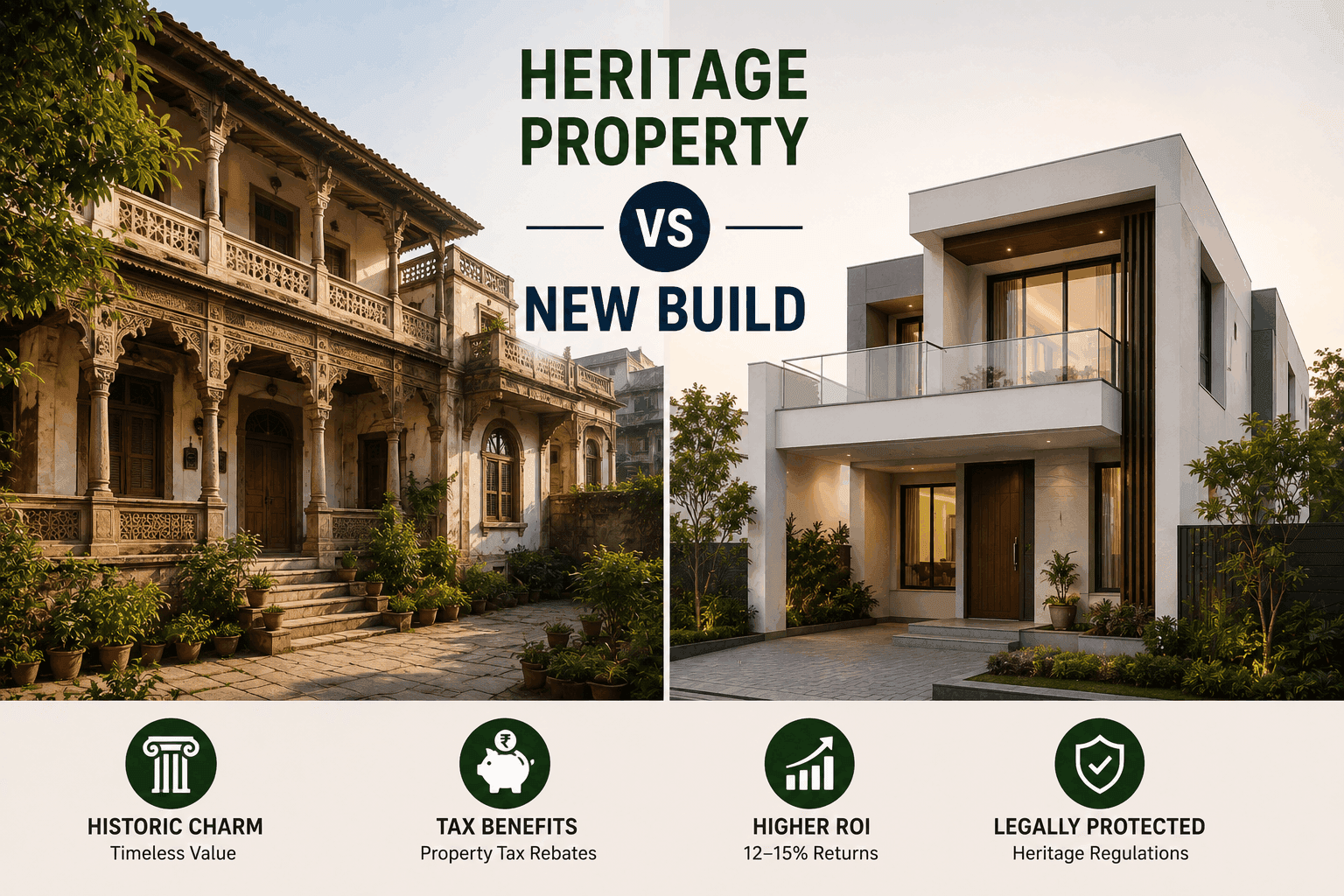
The Dream of Owning a Piece of History
Let me be honest with you. When I first visited a heritage property in Ahmedabad's Pol area—a 150-year-old wooden haveli with intricate carvings and a central courtyard—I was mesmerized. The walls whispered stories of generations. But here is the thing: buying a heritage property in India is not like buying a regular flat in SG Highway or a villa in Shela. It comes with a unique set of legal restrictions and surprising tax benefits. Whether you are a history buff, an investor looking for something different, or someone who simply loves old-world charm, you need to understand what you are getting into. In this comprehensive guide, I will walk you through the legal landscape, the financial perks, and the practical realities of buying heritage property in India: Legal Restrictions & Tax Benefits.
What Exactly Qualifies as a Heritage Property in India?
Before we dive into the nitty-gritty, let us clarify what we mean by "heritage property." In India, this is not a casual label. The Archaeological Survey of India (ASI), state archaeology departments, and local municipal corporations classify buildings as heritage based on age, architectural significance, historical association, or cultural value.
In Gujarat, for instance, the Ahmedabad Municipal Corporation (AMC) has listed over 1,000 heritage structures in the Walled City's Pols, while Vadodara's Sayaji Nagar and Surat's old quarters have their own lists. Properties can be graded:
- Grade I: Nationally important (e.g., Sarkhej Roza, Rani no Hajiro)
- Grade II: State or regional importance (e.g., old havelis in Vadodara's Mandvi area)
- Grade III: Locally significant (e.g., many Pol houses in Ahmedabad)
Here is a critical point: even if a property is not officially listed, it may still be subject to heritage regulations if it falls within a heritage precinct. In Ahmedabad's Pols, for example, any construction or renovation requires special permission from the AMC's Heritage Committee. So, always check the status before you fall in love with a property.
Legal Restrictions: What You Cannot Do
1. You Cannot Just Renovate or Demolish Freely
This is the biggest shock for most buyers. Imagine buying a beautiful old haveli in Ahmedabad's Doshiwada ni Pol, only to find out you cannot change its facade, add a modern kitchen, or even replace the wooden windows with uPVC frames without approval.
Under the Gujarat Heritage Regulations (often part of the local Development Control Regulations), any alteration, repair, or addition to a heritage property requires prior permission from the Heritage Conservation Committee. This includes:
- Changing the external appearance (color, materials, design)
- Structural changes
- Demolition (which is almost never allowed for Grade I and II properties)
- Adding floors or extensions
In my experience, this process can take 3-6 months, sometimes longer. You will need to submit detailed plans, photographs, and a heritage impact assessment. And there is no guarantee of approval.
2. Restrictions on Use and Commercialization
Can you turn that heritage bungalow in Vadodara's Alkapuri into a boutique hotel or a restaurant? Possibly, but with conditions. Many heritage properties are zoned for residential use only. Even if commercial use is allowed, you may face restrictions on parking, signage, noise levels, and operating hours.
Take the case of Ramesh, a client from Ahmedabad who bought a Grade III heritage property in the Kalupur area. He wanted to open a heritage-themed café. The AMC allowed it only after he agreed to:
- Keep the original facade intact
- Use traditional materials for any repairs
- Limit seating to 30 guests
- Provide off-street parking
The process took 14 months. But today, his café is a hit with tourists and locals alike.
3. Transfer and Sale Restrictions
Here is something many buyers overlook: some heritage properties have restrictions on who can buy them. In certain cases, especially for properties owned by trusts or religious institutions, you may need permission from the Charity Commissioner or the state government to complete the sale.
Also, if the property is listed under the Ancient Monuments and Archaeological Sites and Remains Act (1958), you cannot sell it without central government approval. This is rare for residential properties in Gujarat, but possible for those near protected monuments like the Adalaj Stepwell or the Rani ki Vav.
4. Insurance and Liability Issues
Insuring a heritage property is tricky. Most standard home insurance policies exclude coverage for unique architectural features, antique woodwork, or traditional stone carvings. You will need a specialized heritage insurance policy, which costs 20-30% more than regular home insurance.
Moreover, if your property is open to the public (as some heritage homes are, due to their historical importance), you may face liability for accidents or damages. This is a serious consideration if you plan to rent it out or use it commercially.
Tax Benefits: The Silver Lining
Now, let us talk about the good news. The government does offer incentives to encourage the preservation of heritage properties. Here are the key tax benefits you can avail:
1. Income Tax Deduction Under Section 80G
Donations made to approved heritage conservation funds or trusts are eligible for a 50% deduction under Section 80G of the Income Tax Act. If you are buying a heritage property and later make donations for its upkeep, you can claim this benefit. However, this applies only to donations, not the purchase price itself.
2. Property Tax Rebates from Municipal Corporations
Many local bodies, including the AMC and the Vadodara Municipal Corporation (VMC), offer property tax rebates for heritage property owners. In Ahmedabad, for instance, owners of listed heritage properties can get up to 50% rebate on property tax if they maintain the structure in its original condition.
Practical tip: Apply for this rebate immediately after purchase. You will need to submit a certificate from the Heritage Committee confirming the property's status and your compliance with conservation guidelines.
3. GST Benefits for Restoration Work
Under GST, restoration work on heritage properties is often classified as "conservation services" and may attract a lower GST rate of 5% (instead of the standard 18% for construction services). This applies to work done by registered contractors who specialize in heritage conservation. But here is the catch: you must use traditional materials and techniques to qualify. Using modern materials like cement instead of lime mortar could disqualify you from this benefit.
4. Capital Gains Tax Exemption (Under Certain Conditions)
This is a nuanced area. If you sell a heritage property that you have held for more than 3 years, the gains are considered long-term capital gains. You can claim exemption under Section 54 if you reinvest the proceeds into another residential property. However, if the heritage property is not your primary residence (e.g., it is a second home or an investment), the exemption may not apply.
My recommendation: Always consult a chartered accountant who specializes in real estate before selling. The rules are complex, and one wrong step could cost you lakhs in taxes.
A Practical Guide: Step-by-Step for Buying Heritage Property in Gujarat
Step 1: Verify the Heritage Status
Do not rely on the seller's word. Check with:
- The local municipal corporation's heritage cell (e.g., AMC Heritage Department)
- The state archaeology department
- The ASI (for nationally important sites)
In Ahmedabad, you can visit the AMC's website and search for your property's survey number in the heritage list. For properties in the Pols, the list is publicly available.
Step 2: Get a Structural and Legal Audit
Heritage properties are old. They may have termite damage, weak foundations, or outdated electrical wiring. Hire a structural engineer with experience in heritage buildings. Also, get a lawyer to check for:
- Pending litigation
- Unpaid property taxes
- Restrictions on transfer
- Any easements or rights of way (common in Pols where multiple families share walls and passages)
Step 3: Secure Financing
Banks are cautious about financing heritage properties. Most home loans are for standard RERA-registered properties. For heritage homes, you may need a loan under the "renovation" or "home improvement" category, which has higher interest rates (typically 9.5-11% vs. 8.5-9% for regular home loans).
Some cooperative banks in Gujarat, like the Gujarat State Cooperative Bank, have special schemes for heritage properties. But expect a lower loan-to-value ratio—usually 60-70% instead of 80-90%.
Step 4: Plan for Restoration Costs
Here is a reality check: restoring a heritage property can cost 2-3 times more than building a new house of the same size. For example, restoring a 2,000 sq. ft. haveli in Ahmedabad's Pol might cost Rs 30-50 lakhs, depending on the extent of work. This includes:
- Structural repairs: Rs 10-15 lakhs
- Woodwork restoration: Rs 5-10 lakhs
- Electrical and plumbing upgrades: Rs 5-8 lakhs
- Traditional finishes (lime plaster, stone flooring): Rs 8-12 lakhs
Always budget for at least 20% contingency.
Step 5: Obtain All Necessary Permissions
Before you start any work, apply to the Heritage Committee. In Ahmedabad, the process is:
1. Submit an application with property documents, photographs, and proposed work plans
2. Pay a fee (typically Rs 5,000-10,000 for residential properties)
3. Wait for inspection by a heritage officer
4. Receive approval or a list of modifications needed
The timeline is usually 60-90 days. Do not start work without approval—you could face fines of up to Rs 5 lakhs under the Gujarat Heritage Regulations.
The Pros and Cons: A Balanced View
Pros
- Unique living experience: Owning a piece of history is unmatched. You become a custodian of culture.
- Tax rebates: Up to 50% property tax rebate in many cities.
- Potential for tourism income: If you open a heritage homestay, you can earn Rs 3,000-5,000 per night in prime locations like Ahmedabad's Pols.
- Appreciation potential: Well-maintained heritage properties in desirable locations (e.g., Alkapuri in Vadodara, Vesu in Surat) can appreciate 8-12% annually, comparable to new developments.
Cons
- High maintenance costs: Annual maintenance can be 5-10% of the property value.
- Restrictive regulations: You cannot modernize freely.
- Financing challenges: Higher interest rates and lower loan amounts.
- Insurance complications: Specialized policies are expensive.
Key Takeaways for Buying Heritage Property in India: Legal Restrictions & Tax Benefits
- Always verify heritage status with the local municipal corporation or ASI before purchase.
- Expect a 3-6 month approval process for any renovations or alterations.
- Claim property tax rebates immediately after purchase—up to 50% in cities like Ahmedabad and Vadodara.
- Budget for restoration costs: Typically Rs 30-50 lakhs for a 2,000 sq. ft. property in Gujarat.
- Consult a heritage architect and a real estate lawyer before signing any agreement.
- Consider commercial use only if the zoning permits it—check with the town planning department.
- Insure with a specialized policy that covers traditional materials and craftsmanship.
Conclusion: Is Heritage Property Right for You?
Buying a heritage property is not for everyone. It requires patience, deep pockets, and a genuine love for history. But for those who are willing to navigate the legal maze, the rewards can be immense—both financially and emotionally.
If you are in Gujarat, I personally recommend starting your search in Ahmedabad's Pols (especially in areas like Doshiwada, Khadia, or Kalupur), Vadodara's Akota or Gotri (where many old bungalows are available), or Surat's Adajan area. Prices for heritage properties in these areas range from Rs 40 lakhs for a small Pol house (800-1,000 sq. ft.) to Rs 2-3 crores for a large haveli or bungalow.
Before you take the plunge, do your due diligence. Talk to current owners of heritage properties—they will give you the real picture. And remember, you are not just buying a house; you are becoming a guardian of India's architectural heritage. That is a responsibility worth taking seriously.
Ready to explore? Start by visiting the AMC Heritage Department website or the Gujarat State Archaeology Department. Or simply walk through the narrow lanes of Ahmedabad's Pols—you might just find your dream home.
*Have you owned or considered buying a heritage property? Share your experience in the comments below—I would love to hear your story.*