
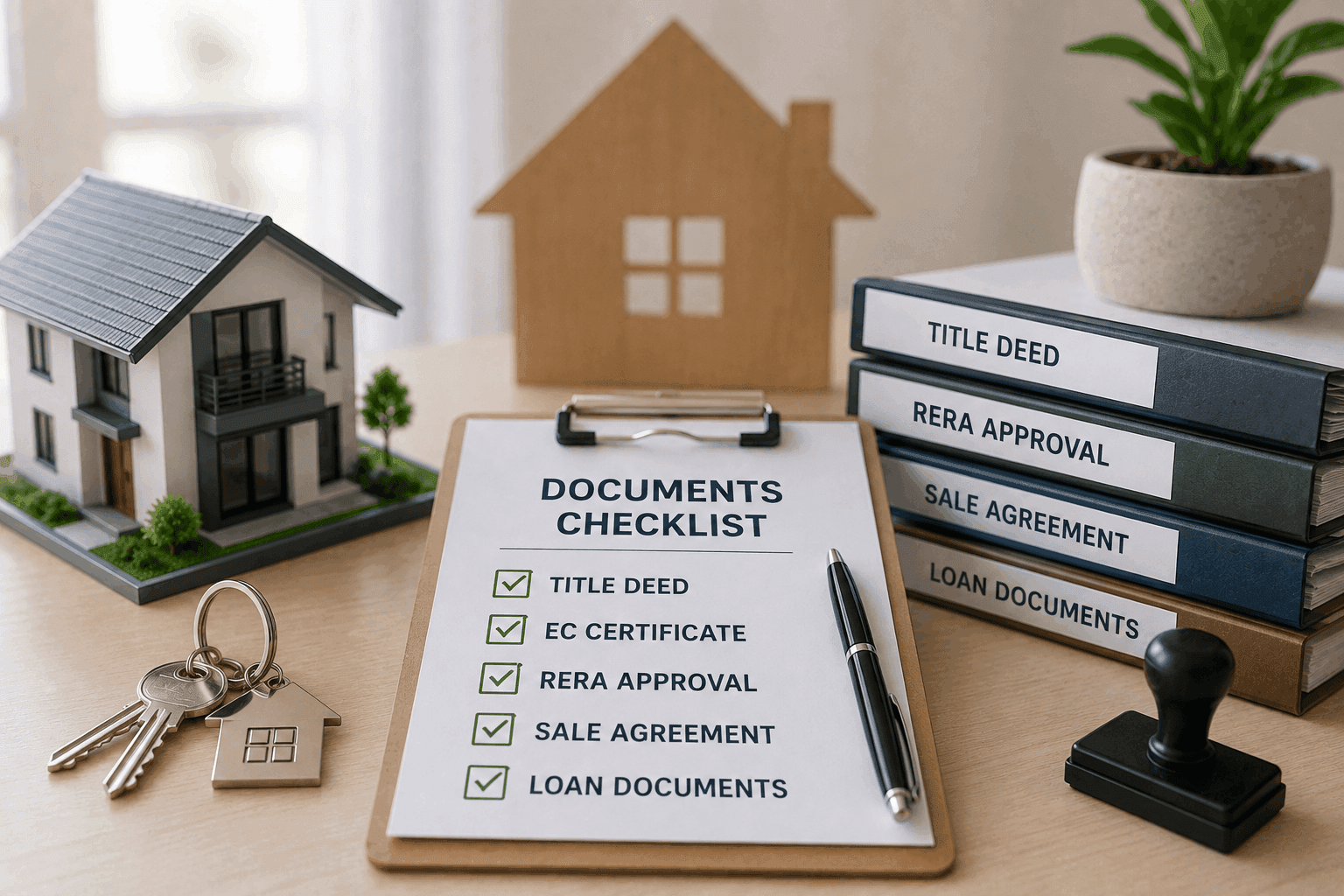
Buying a house is one of the most significant financial decisions you will ever make. But let’s be honest – the paperwork can be overwhelming. Whether you are eyeing a ready-to-move-in flat on SG Highway in Ahmedabad or a villa in Surat’s Vesu area, having the right documents in place is non-negotiable. In this guide, I will walk you through the Documents Required to Buy a House in India: Complete 2026 Checklist, covering everything from title deeds to tax receipts. By the end, you will know exactly what to collect, why it matters, and how to avoid common pitfalls.
Why This 2026 Checklist Matters More Than Ever
In 2024-25, the Gujarat property market has seen a surge in demand, especially in GIFT City, Gandhinagar, and emerging corridors like Shela in Ahmedabad. Prices for a 2BHK in a decent society now range from Rs 45-55 lakhs in Vastral to Rs 80 lakhs - 1.2 crores on SG Highway. With RERA Gujarat becoming stricter, developers are required to maintain transparent records. But here is the thing – many buyers still get cheated because they skip verifying documents.
What many buyers overlook is that even a minor missing document can delay your home loan approval or, worse, land you in a legal mess. So, let’s break this down step by step.
Documents Required to Buy a House in India: Complete 2026 Checklist for Buyers
1. Title Deed and Chain of Ownership
The title deed is the single most important document. It proves the seller owns the property. But don’t just take their word for it – you need to verify the chain of ownership for at least the last 30 years. In Gujarat, many old properties in areas like Naroda or Kalawad Road, Rajkot, may have unclear succession.
What to check:
- Original sale deed or gift deed.
- Previous sale deeds to ensure no disputes.
- Encumbrance certificate (EC) from the sub-registrar’s office for the last 13-30 years. This confirms no pending loans or legal claims.
*Pro tip:* In my experience, always hire a local advocate to verify the title. It costs Rs 5,000-10,000 but saves crores in potential losses.
2. Encumbrance Certificate (EC)
This is your safety net. An EC shows all registered transactions related to the property. If there is any mortgage, lien, or court case, it will appear here.
You can get an EC online from the Gujarat e-Dhara portal or the sub-registrar’s office. I personally recommend checking the last 13 years of EC – banks often ask for 12-13 years anyway.
3. Approved Building Plan and Completion Certificate
For a flat in a new project, say a high-rise on Bopal-Ghuma Road, the builder must have an approved plan from the Ahmedabad Urban Development Authority (AUDA) or the local municipal corporation. The completion certificate (CC) is proof that the building is constructed as per norms and is safe for occupation.
- For under-construction properties: Ask for the commencement certificate (CC) and the latest RERA registration number.
- For resale flats: Ensure the society has an occupation certificate (OC). Without OC, you may face issues with utilities or bank loans.
*Real example:* A buyer in Gota, Ahmedabad, recently lost Rs 20 lakhs because the builder had not obtained OC. The buyer could not get a home loan and had to sell at a loss.
4. Sale Deed and Agreement for Sale
Once you finalize the deal, you will sign a sale deed (for ready property) or an agreement for sale (for under-construction). This document must be registered with the sub-registrar.
Key points:
- Ensure all parties (buyer, seller, witnesses) sign.
- Check that the property description matches the approved plan.
- Pay stamp duty correctly – in Gujarat, it is 4.9% of the market value for men and 4.9% for women (though some concessions apply).
*Rhetorical question:* Wondering if you can do this yourself? Honestly, I would not recommend it. A lawyer’s review is worth every rupee.
5. RERA Registration Certificate
Since 2016, all residential projects with more than 8 units must be registered under RERA. For Gujarat, you can verify the RERA number on the Gujarat RERA website (gujrera.gujarat.gov.in).
Why it matters:
- RERA ensures timely possession and quality standards.
- If the builder delays possession beyond the promised date, you can claim compensation.
- For resale flats, check if the society has RERA compliance, especially for projects launched after 2016.
6. Home Loan Documents (If Applicable)
If you are taking a home loan, the bank will demand its own set of documents. But here is what you need to prepare:
- KYC documents: Aadhaar, PAN card, passport-size photos.
- Income proof: Salary slips (last 3 months), bank statements (last 6 months), ITRs (last 2-3 years).
- Property documents: All the above – title deed, EC, sale deed, RERA certificate.
- For self-employed: Business registration, GST returns, profit-loss statements.
*Practical tip:* Keep all documents ready in a digital folder. Most banks now accept scanned copies online.
7. Society Documents (For Apartments)
If you are buying a flat in a society, you need:
- No Objection Certificate (NOC) from the society.
- Share certificate or membership certificate.
- Maintenance bill receipts (to ensure no dues).
- By-laws of the society.
In Ahmedabad’s Satellite area, many societies have strict rules about parking and pet ownership. So, read the by-laws carefully.
8. Tax Receipts and Utility Bills
For resale properties, ask for:
- Property tax receipts (last 3-5 years).
- Electricity and water bills (to verify no pending dues).
- If the property was rented, get a no-dues certificate from the tenant.
*Rhetorical question:* Sounds like a lot, right? But imagine discovering after moving in that the previous owner had unpaid electricity bills of Rs 50,000. That is a headache you can avoid.
9. Additional Documents for NRIs
If you are an NRI buying a property in Gujarat, you will need:
- Passport and visa copy.
- OCI or PIO card (if applicable).
- Power of Attorney (PoA) if you are not physically present.
- Proof of NRE/NRO account for fund transfer.
*Quick tip:* The PoA must be registered with the Indian consulate in your country of residence. Otherwise, it may not be valid in India.
Key Takeaways: Your 2026 Document Checklist
- Title Deed & EC: The bedrock of your purchase. Never skip these.
- RERA Registration: Non-negotiable for under-construction projects.
- OC/CC: Essential for ready properties.
- Home Loan Documents: Keep them organized to speed up the loan process.
- Society NOC: Don’t forget this if buying in a cooperative society.
- Tax & Utility Receipts: Verify no outstanding dues.
*Remember:* In Gujarat, you can check property documents online via the e-Dhara portal. Use it before you pay any advance.
Conclusion: Your Next Steps
Buying a home should be exciting, not stressful. With this Documents Required to Buy a House in India: Complete 2026 Checklist, you now have a clear roadmap. Start by collecting the title deed and encumbrance certificate. Then, verify RERA compliance. Finally, consult a local real estate lawyer – especially if you are buying in emerging areas like Shela or GIFT City.
*Here is my honest advice:* Do not rush. Take a week to gather and verify all documents. It will save you years of regret. If you need more help, comment below or check out our other guides on Gujarat property trends. Happy house hunting!