
Introduction
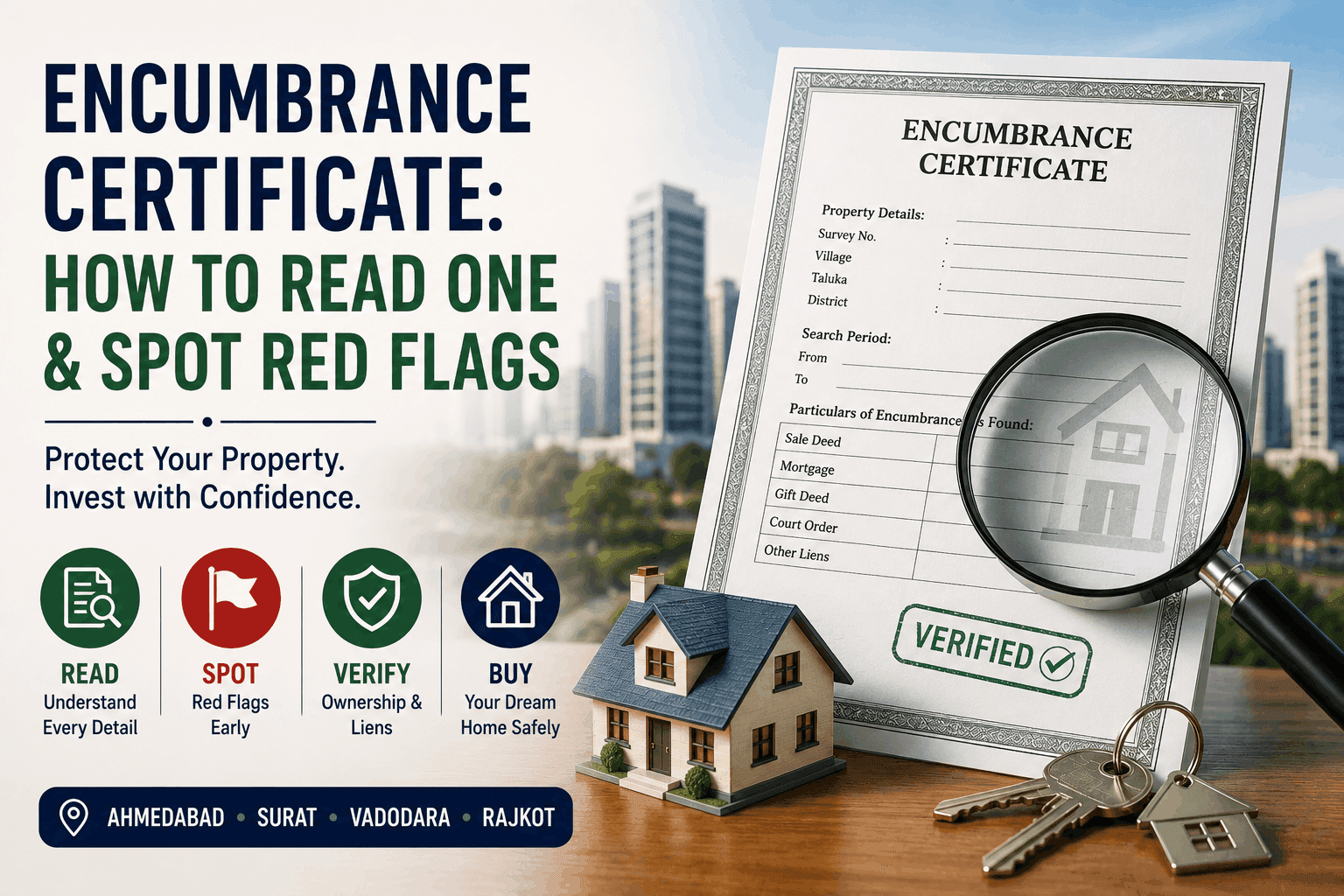
You have found your dream flat in Ahmedabad. It is a spacious 3BHK on SG Highway, priced at Rs 1.2 crores. The location is perfect, the builder has a decent reputation, and the possession date seems realistic. But before you sign that agreement, there is one document that can make or break your investment. I am talking about the Encumbrance Certificate: How to Read One and Spot Red Flags is a skill every serious buyer must master.
In my 15 years covering Gujarat real estate, I have seen too many buyers skip this step. They assume the builder is honest or that the bank would have checked it. The truth is, an encumbrance certificate (EC) is your property's medical report. It tells you if the land has any legal diseases. Wondering what those diseases look like? Let me walk you through it.
What Exactly Is an Encumbrance Certificate?
An encumbrance certificate is a legal document issued by the sub-registrar's office. It records all registered transactions related to a specific property over a given period. Think of it as a timeline of who owned the land, who sold it, and if there are any loans or mortgages against it.
Here is the thing: a clean EC shows no outstanding loans, no pending legal disputes, and no fraudulent sales. But a messy EC? That is your red flag waving furiously.
What Does a Clean EC Look Like?
A clear EC will show only genuine sale deeds, gift deeds, or inheritance transfers. For example, if you are buying a flat in Bopal, Ahmedabad, the EC for the last 13 years should list:
- The original land owner's name
- The builder's purchase deed
- Any subsequent sale deeds to individual buyers
If there is a loan entry, it must show a corresponding "satisfaction" or "closure" entry within a reasonable time. For instance, a home loan taken in 2018 should show a closure entry by 2020 or 2021. Without that closure, the property is still mortgaged.
How to Read an Encumbrance Certificate: Step-by-Step
Now, let me give you a practical guide. I recommend you open a sample EC from the Gujarat government's e-Dhara portal while reading this.
Step 1: Check the Period
Every EC covers a specific date range. If you are buying a property in Shela, Ahmedabad, you should request an EC for at least the last 13 years. Why 13 years? Because Gujarat's limitation period for property disputes is 12 years. A 13-year EC covers that window plus a buffer.
Step 2: Look for the Document Type
Each entry has a code like "Sale Deed," "Gift Deed," "Mortgage," or "Release Deed." Pay special attention to:
- Mortgage entries: These indicate loans taken against the property
- Release Deed: This should follow a mortgage entry to show loan closure
- Power of Attorney: This can be misused, so note who holds it
Step 3: Verify the Names
Are the seller's names consistent with the title deed? In Surat's Vesu area, I once saw an EC where the seller's name was misspelled in one entry. That small mistake caused a six-month delay in registration. Cross-check every name with the sale agreement.
Step 4: Check for Gaps
A clean EC has continuous entries. If there is a gap of more than 2-3 years, that is suspicious. Maybe the property was sold informally, or there was a dispute. For example, a property on Kalawad Road, Rajkot, showed no entries from 2015 to 2018. Later, we discovered the owner had died and the legal heir had not updated the records.
Spotting Red Flags in an Encumbrance Certificate
Here is where my experience becomes your advantage. Let me share specific red flags I have seen in Gujarat properties.
Red Flag 1: Multiple Mortgages Without Closure
Look, it is normal for a builder to take a construction loan. But if you see three mortgages and only two closures, that property is still encumbered. The bank can legally claim ownership. I once advised a buyer in Gota, Ahmedabad, who found an outstanding mortgage of Rs 50 lakhs from 2017. The builder had forgotten to get it released. We insisted on a release deed before payment.
Red Flag 2: Unexplained Gift Deeds
A gift deed from a distant relative or a stranger is a classic red flag. In Vadodara's Alkapuri area, I saw an EC where a property was "gifted" to a person who had no relation to the original owner. That turned out to be a fraudulent transfer to hide a loan default.
Red Flag 3: Court Orders or Attachments
If you see entries like "Civil Suit" or "Attachment Order" from a court, run. This means there is a legal dispute. The property cannot be sold until the case is resolved. In Surat's Adajan area, a buyer lost Rs 20 lakhs because he did not check this. The property was under attachment for a tax default.
Red Flag 4: Inconsistent Property Descriptions
The EC should describe the property consistently. If one entry says "Plot No. 12, Survey No. 45" and another says "Plot No. 12A, Survey No. 45/1," there is a mismatch. This could mean the property was subdivided illegally. In Gandhinagar's GIFT City area, such mismatches are common because of rapid development.
Real-Life Example: How a Buyer Avoided a Disaster
Let me tell you about Ramesh, a first-time buyer from Ahmedabad. He found a beautiful 2BHK in Chandkheda for Rs 45 lakhs. The price was below market rate. Excited, he almost paid the booking amount. I told him to get an encumbrance certificate first.
When the EC arrived, it showed a mortgage of Rs 30 lakhs from 2019 with no closure. The seller claimed he had repaid it but lost the papers. I recommended Ramesh to demand a release deed from the bank. The seller could not produce it. Turns out, the loan was still active. Ramesh walked away. Six months later, the property was auctioned by the bank. He saved his Rs 45 lakhs.
What Would Have Happened?
If Ramesh had bought that flat, he would have owned a property that the bank could seize. His home loan would have been rejected. He would have lost his savings. All because he skipped one document.
How to Obtain an Encumbrance Certificate in Gujarat
In Gujarat, you can get an EC online through the e-Dhara portal (https://edhara.gujarat.gov.in). Here is a quick process:
1. Visit the portal: Select "Encumbrance Certificate" from the menu
2. Enter property details: You need the survey number, village, and district. For example, if the property is in Satellite, Ahmedabad, enter the correct village code
3. Select the period: Choose at least 13 years. I personally recommend 15 years for safety
4. Pay the fee: It is nominal, around Rs 100-200 per year of search
5. Download the EC: It is usually available within 24 hours
Pro Tip from a RERA Expert
Under RERA Gujarat, the builder is required to provide a clear encumbrance certificate for the land. If they hesitate, that is a red flag. I always tell buyers: never pay more than 10% of the property value until you have verified the EC.
Key Takeaways: Your Quick Checklist
- Always request a 13-year EC (15 years if the property is old)
- Verify every mortgage entry has a corresponding closure
- Check for name consistency across all entries
- Look for court orders or attachment entries
- Cross-check the property description with your sale deed
- Do not rely on verbal assurances from the builder
- Use the e-Dhara portal for a quick online check
Conclusion
Buying a home is one of the biggest financial decisions you will make. Whether it is a Rs 45 lakh flat in Chandkheda or a Rs 2 crore villa in Shela, the process is the same. The encumbrance certificate is your shield against legal nightmares.
Here is my final advice: Do not rush. Spend Rs 200 and 30 minutes to check the EC. It could save you years of legal battles. If you find a red flag, walk away. There are plenty of clean properties in Gujarat. I have seen the market bounce back from every downturn, but only for those who did their due diligence.
Now go ahead, get that EC, and buy with confidence. Your dream home is waiting.