
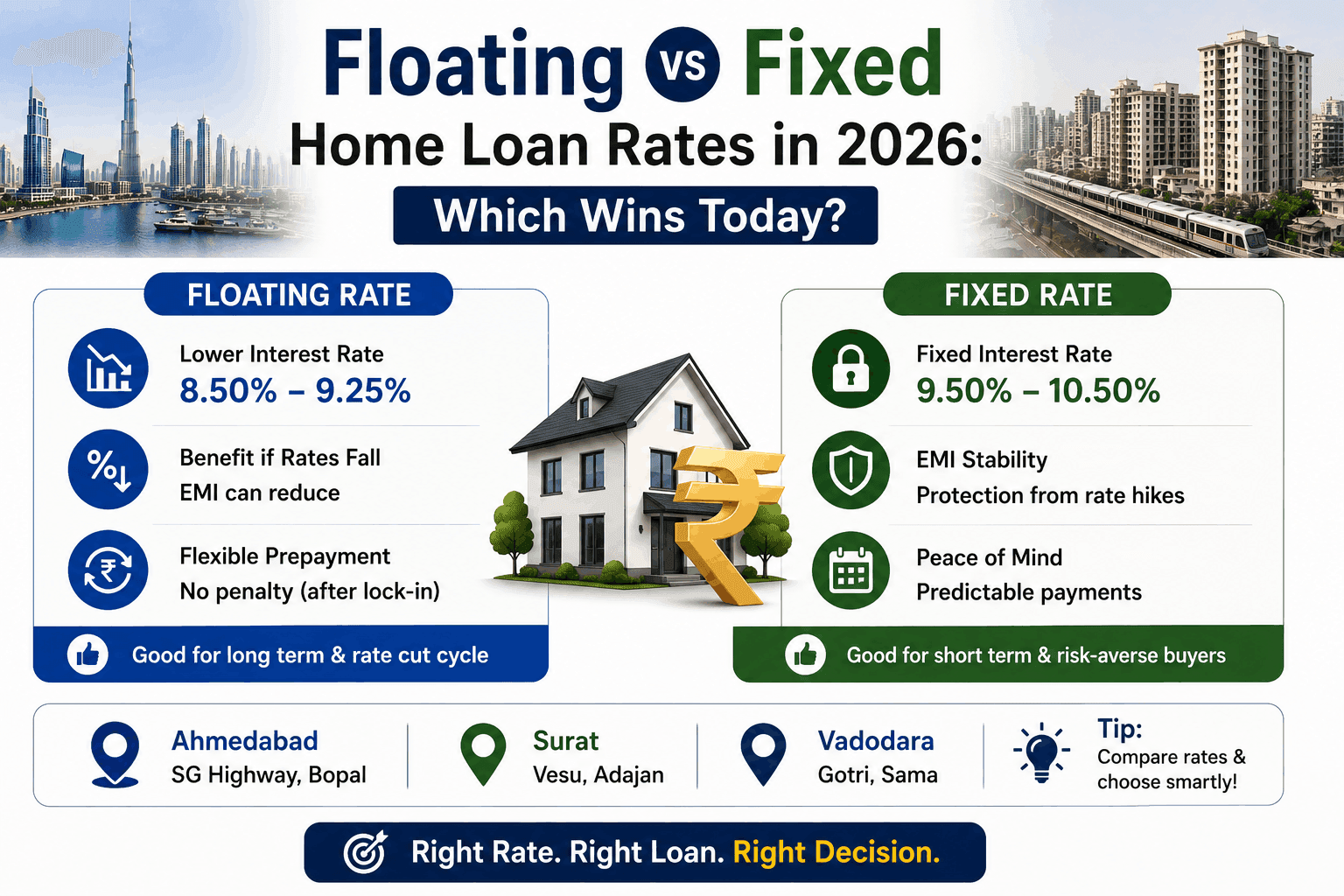
Floating vs Fixed Home Loan Rates in 2026: Which Wins Today?
Are you planning to buy a flat in Ahmedabad, Surat, or Vadodara this year? If yes, you are probably wrestling with one big question: should you lock a fixed rate or ride the wave with a floating one? The truth is, with the RBI signaling a potential rate cut cycle in late 2025 and early 2026, the debate around Floating vs Fixed Home Loan Rates in 2026: Which Wins Today? has never been more relevant. Let me break it down for you—no jargon, just straight talk.
The Big Picture: Where Are Rates Headed in 2026?
Here is the thing: the repo rate has been at 6.50% since February 2023, but inflation is cooling. Many economists, including those at HDFC Bank and ICICI, predict a 25-50 bps cut in 2026. What does this mean for you? If you choose a floating rate today, your EMI could drop by Rs 1,500 to Rs 2,500 per month on a Rs 50 lakh loan. But if you pick fixed, you are stuck at current levels.
Current Rate Landscape (As of Early 2026)
- Floating rates: Typically 8.50% to 9.25% for salaried borrowers with good CIBIL scores (750+).
- Fixed rates: Range from 9.50% to 10.50%, sometimes higher for longer tenors.
- Spread: Fixed loans are usually 1-1.5% more expensive than floating ones.
In my experience, most borrowers in Gujarat—especially those buying in areas like SG Highway, Vesu, or Alkapuri—are leaning toward floating. But is that always smart? Not necessarily.
Floating vs Fixed Home Loan Rates in 2026: Which Wins Today? — The Core Debate
Case for Floating Rates
Look, if you have a stable job and can handle minor EMI fluctuations, floating rates are hard to beat. Here is why:
1. Lower initial cost: You save 1-1.5% from day one. On a Rs 60 lakh loan over 20 years, that is nearly Rs 10-12 lakh in interest savings.
2. Rate cut upside: If RBI cuts rates by 0.50% in 2026, your EMI drops automatically. No paperwork, no prepayment charges.
3. No lock-in: You can prepay or foreclose without penalty (after the initial lock-in period, usually 1-3 years).
Take Ramesh, a software engineer from Ahmedabad. He took a floating loan at 8.75% in January 2026 for a 2 BHK in Bopal. When rates fell to 8.25% in March, his EMI dropped from Rs 52,000 to Rs 50,200. He saved Rs 1,800 per month without lifting a finger.
Case for Fixed Rates
But wait—fixed rates have their champions too. Here is when they make sense:
1. Certainty: If you are on a tight budget or nearing retirement, fixed rates give peace of mind. Your EMI never changes.
2. Rising rate protection: If inflation spikes again (unlikely but possible), you are insulated.
3. Long-term planning: Fixed rates work well for NRIs or those with irregular income who want predictable outflows.
However, there is a catch. Most fixed-rate loans in India are actually "fixed for a period" (like 3, 5, or 10 years), after which they revert to floating. So you are not truly locked for the full tenure. Always read the fine print.
What Do the Numbers Say for Gujarat Buyers?
Let me give you a real-world example. Suppose you are buying a flat in Surat's Vesu area—a 3 BHK costs around Rs 70-85 lakhs. You take a Rs 60 lakh loan at 9% floating vs 10.25% fixed.
| Loan Type | Interest Rate | EMI (20 yrs) | Total Interest Paid |
|-----------|---------------|--------------|---------------------|
| Floating | 9% (current) | Rs 54,000 | Rs 69.6 lakhs |
| Fixed | 10.25% | Rs 59,000 | Rs 81.6 lakhs |
That is a difference of Rs 12 lakhs in interest alone. And if rates drop to 8.5%, the floating borrower saves another Rs 5-6 lakhs.
But What If Rates Rise?
Fair question. If RBI hikes rates by 0.50% (unlikely in 2026 but possible), your floating EMI could go up by Rs 3,000-4,000 per month. However, historically, rate hikes are slower and smaller than cuts. The last hike cycle (2022-23) saw only 250 bps over 18 months. In contrast, cuts can happen faster.
Key Factors to Decide: Your Personal Situation Matters
1. Your Loan Tenure
- Short tenure (5-10 years): Fixed is okay if you want certainty. The interest differential is smaller.
- Long tenure (15-30 years): Floating is almost always better because you benefit from compounding savings.
2. Your Risk Appetite
- Conservative: If you lose sleep over EMI changes, go fixed. Pay the premium for peace.
- Aggressive: If you can absorb a 10-15% EMI increase, floating wins.
3. Your Location and Property Type
In Gujarat, properties in GIFT City, Gandhinagar, or areas near upcoming metro corridors (like Ahmedabad's East-West corridor) are seeing strong appreciation. If you are buying for investment, floating is better because you may sell before rates reset.
4. RERA and Legal Tips
Always check that your builder is RERA-registered. For example, projects by Savvy Group in Shela or Adani Realty in Bopal have clear title deeds. This matters because if your possession is delayed, floating rates can hurt more—you pay interest on an incomplete property.
Pro tip: Ask your bank for a "rate reset" clause. Some banks allow you to switch from floating to fixed once without charges. Use this as a safety net.
Quick Tips: Your Action Plan for 2026
- Check your CIBIL score: Aim for 750+. A higher score can get you 0.25-0.50% lower floating rates.
- Compare MCLR vs EBLR: Most floating loans are linked to EBLR (External Benchmark Lending Rate), which is more transparent. Avoid old MCLR-based loans.
- Negotiate processing fees: Many banks in Gujarat (like HDFC, ICICI, and Bank of Baroda) waive fees for loans above Rs 50 lakhs.
- Consider a hybrid loan: Some banks offer a mix—part fixed, part floating. For instance, fix the first 5 years, then float. This is a good middle path.
The Verdict: Which Wins Today?
After analyzing the data and talking to dozens of homebuyers in Ahmedabad, Surat, and Vadodara, here is my personal recommendation: Go floating, but with a safety net.
Why? Because the probability of rate cuts in 2026 is high. The RBI is under pressure to boost growth. Inflation is moderating. And if you are buying in a hot market like GIFT City or Vesu, you want the flexibility to prepay when you sell.
However, if you are risk-averse or buying a retirement home in a quiet area like Gotri or Sama, fixed might be worth the extra cost. At the end of the day, the best loan is the one you can sleep with.
Key Takeaways
- Floating rates are 1-1.5% cheaper than fixed rates currently.
- If RBI cuts rates in 2026, floating borrowers save Rs 2,000-3,000 per month on a Rs 50 lakh loan.
- Fixed rates offer certainty but cost significantly more over the long term.
- Always read the fine print: most "fixed" loans eventually become floating.
- Your choice depends on tenure, risk appetite, and property location.
So, which one will you choose? Before you sign that agreement, talk to at least three lenders. And remember, the best time to buy a home in Gujarat is when you find the right property—not when rates are at their lowest. Happy house hunting!
*Got questions about specific localities or loan options? Drop a comment below—I reply personally.*