Introduction
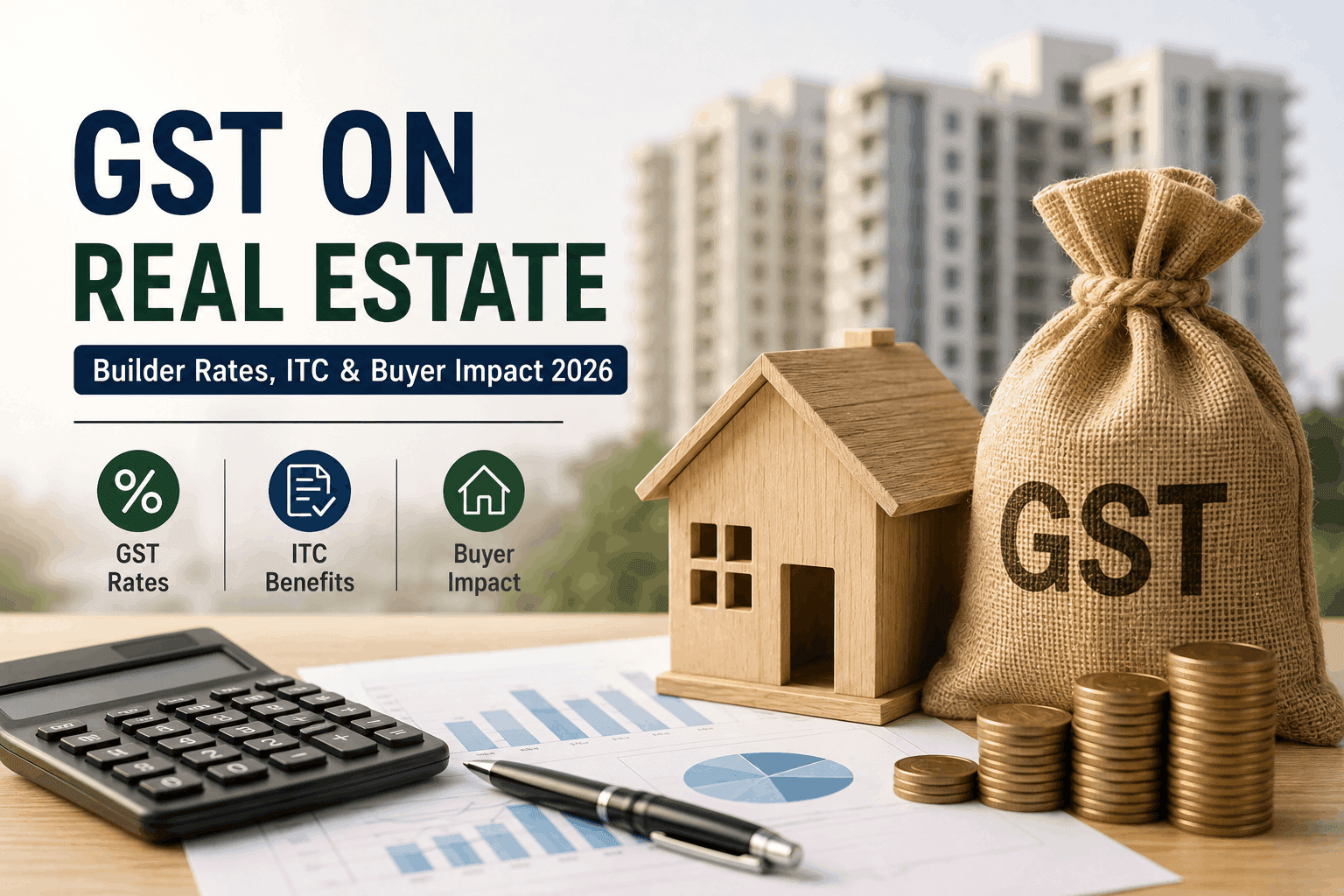
If you are planning to buy a home in Ahmedabad, Surat, or Vadodara in 2026, you are probably hearing a lot about GST on real estate. And honestly, it can get confusing. The Goods and Services Tax (GST) has reshaped how property is priced, how builders calculate costs, and what you, as a buyer, ultimately pay. But here is the thing: many buyers still do not understand the full picture. They see a 5% or 12% rate and assume that is the end of the story. It is not. The reality is that GST on real estate in India: builder rates, ITC & buyer impact 2026 involves a complex interplay of input tax credit (ITC), project classification, and government policies. In this article, I will break it down for you in plain language. No jargon overload. Just what you need to know before you sign that agreement.
Understanding GST on Real Estate in India: Builder Rates & ITC
First, let us get the basics straight. GST on real estate applies to under-construction properties. Ready-to-move-in flats with a completion certificate are exempt from GST. That is your first takeaway. For under-construction projects, the GST rate depends on the type of property and whether the builder claims Input Tax Credit (ITC).
How Builder Rates Work
Under the current regime:
- Affordable housing: 1% GST (without ITC)
- Other than affordable housing: 5% GST (without ITC)
These rates have been in effect since April 2019. But here is the catch: builders can choose to pay 12% GST with ITC or 5% without ITC. In my experience, most builders in Gujarat opt for the lower rate because it simplifies compliance. However, this means they cannot claim ITC on materials like cement, steel, or sand. Guess what happens next? That cost gets passed on to you in the form of higher base prices.
Take a project on SG Highway, Ahmedabad. A builder might quote Rs 5,500 per square foot plus 5% GST. But if they had chosen 12% with ITC, the base price might have been lower. The net effect? You pay roughly the same overall. That is why comparing only GST rates is misleading. You need to look at the all-inclusive price.
What About ITC?
Input Tax Credit is the builder's ability to claim a refund on GST paid for raw materials. When ITC is available, the builder's cost reduces. In theory, this should lower the final price for you. But in practice, many buyers do not see the benefit because builders adjust their margins. In my view, the 1% and 5% rates without ITC are actually simpler for buyers. You know exactly what you are paying. No hidden adjustments.
Buyer Impact 2026: What Changes to Expect
Now, let us talk about the future. The government is considering revisions to GST on real estate. There is talk of merging the two rates into a single 6% slab with ITC. But nothing is confirmed yet. However, based on trends, here is what I expect for 2026.
Price Implications for Gujarat Markets
In cities like Surat (Vesu, Adajan) and Vadodara (Alkapuri, Akota), property prices have already risen 10-15% in the last two years. If GST rates change, expect another 2-3% impact. But here is the good news: if ITC is reintroduced, builders in competitive markets like Gota or Shela in Ahmedabad might absorb some of the cost to attract buyers.
Rhetorical question: Would you rather pay a higher GST on a lower base price or a lower GST on a higher base price? The answer is not obvious. That is why you must ask your builder for a detailed cost breakdown.
Who Benefits Most?
First-time homebuyers in the affordable segment (flats under Rs 45 lakhs in areas like Chandkheda or Naroda) benefit from the 1% rate. Investors looking at luxury projects in Bopal or Piplod pay 5% but get better amenities. In my opinion, the current structure slightly favors end-users over investors.
Practical Tips for Buyers in Gujarat
Here is what I tell my clients:
1. Always check the project's RERA registration number. RERA Gujarat ensures the builder cannot change the project plan without your consent. This protects your GST-related costs too.
2. Ask for a cost breakup. The builder should clearly show the base price, GST (with rate), and other charges like maintenance deposit or clubhouse fee. Some builders try to bundle GST into the base price. Do not fall for it.
3. Compare ready-to-move vs under-construction. Ready-to-move flats in Satellite or Alkapuri might cost more upfront but save you 5% GST. However, under-construction projects in emerging areas like GIFT City, Gandhinagar offer better appreciation potential.
4. Consider the total cost, not just GST. Registration charges (4-6% in Gujarat), stamp duty, and home loan processing fees add up. A flat priced at Rs 80 lakhs in Vesu, Surat could end up costing Rs 90 lakhs after all taxes and fees.
A Real Buyer Story
Take Ramesh, a first-time buyer from Ahmedabad. He was looking at a 2-BHK in a new project on 150 Feet Ring Road, Rajkot. The builder quoted Rs 65 lakhs plus 5% GST. Ramesh assumed the total would be Rs 68.25 lakhs. But when he received the final agreement, there were additional charges for parking (Rs 2 lakhs), maintenance deposit (Rs 50,000), and clubhouse (Rs 1 lakh). Suddenly, the total crossed Rs 72 lakhs. Ramesh was shocked. He did not realize that GST applies only to the basic sale price, not to these extras. My advice? Get everything in writing before you pay the booking amount.
Key Takeaways
- GST on under-construction property is 1% (affordable) or 5% (others) without ITC.
- Ready-to-move flats with completion certificate are GST-free.
- Builder's choice of GST rate affects the base price. Compare all-inclusive costs.
- In 2026, possible rate revision to 6% with ITC could change the math.
- Always verify RERA registration and ask for a detailed cost breakup.
Conclusion
Navigating GST on real estate in India: builder rates, ITC & buyer impact 2026 does not have to be stressful. The key is to stay informed and ask the right questions. Whether you are buying a flat in Ahmedabad's SG Highway or a villa in Surat's Vesu, understanding how GST affects your final price will save you money and headaches. So, before you sign that agreement, take a moment to review the numbers. And if you are unsure, consult a real estate advisor. After all, this is one of the biggest investments of your life. Make it count.