Introduction
Are you planning to buy a home in Gujarat in 2026? If yes, you must understand how GST impacts your purchase—especially for under-construction flats. Here is the thing: the government has simplified the GST structure for real estate, but confusion still lingers among buyers. In this comprehensive guide, I will break down the GST on Under-Construction Property: New 5% / 1% Rates Explained 2026 so you can make an informed decision. Whether you are eyeing a luxury apartment on SG Highway, Ahmedabad, or a budget-friendly flat in Vesu, Surat, this post will save you time and money.
The New GST Rates for Under-Construction Properties in 2026
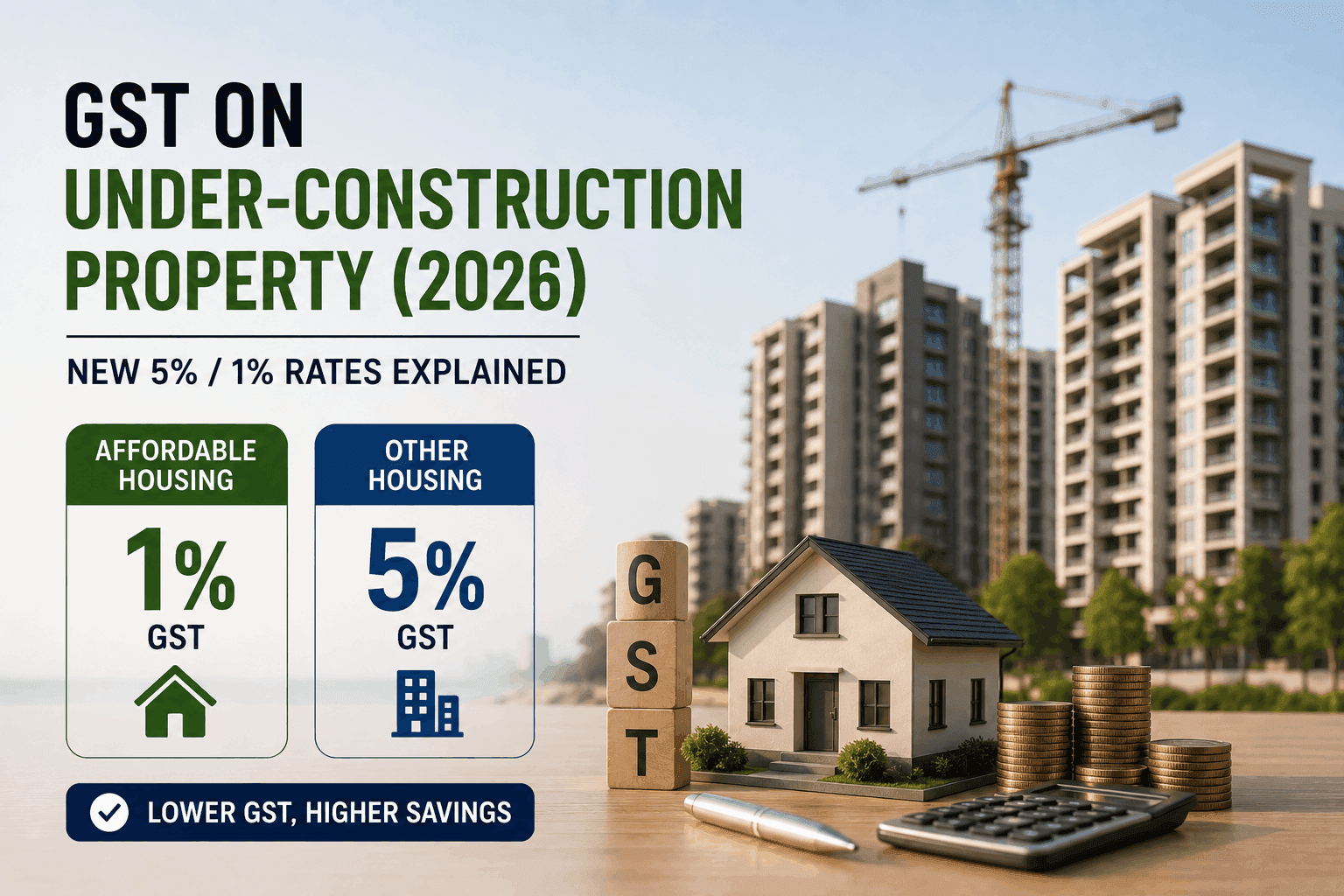
Let us get straight to the point. As of 2026, the GST rates on under-construction residential properties are:
- Affordable Housing: 1% GST (without Input Tax Credit)
- Non-Affordable Housing: 5% GST (without Input Tax Credit)
But what exactly qualifies as affordable housing? According to the latest government definition, a property is considered affordable if:
- The carpet area does not exceed 60 square meters (approx. 645 sq ft) in metro cities like Ahmedabad, Surat, and Vadodara.
- The total sale price is up to Rs 45 lakhs.
In non-metro cities like Rajkot or Gandhinagar, the carpet area limit is 90 square meters (approx. 968 sq ft). Remember, these limits are subject to periodic revision, so always check the latest notification.
Why No Input Tax Credit (ITC)?
You might wonder: why did the government remove ITC for builders? The answer is simple—to reduce litigation and pass on benefits to buyers. Earlier, builders could claim ITC on inputs like cement and steel, but this often led to disputes and delayed projects. Now, with a flat GST rate and no ITC, builders are expected to reduce prices. In my experience, this has largely worked, though some developers still try to pocket the savings.
How GST Impacts Your Home Loan EMI and Total Cost
Here is a practical scenario. Suppose you are buying a 2BHK flat in Bopal, Ahmedabad, priced at Rs 60 lakhs. Under the old regime, you would pay 12% GST (with ITC), which came to Rs 7.2 lakhs. Under the new 5% GST, you pay only Rs 3 lakhs—a saving of Rs 4.2 lakhs! That is a significant amount, especially for a middle-class family.
But wait—does this affect your home loan EMI? Absolutely. Since GST is added to the property cost upfront, a lower GST means you need a smaller down payment and lower loan amount. For example, if your loan is 80% of the property value, a Rs 4.2 lakh saving reduces your loan by Rs 3.36 lakhs. Over a 20-year tenure at 8.5% interest, this translates to an EMI saving of about Rs 3,000 per month. Not bad, right?
Real-Life Example: Meet Ramesh from Vadodara
Take Ramesh, a first-time buyer from Gotri, Vadodara. He was confused between a ready-to-move flat and an under-construction one. Ready-to-move flats attract no GST, but they are often 10-15% more expensive. Ramesh chose an under-construction property in a new project by a reputed builder, paying Rs 55 lakhs. With 5% GST, his total cost was Rs 57.75 lakhs. He saved nearly Rs 5 lakhs compared to a ready-to-move flat. "The GST clarity gave me confidence," he told me. "I also got a better location and modern amenities."
Affordable Housing vs Luxury: Which One to Choose?
Now, the big question: should you go for affordable housing at 1% GST or a luxury flat at 5%? The answer depends on your budget and needs.
Affordable Housing (1% GST)
- Pros: Lowest GST, government subsidies under PMAY, often located in developing areas like Shela, Ahmedabad or Althan, Surat.
- Cons: Smaller carpet area, limited amenities, potentially longer commute.
Luxury Housing (5% GST)
- Pros: Larger space, premium amenities like swimming pool, clubhouse, better location (e.g., Satellite, Ahmedabad or Adajan, Surat).
- Cons: Higher GST, no PMAY benefits, higher maintenance costs.
In my view, if you are a young professional or starting a family, affordable housing with 1% GST is a smart choice. But if you plan to live long-term and value space, go for the 5% option. Wondering where to invest? I personally recommend areas like Gota, Ahmedabad for affordable projects and Alkapuri, Vadodara for luxury.
RERA and GST: What Buyers Must Know
Here is a critical tip: always check if the project is RERA-registered. RERA ensures timely possession and quality construction. Under RERA Gujarat, builders must pay GST on the sale price, not the super built-up area. This protects you from hidden charges. For example, some builders used to charge GST on parking and clubhouse fees—now, that is illegal.
Also, remember that GST is not applicable on:
- Ready-to-move properties (where completion certificate is issued)
- Resale flats
- Land and plot purchases
Practical Actionable Tip
Before signing the agreement, ask your builder for a detailed cost breakup. Ensure GST is calculated on the base price plus basic amenities (like lift, generator). Do not pay GST on maintenance charges or stamp duty. If you feel the builder is overcharging, file a complaint with RERA Gujarat. I have seen many buyers save lakhs just by being vigilant.
Key Takeaways
- GST on under-construction property is 1% for affordable housing (up to Rs 45 lakhs, 60 sq m carpet area) and 5% for others.
- No Input Tax Credit means builders cannot claim refunds, so prices are more transparent.
- Lower GST reduces your home loan EMI by thousands of rupees.
- Always verify RERA registration and get a cost breakup in writing.
- Ready-to-move flats have zero GST but are costlier overall.
Conclusion
Understanding GST on Under-Construction Property: New 5% / 1% Rates Explained 2026 is not just about saving money—it is about making a confident investment. Whether you choose a 1% affordable home in Gandhinagar's GIFT City or a 5% luxury flat in Rajkot's Kalawad Road, the key is to be informed. The Gujarati real estate market is booming, and with these simplified GST rules, now is a great time to buy.
Still have questions? Drop a comment below or consult a local real estate advisor. Remember, a well-informed buyer is a happy homeowner. Happy house hunting!