
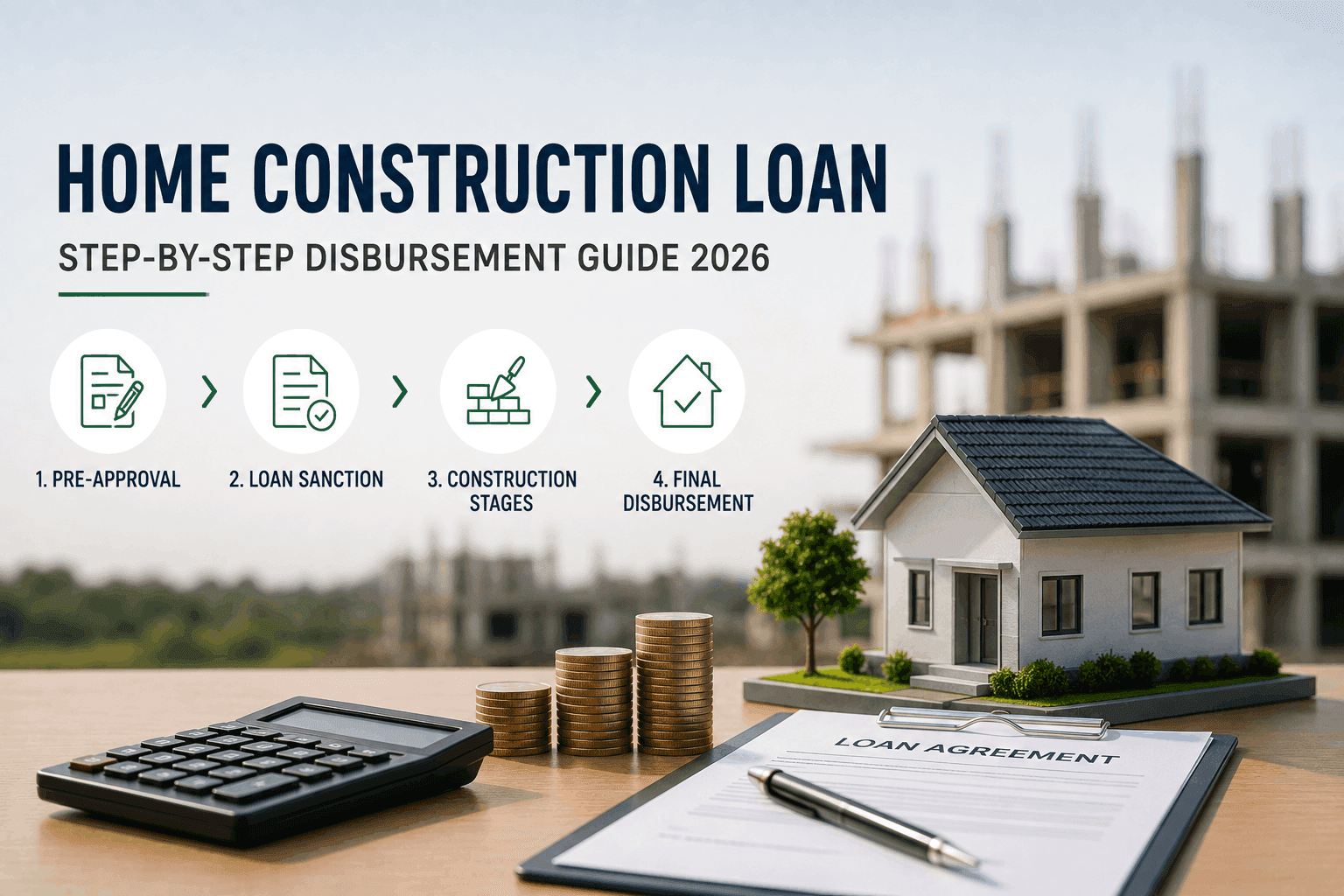
Building your dream home is one of life's most exciting milestones. But let's be honest—navigating the financial side, especially the loan disbursement process, can feel overwhelming. If you're planning to construct a house in Gujarat, understanding how a Home Construction Loan in India: Step-by-Step Disbursement Guide 2026 works is crucial. In this guide, I'll walk you through every stage, from application to final payout, with practical tips for Ahmedabad, Surat, and Vadodara buyers.
What is a Home Construction Loan and How is it Different?
Unlike a ready-to-move-in home loan, a construction loan disburses money in stages as your house progresses. Think of it as a financial scaffold—funds arrive exactly when you need them.
Key Differences from Regular Home Loans
- Disbursement: Paid in tranches (typically 4-6 stages) against construction milestones.
- Interest: Charged only on the amount disbursed, not the total sanctioned loan.
- Documentation: Requires land title, building plan approval, and contractor agreement.
In my experience, many first-time builders in Gujarat confuse this with a plot purchase loan. The truth is, a construction loan covers both material and labor costs, but only after you've owned the land for at least 6-12 months.
Step 1: Pre-Approval and Documentation
Before you break ground, get a pre-approved loan. This tells you exactly how much you can borrow. Here is what you'll need:
- Land documents: Sale deed, encumbrance certificate, and property tax receipts.
- Construction plan: Approved by the local municipal corporation (e.g., AMC for Ahmedabad, SMC for Surat).
- Contractor agreement: Registered with a detailed cost estimate.
- Your financials: IT returns for 3 years, salary slips, and bank statements.
Pro tip: If you're building in emerging areas like Shela or Gota in Ahmedabad, ensure your land is RERA-registered. Lenders are strict about this post-2025.
Step 2: Sanction Letter and Loan Agreement
Once your documents are verified, the bank issues a sanction letter. This is your green light. But don't celebrate yet—you'll sign a loan agreement that outlines:
- Loan amount and interest rate (typically 8.5%-10% p.a. in 2026).
- Disbursement schedule based on construction stages.
- Penalty clauses for delays.
Rhetorical question: How many buyers actually read the fine print? I recommend checking the pre-payment charges—most banks waive them for floating rates.
Step 3: First Disbursement – Foundation Stage
The first tranche, usually 20-25% of the loan, is released after:
- Site visit by the bank's engineer.
- Verification of foundation work (e.g., footing, plinth beam).
- Submission of original bills for materials like cement and steel.
Example from Ahmedabad
Take Ramesh, a buyer constructing a 3BHK in Bopal. His first disbursement of Rs 12 lakhs came after he showed receipts for 1,200 bags of cement and 10 tonnes of steel from a local dealer. The bank also checked that the foundation depth matched the approved plan.
Step 4: Subsequent Disbursements – Slab, Brickwork, and Finishing
After the foundation, disbursements follow a fixed cycle:
Slab Stage (30-35% of loan)
Released after the first floor slab is cast and cured. The bank verifies:
- Shuttering removal.
- Compliance with earthquake-resistant norms (critical in Gujarat).
- Payment proof to the contractor.
Brickwork and Plaster (20-25% of loan)
This stage covers walls, plastering, and electrical conduits. In my view, this is where delays happen—buyers often underestimate the time for curing. Aim for 28 days between slabs.
Finishing Stage (15-20% of loan)
Includes flooring, painting, plumbing, and sanitary fixtures. The bank may release this in two parts: one after tiling and one after final paint.
Here's a reality check: If you're building in Surat's Vesu area, where labour costs are high, negotiate with your contractor for a fixed-price contract. Banks prefer this.
Step 5: Final Disbursement – Completion Certificate
The last 5-10% is released only after:
- Occupancy certificate (OC) from the local authority.
- Final inspection by the bank.
- No outstanding dues to the contractor.
RERA tip: In Gujarat, RERA mandates that the builder/owner must register the project if it has more than 8 units. For individual homes, ensure your OC is from the municipal corporation, not just a private engineer.
Common Pitfalls and How to Avoid Them
- Incomplete documentation: Missing land title or building plan approval can stall disbursements for months. Keep photocopies handy.
- Cost overruns: Construction costs in Gujarat rose 12-15% in 2025 due to steel and cement prices. Add a 10% buffer to your budget.
- Contractor disputes: I've seen cases in Vadodara's Akota where the contractor vanished after the first disbursement. Always pay via cheque or bank transfer.
Actionable tip: Use a project management app like Buildertrend or even a simple Excel sheet to track milestones. Share it with your bank's loan officer—they appreciate transparency.
Quick Tips for a Smooth Disbursement
- Choose the right bank: Some banks like HDFC and SBI have dedicated construction loan teams in Gujarat. ICICI offers online tracking.
- Maintain a separate bank account: Deposit your own contribution and loan disbursements here. It helps with audit trails.
- Get a structural engineer: For high-value loans (above Rs 1 crore), banks may insist on an independent engineer's report. Factor in Rs 10,000-15,000 for this.
- Understand interest calculation: Interest is charged on the disbursed amount from the date of disbursement. So, don't delay construction—every month of delay costs you.
Conclusion
Building a home in Gujarat—whether in Ahmedabad's SG Highway, Surat's Piplod, or Rajkot's Kalawad Road—is a rewarding journey. But the loan disbursement process requires patience and planning. Remember, the key is to stay organized, communicate with your bank, and never skip the legal checks.
Call-to-action: Ready to start? Download my free checklist for home construction loan documentation at [yourwebsite.com]. Or drop a comment below with your query—I reply within 24 hours.