
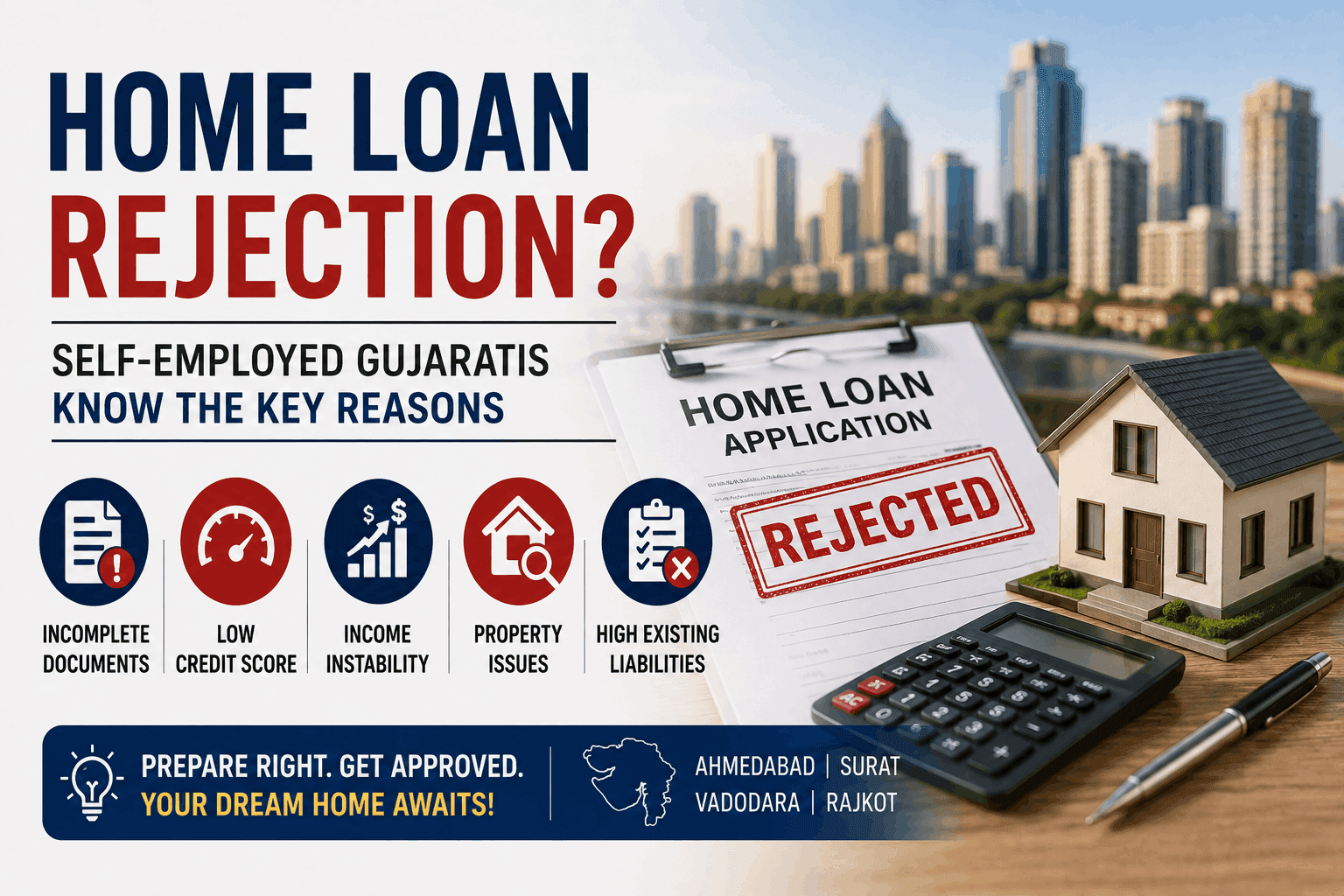
You run a thriving business in Ahmedabad. Your turnover is solid. Yet your home loan application got rejected. Sound familiar?
Here is the truth: being self-employed in Gujarat comes with unique home loan hurdles that salaried buyers simply don't face. Banks see you as a risk—even when your business is booming. But why exactly? And more importantly, what can you do about it?
Let me walk you through the specific reasons home loan rejection happens for self-employed Gujaratis. I have seen this pattern repeat across Surat, Vadodara, and Rajkot. The good news? Most of these issues are fixable.
Why Banks View Self-Employed Gujaratis Differently
Banks love predictability. A salaried employee with a steady monthly income? Easy to assess. A self-employed professional with fluctuating earnings? That makes loan officers nervous.
Here is the thing: Gujarat has a massive self-employed population—from diamond traders in Surat to textile manufacturers in Ahmedabad. Yet, many face rejection because their income documentation does not match what banks expect.
The Income Volatility Problem
Your business might earn Rs 15 lakhs one year and Rs 8 lakhs the next. For a bank, that inconsistency is a red flag. They want to see stable, growing income over at least three years.
In my experience, I have seen a Surat-based diamond merchant with annual profits of Rs 40 lakhs get rejected simply because his income dipped 20% in the previous year. The bank wanted three years of consistent growth. He had two years of growth and one dip. Rejected.
What many buyers overlook is that banks also check your business's GST returns, IT returns, and bank statements. If any of these show gaps or mismatches, your application gets flagged.
Key Documentation Gaps That Trigger Rejection
You might think your IT returns are enough. They are not. Banks demand a complete financial picture. Here are the most common documentation issues I see:
Missing or Inconsistent IT Returns
If you have filed zero-income returns for even one year in the last three, expect rejection. Banks want three consecutive years of IT returns showing net profit. No exceptions.
Take Ramesh, a Vadodara-based real estate agent. He skipped filing returns for two years because his income was low. When he applied for a home loan worth Rs 35 lakhs for a 2BHK in Gotri, the bank asked for three years of returns. He had only one. Rejected.
Bank Statement Irregularities
Banks scrutinize your savings account statements for the last six months. They look for:
- Large cash deposits without explanation
- Frequent overdrafts
- Irregular credit patterns
If your business deals in cash—common in Gujarat's retail and trading sectors—your bank statement might not reflect your true income. This is a major rejection reason.
GST Return Mismatches
Since 2020, banks cross-check your GST returns with your IT returns. If the turnover shown in GST does not match your declared income, your application gets flagged. I personally recommend reconciling these before applying.
How Business Type Affects Your Loan Eligibility
Not all self-employed borrowers are treated equally. Banks categorize you based on your business type:
Proprietorship vs. Partnership vs. Private Limited
- Proprietors: Highest rejection rate. Banks view them as personally liable for all debts. They demand higher margins and stricter documentation.
- Partnership firms: Slightly better. Banks assess the firm's financials and each partner's personal credit.
- Private Limited companies: Most favorable. Banks see them as more stable and professionally managed.
In my view, if you run a proprietorship, consider converting to a private limited company before applying for a large loan. It makes a difference.
Industry-Specific Risks
Banks have a list of high-risk industries. In Gujarat, these include:
- Diamond and jewellery trading (price volatility)
- Real estate development (project delays)
- Textile manufacturing (seasonal demand)
- Agriculture-dependent businesses (weather risks)
If your business falls in one of these categories, expect stricter scrutiny. You might need a higher down payment or a co-applicant with stable income.
Credit Score and CIBIL Issues for Business Owners
Your personal credit score matters. But many self-employed Gujaratis mix personal and business finances. This creates confusion.
The Mixed Credit Problem
You might have taken a business loan in your personal name. If that loan had a late payment, it affects your personal CIBIL score. Banks check both personal and business credit reports.
Here is what I tell my clients: keep personal and business credit separate. Use a separate credit card for business expenses. Do not use your personal card for business purchases.
Low Credit Score Due to High Utilization
Self-employed individuals often use credit cards for working capital. If your credit utilization exceeds 30%, your score drops. A score below 750 usually leads to rejection or higher interest rates.
Wondering what your score is? Check it on CIBIL or Experian before applying. You can improve it in 3-6 months by paying down balances and avoiding new credit inquiries.
Property and Location Factors That Impact Loan Approval
Even if your finances are perfect, the property itself can cause rejection. Banks assess the property's legal status, location, and market value.
Legal Clearance Issues
In Gujarat, many properties in areas like Bopal, Shela, or Gota have unclear titles. Banks require clear title deeds, RERA registration, and approved building plans. If the builder has not obtained all approvals, the loan gets rejected.
Location-Based Restrictions
Banks have a list of preferred localities. For example:
- Ahmedabad: SG Highway, Satellite, Bopal (high preference)
- Surat: Vesu, Adajan, Piplod (high preference)
- Vadodara: Alkapuri, Akota (high preference)
- Rajkot: Kalawad Road, 150 Feet Ring Road (medium preference)
Properties in less developed areas or with poor infrastructure connectivity face higher rejection rates or lower loan-to-value ratios.
Market Value Discrepancies
Banks send their own valuers to assess the property. If the valuer's estimate is lower than the agreed price, the loan amount gets reduced. You then need to bring in more down payment.
In my experience, I have seen a 2BHK in Gandhinagar's GIFT City area valued at Rs 60 lakhs by the seller but only Rs 48 lakhs by the bank. The buyer had to arrange Rs 12 lakhs extra. Many self-employed buyers cannot manage this sudden gap.
How to Improve Your Home Loan Approval Chances
You are not stuck. Here are practical steps you can take today:
Strengthen Your Documentation
- File IT returns for at least three consecutive years with consistent income
- Maintain a separate business bank account with regular transactions
- Reconcile GST returns with IT returns before applying
- Keep all business registration documents ready
Improve Your Credit Profile
- Pay all EMIs and credit card bills on time
- Keep credit utilization below 30%
- Avoid multiple loan applications in a short period
- Check your CIBIL score 6 months before applying
Choose the Right Lender
Not all banks have the same criteria. Some specialize in self-employed borrowers. For example:
- HDFC and ICICI have dedicated self-employed programs
- Regional banks like Bank of Baroda may have more flexible criteria for Gujarat-based businesses
- Co-operative banks sometimes offer loans with lower documentation but higher interest rates
In my view, apply to at least 3-4 lenders. Do not fixate on one. Loan rejection from one bank does not mean rejection from all.
Consider a Co-Applicant
Adding a co-applicant with stable income—like a salaried spouse or sibling—can boost your eligibility. The bank considers the combined income, reducing perceived risk.
Increase Your Down Payment
If you can put down 30-40% instead of the standard 20%, banks see you as less risky. This works especially well if your income documentation is weak.
Quick Tips for Self-Employed Home Loan Applicants in Gujarat
Here is a summary of actionable steps:
- File IT returns every year, even if your income is low. Zero returns are better than no returns.
- Maintain a business bank account with at least 6 months of regular transactions.
- Avoid large cash deposits in your savings account. Use proper banking channels.
- Get a CIBIL report and fix errors before applying.
- Choose a property in a bank-approved locality with clear titles.
- Apply with a co-applicant if your income is variable.
- Consider a smaller loan amount if your documentation is weak.
Final Thoughts: Don't Let Rejection Stop You
A home loan rejection is not the end. It is a signal to fix something. Many self-employed Gujaratis get approved after addressing these specific issues. The key is preparation.
Are you ready to apply? Start by checking your credit score and gathering your IT returns. If you need help, consult a home loan advisor who understands the Gujarat market. They can guide you to the right lender.
Remember: your business success should speak for itself. With the right approach, your dream home in Ahmedabad, Surat, or Vadodara is within reach.
Have questions about your specific situation? Drop a comment below. I reply to every query personally.