
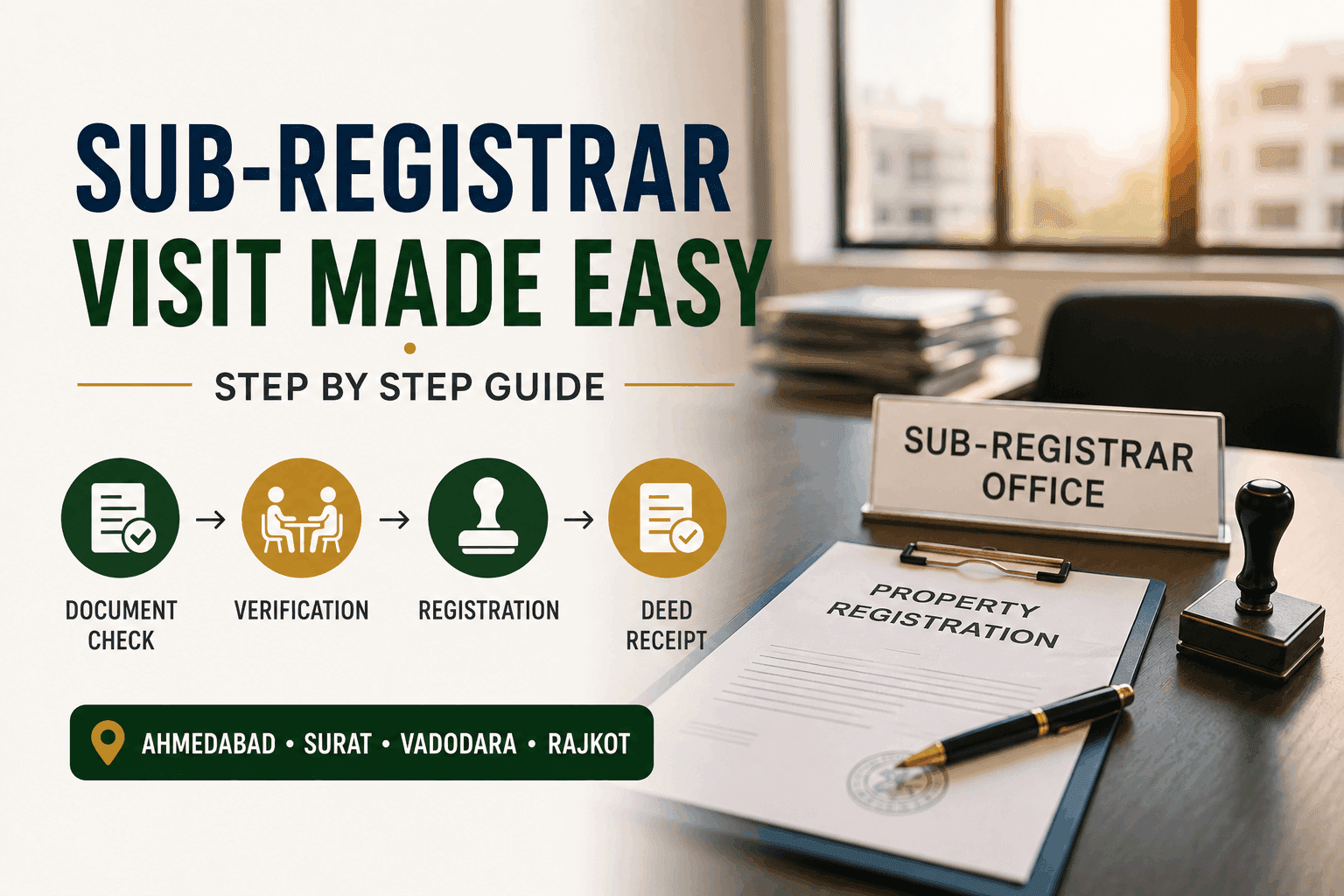
If you are buying property in Gujarat—whether it is a flat in Ahmedabad's SG Highway or a bungalow in Surat's Vesu—the Sub-Registrar office visit is the final, nerve-wracking hurdle. Many buyers assume it is just a formality. But I have seen deals fall apart because people walked in unprepared. So, let me walk you through how a Gujarat Sub-Registrar office visit actually works step by step, from queuing up to walking out with a registered deed. Trust me, knowing this process can save you hours, maybe even lakhs.
Why the Sub-Registrar Visit Matters More Than You Think
Here is the thing: registration is not optional. Under the Registration Act, 1908, any sale deed for property worth over Rs 100 must be registered. In Gujarat, the Sub-Registrar of Assurances (SRO) is your one-stop for this. But beyond legality, registration gives you public notice—meaning your ownership is recorded for the world to see. Without it, you have no legal title.
What many buyers overlook is that the SRO also checks stamp duty payment, verifies identity, and ensures the property is free from certain encumbrances. In my experience, the entire process—from document submission to deed return—takes 2-4 hours, depending on the office. But if you miss a step, you could be sent back. Let us break it down.
Step 1: Preparation Before You Step Out
Before you even think of visiting the SRO, you need a few things ready. Do not skip this. I have seen buyers arrive with incomplete documents and waste an entire day. Here is your checklist:
- Original sale deed (drafted on Rs 100 non-judicial stamp paper or e-stamp). Ensure it has all schedules—property details, boundaries, seller's chain of title.
- Stamp duty paid: In Gujarat, you pay stamp duty (4.9% for men, 5.9% for women in urban areas) and registration fee (1% of the market value). You can pay via e-stamp or physical stamp papers. I personally recommend e-stamp—it is faster and less prone to errors.
- Identity proofs: Aadhaar, PAN card, and two passport-size photos for both buyer and seller.
- Property documents: Previous sale deed, tax receipts, and encumbrance certificate (EC) for the last 13 years. The EC proves no legal disputes.
- Witnesses: You need two witnesses. They must bring their Aadhaar and photos. Choose people who can physically come—some offices insist on in-person verification.
Pro tip: If you are buying a flat in a society like Shivalik Highrise in Bopal or a villa in Shela, also carry the society's NOC and the builder's completion certificate. The SRO may ask for these to verify the property is not under litigation.
How a Gujarat Sub-Registrar Office Visit Actually Works Step by Step: The Queue and Token System
Now, you are at the SRO office. In Gujarat, most offices—like the one in Ahmedabad's Ellisbridge or Surat's Athwa—have a token system. Arrive early, ideally by 9:30 AM. The office opens at 10:30 AM, but the queue starts forming by 9 AM.
Here is the flow:
1. Token Collection: Go to the reception counter. Show your draft deed and proof of stamp duty payment. You will get a token number. Keep it safe—this is your ticket.
2. Document Scrutiny: A clerk will call your token. They check all documents—stamp duty, identity proofs, EC. If anything is missing, they will tell you. Do not argue. Just note what is needed and come back. In my experience, the most common rejections are because of mismatched signatures or missing schedules.
3. Payment of Registration Fee: If documents are OK, you pay the registration fee (1% of market value). In Ahmedabad's upscale areas like Satellite or Prahlad Nagar, market value for a 2-BHK flat can be Rs 50-70 lakhs, so expect a fee of Rs 50,000-70,000. Carry a demand draft or pay via online portal—most offices now accept digital payments.
Step 2: The Actual Registration Process
Once documents are cleared, you move to the Sub-Registrar's chamber. This is the big moment. The Sub-Registrar or a deputy will:
- Verify identity: They will ask for photo IDs and may ask questions to confirm you are the buyer. For example, they might ask, "What is the property address?" or "Who is the seller?"
- Read the deed aloud: In many offices, the Sub-Registrar reads the deed summary. You must confirm it is correct. Do not rush. Listen carefully.
- Take thumb impressions: Both buyer and seller give left thumb impressions on the deed. Witnesses also sign.
- Photographs: Your photo is taken for the record.
Important: The entire process is recorded on CCTV. Do not joke around or argue. I once saw a buyer lose his cool because the Sub-Registrar asked for an additional document. He was asked to leave and come back the next day. Stay calm.
Step 3: After Registration—What Happens Next?
After the Sub-Registrar signs, the deed is considered registered. But you do not get it immediately. Here is the timeline:
- Return of Deed: The office retains the original deed for scanning. You usually get it back in 7-15 working days. Some offices, like in Gandhinagar's GIFT City, offer same-day return for a small fee. Ask about this.
- Encumbrance Certificate: After registration, the SRO updates the records. You can apply for an EC after 30 days to confirm the property is now in your name. This is crucial if you plan to sell later.
What about the market value? In Gujarat, the SRO uses a ready reckoner rate (jantri) to calculate stamp duty. For instance, in Rajkot's 150 Feet Ring Road, jantri might be Rs 5,000 per sq ft, while actual market price is Rs 7,000. You pay stamp duty on the higher of the two. Always check jantri before buying—it affects your total cost.
Common Mistakes That Delay Registration
Let me share a story. A client of mine, Ramesh, bought a flat in Vadodara's Alkapuri. He went to the SRO with incomplete documents—he forgot the previous owner's death certificate (the seller had inherited the property). The clerk rejected his file. He had to come back after a week, losing the booking and paying a penalty of Rs 5,000.
Here are mistakes I see often:
- Incorrect stamp duty: If you underpay, the SRO will reject. Double-check calculations. For a property worth Rs 60 lakhs in Surat's Adajan, stamp duty at 4.9% is Rs 2.94 lakhs. Do not guess.
- Missing witness signatures: Both witnesses must sign in the SRO's presence. If one is absent, you are stuck.
- Property address mismatch: The deed must match the EC and tax receipts exactly. Even a typo can cause rejection.
RERA tip: If the property is under RERA (most new projects in Gujarat are), ensure the builder's RERA registration number is on the deed. The SRO may ask for it. It adds a layer of buyer protection.
How to Make Your Visit Smooth and Fast
Here is what I tell every buyer: Preparation is everything. Follow these steps:
1. Hire a local advocate or document writer: They know the SRO staff and process. In Ahmedabad, many writers near Ellisbridge SRO charge Rs 2,000-5,000. Worth every rupee.
2. Carry extra copies: Photocopies of all documents. The SRO may ask for them.
3. Reach early: The first 10 tokens are processed fastest. If you come at 11 AM, you might wait 3 hours.
4. Dress formally: It sounds silly, but Sub-Registrars take you more seriously if you look professional.
Actionable tip: Before your visit, download the Gujarat e-Dhara portal app. You can check property records and jantri rates online. This helps you verify the property's market value before paying stamp duty.
Key Takeaways for a Stress-Free Registration
- The entire process takes 2-4 hours if you are prepared.
- Always carry original documents plus two sets of photocopies.
- Stamp duty varies by gender—women pay 1% less in urban areas. Use this if applicable.
- The Sub-Registrar's office is not a place for negotiation. Be polite and patient.
Wondering if you need a lawyer? In my view, yes—especially if the property is old or has multiple owners. The lawyer can verify the chain of title and avoid future disputes.
Conclusion: Your Turn to Act
Understanding how a Gujarat Sub-Registrar office visit actually works step by step takes the fear out of property registration. Whether you are buying a flat in Gandhinagar's GIFT City or a plot in Rajkot's Kalawad Road, the process is the same. The key is preparation.
So, here is my call-to-action: Before you visit the SRO, spend one hour checking your documents. Use the e-Dhara portal. Get a lawyer if needed. Trust me, that hour will save you a day of frustration.
Have questions about a specific SRO in Gujarat? Drop a comment below—I reply to every query. Happy home buying!