
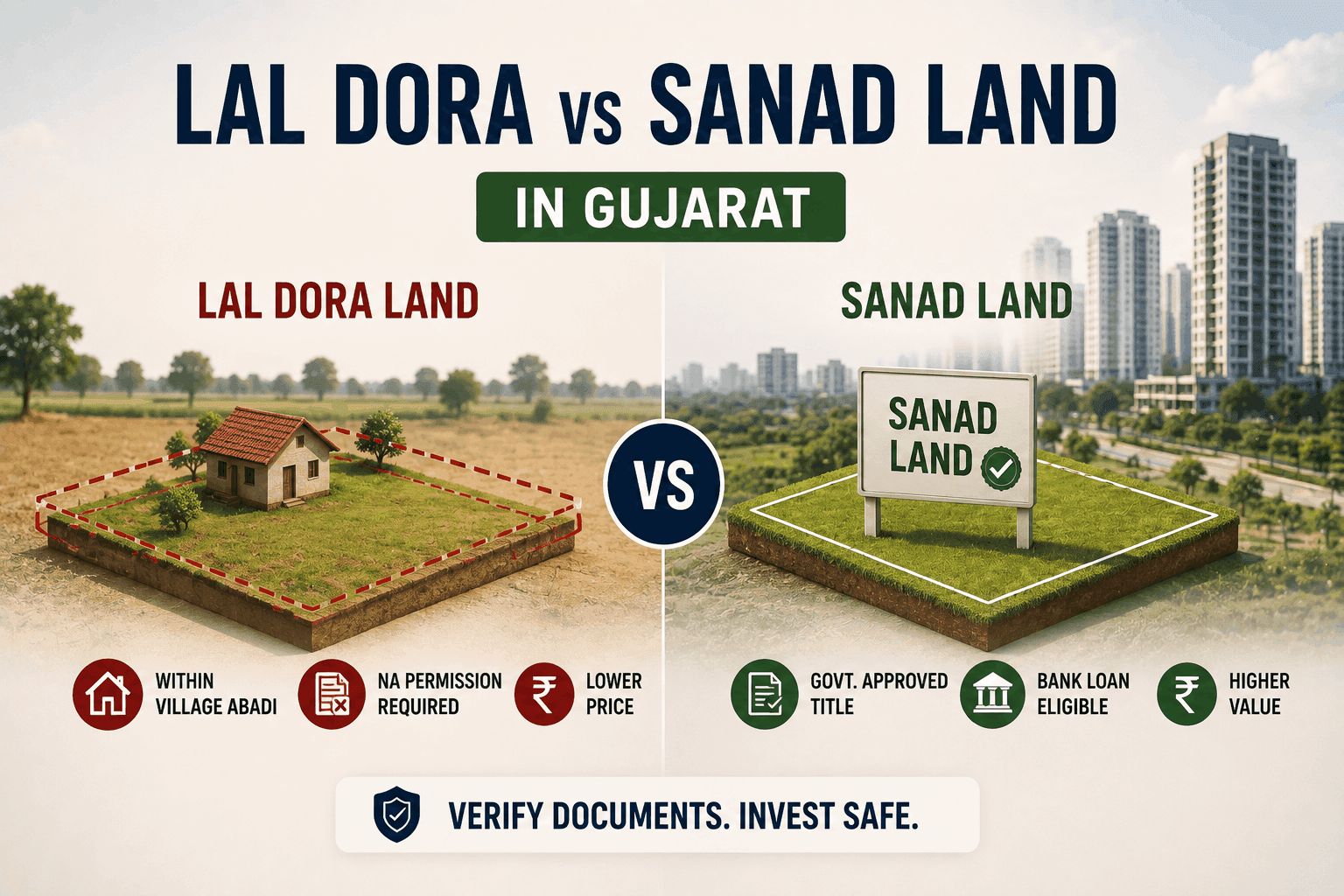
If you are scouting for affordable land in Gujarat, chances are you have come across terms like Lal Dora and Sanad. These are not just bureaucratic jargon—they can make or break your investment. In fact, many first-time buyers in Ahmedabad and Surat have ended up in legal tangles simply because they did not understand what these terms really mean. So, what exactly is Lal Dora land? And how is Sanad land different? More importantly, how can you buy such land without losing your hard-earned money? Let me break it down for you.
What is Lal Dora Land in Gujarat?
Lal Dora is a historical classification used for land within the original village settlement (abadi). In Gujarat, this term is most commonly seen in older villages around Ahmedabad, Vadodara, and Rajkot. The land was originally meant for residential use by village residents and was exempt from certain urban development rules.
Here is the thing: Lal Dora land is not automatically legal for construction. You need to check whether the land has been converted to non-agricultural (NA) use. Without NA permission, you cannot build a permanent structure. Many buyers in areas like Bopal and Shela near Ahmedabad have discovered this the hard way—they bought a plot at a bargain price, only to find they could not get a building permit.
Key Characteristics of Lal Dora Land
- No NA permission required traditionally, but now mandatory for new constructions.
- Limited saleability—you can only sell to someone from the same village or with special permission.
- Lower price—typically 30-50% cheaper than regular residential plots.
- No RERA registration—these plots are often outside RERA's ambit.
But what does this mean for you? Simply put, if you are a buyer from outside the village, you may face restrictions. In my experience, the safest approach is to stick to Sanad land if you want a hassle-free transaction.
Understanding Sanad Land: The Legal Alternative
Sanad land is essentially land that has been regularized by the government. In Gujarat, the state has issued Sanads (certificates) for certain parcels of land that were originally unauthorized or had disputed titles. Once a Sanad is issued, the land becomes marketable and can be sold to anyone.
Now, here is where it gets interesting. Sanad land is often found in areas that were once agricultural but have now become urbanized. Take, for example, the outskirts of Surat—places like Vesu and Adajan. Many plots here were originally Sanad land. Today, they are prime real estate.
Benefits of Sanad Land
- Clear title—the government has verified ownership.
- NA conversion possible—you can get it converted for residential or commercial use.
- Bank loans available—most banks accept Sanad land as collateral.
- RERA registration possible—if the project is large enough.
However, do not assume all Sanad land is problem-free. You must verify the Sanad certificate's authenticity at the district collector's office. I personally recommend hiring a local lawyer who specializes in Gujarat property law.
Lal Dora vs Sanad: Which One Should You Choose?
The answer depends on your budget and risk appetite. If you are looking for a plot in a village near Gandhinagar or on the outskirts of Rajkot, Lal Dora land can be a good option—provided you are a local resident. But if you are an investor from outside the area, Sanad land is the safer bet.
Let me give you a real example. A client of mine, Ramesh, bought a Lal Dora plot in Gota, Ahmedabad, for Rs 22 lakhs. He thought he had struck a goldmine. But when he applied for a home loan, the bank rejected it because the land had no NA permission. He ended up spending another Rs 5 lakhs on legal fees and conversion charges. Had he chosen a Sanad plot, he would have saved both time and money.
Price Comparison (2024-2025)
- Lal Dora land in Bopal: Rs 35-50 lakhs per acre
- Sanad land in Bopal: Rs 80 lakhs to 1.2 crores per acre
- Lal Dora land in Vesu, Surat: Rs 40-60 lakhs per acre
- Sanad land in Vesu: Rs 1-1.5 crores per acre
Wondering where to invest? If you have a budget of Rs 50-60 lakhs, Sanad land in developing areas like Chandkheda or Naroda might be a better long-term bet.
Legal Tips for Buying Lal Dora and Sanad Land in Gujarat
Here is what every buyer should know before signing any agreement:
1. Verify the Land Record
Visit the e-Dhara portal (Gujarat's online land records system) and check the 7/12 extract. This document shows the current owner, land type, and any encumbrances. For Lal Dora land, the extract will mention "Lal Dora" or "Abadi." For Sanad land, look for "Sanad No." and the date of issuance.
2. Check NA Permission Status
If the land is still agricultural, you cannot build a house. You need to apply for NA conversion at the district collector's office. This process takes 3-6 months and costs around Rs 50,000-1 lakh depending on the area. In my view, always buy land that already has NA permission.
3. RERA Compliance
While Lal Dora plots are usually exempt from RERA, any project with more than 8 units must be registered. If you are buying a plotted development in areas like SG Highway or Althan, insist on RERA registration. It gives you legal protection.
4. Title Search
Do not rely on the seller's word. Get a title search done by a lawyer. In Gujarat, many Lal Dora lands have multiple claimants. A proper title search can save you from future litigation.
5. Sale Deed Registration
Always register the sale deed at the sub-registrar's office. Unregistered agreements are not valid in court. The stamp duty in Gujarat is 4.9% for men and 4.4% for women. Take advantage of the lower rate if you are a woman buyer.
Key Takeaways: What Every Buyer Should Know
- Lal Dora land is cheaper but comes with restrictions. Best for local buyers.
- Sanad land is more expensive but legally safer. Ideal for investors.
- Always check the 7/12 extract before paying any advance.
- NA conversion is a must for construction. Do not skip it.
- RERA registration is your safety net. Look for it in large projects.
- Budget at least 10-15% extra for legal fees and conversion costs.
Conclusion
Buying land in Gujarat can be a rewarding investment, but only if you do your homework. Lal Dora and Sanad land both have their pros and cons. The key is to match the land type with your specific needs. Are you a local resident looking for a home? Lal Dora might work. Are you an outsider wanting to build a retirement home or flip the property? Go for Sanad.
Remember, a plot that looks like a steal today can become a legal nightmare tomorrow. So, take the time to verify documents, consult a local lawyer, and never rush into a deal. If you have questions about a specific locality in Ahmedabad, Surat, or Vadodara, feel free to reach out. I have helped hundreds of buyers navigate these tricky waters—and I can help you too.
Ready to find your perfect plot? Start with a visit to the e-Dhara portal and check the 7/12 extract of any land you are considering. That one step can save you lakhs of rupees and years of stress.