
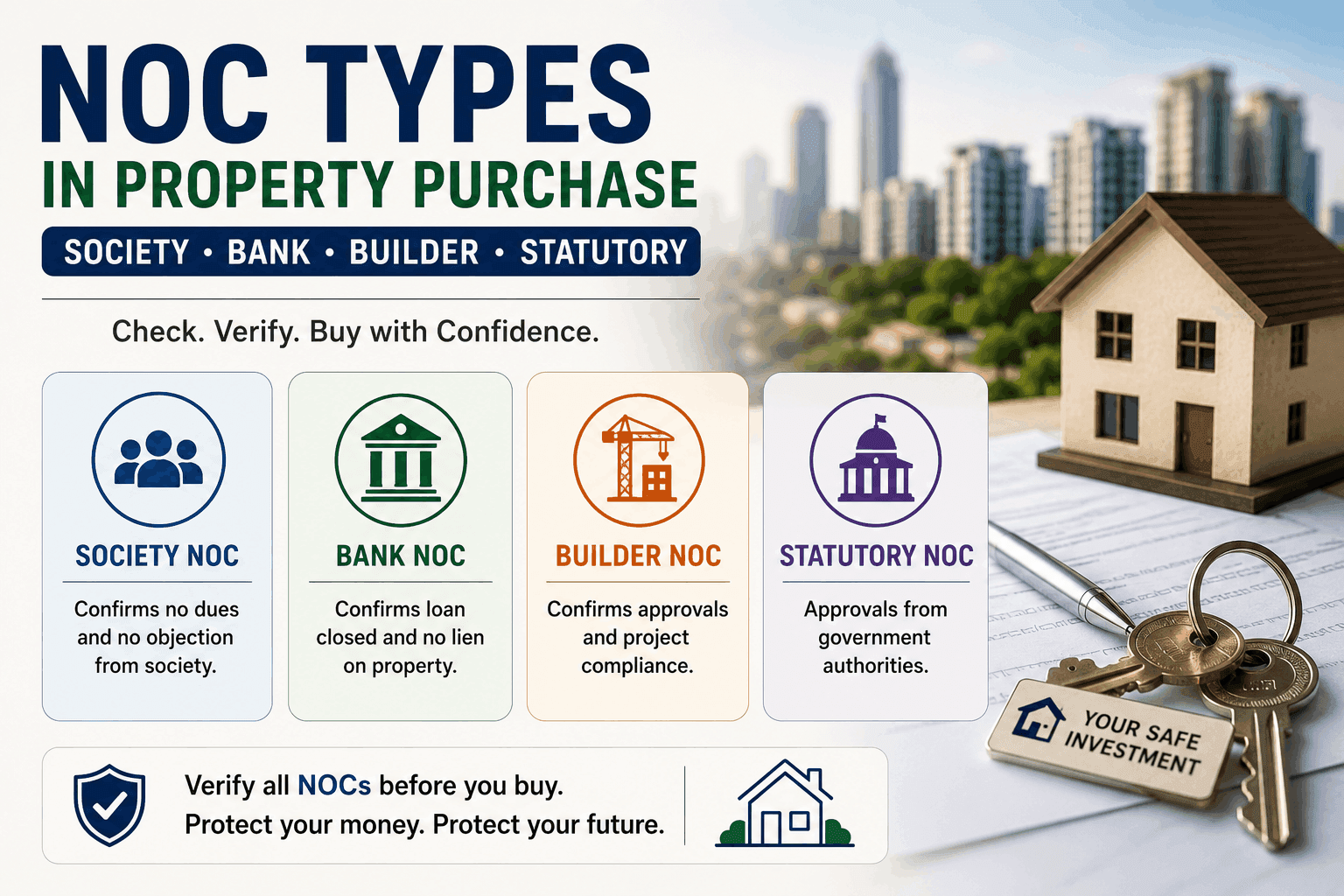
So you have finally shortlisted that dream 3BHK in a gated society on SG Highway in Ahmedabad. The price seems right – around Rs 85 lakhs for a 1,500 sq ft flat. You are excited. But wait – before you sign that agreement, there is something critical you need to understand. I am talking about NOC types in property purchase: society, bank, builder, and statutory. These clearances can make or break your deal. Miss one, and you could be stuck in legal limbo for years. In this post, I will break down each type, what it means for you as a buyer, and exactly how to verify them. Trust me, this is one area where cutting corners costs dearly.
What Are NOCs and Why Do They Matter in Gujarat Property?
NOC stands for No Objection Certificate. Think of it as a green signal from various authorities that the property you are buying is legally clean. In Gujarat, especially in fast-growing cities like Ahmedabad, Surat, and Vadodara, properties often pass through multiple hands. Without proper NOCs, you could end up with a flat that has pending dues, illegal construction, or even a disputed title.
Here is the thing – many buyers focus only on the price and location. They forget that a property without NOCs is like a car without brakes. Looks great, but dangerous. In my 15 years of covering the Gujarat real estate market, I have seen too many cases where families lost their life savings because they skipped this step.
The Four Pillars of NOC Types in Property Purchase: Society, Bank, Builder, and Statutory
Let me simplify this for you. There are four main categories of NOCs you need to check:
1. Society NOC – From the housing society or apartment association
2. Bank NOC – From the lender who financed the previous owner
3. Builder NOC – From the developer confirming clearances
4. Statutory NOC – From government bodies like AMC, AUDA, fire department, etc.
Each serves a different purpose. Let us dive deep into each one.
Society NOC: Why Your Neighbor's Approval Matters
When you buy a resale flat in a society in areas like Satellite, Bopal, or Vastral in Ahmedabad, the society has a say. Why? Because the society maintains common areas, collects maintenance fees, and has bylaws. A Society NOC confirms that:
- The previous owner has paid all maintenance dues up to the date of transfer
- There are no pending legal disputes involving the flat
- The society has no objection to the transfer of ownership
In my experience, this is often the most overlooked NOC. Buyers assume that if the seller says dues are clear, it is fine. But I have seen cases where new owners were slapped with Rs 2-3 lakhs of unpaid maintenance from years ago. The society can even deny you access to amenities until dues are cleared.
Real example: Take Ramesh, a first-time buyer from Gandhinagar. He bought a flat in Gota for Rs 65 lakhs. The seller gave him a clean chit. But after possession, the society demanded Rs 1.2 lakhs in pending maintenance. Ramesh had to pay up because the society NOC was never obtained. Lesson learned the hard way.
Actionable tip: Always ask for a Society NOC in writing. Verify with the society secretary directly. Do not rely on the seller's word.
Bank NOC: Clearing the Loan Lien
If the previous owner had taken a home loan on the property, the bank has a lien on it until the loan is fully repaid. A Bank NOC confirms that:
- The loan has been fully settled
- The bank has no further claim on the property
- The original documents (like the sale deed) can be handed over to you
This is especially important in areas like Vesu in Surat or Alkapuri in Vadodara, where many properties are financed. Without a Bank NOC, you could buy a flat only to find out later that the bank still holds the title. The bank could even auction the property to recover dues.
Here is a question for you: Would you buy a car without knowing if the previous loan was cleared? Probably not. So why take that risk with a property worth Rs 50 lakhs or more?
Legal tip under RERA Gujarat: RERA mandates that all encumbrances on a property must be disclosed. But buyers still need to verify. Ask for the Bank NOC and cross-check with the bank's branch. It takes 15 minutes but saves years of headache.
Builder NOC: The Developer's Guarantee
In new projects or under-construction flats, the builder NOC is crucial. This is not just a formality. It confirms that:
- The builder has obtained all necessary approvals from local authorities
- The project complies with RERA registration and building plan sanctions
- There are no pending litigations against the builder
In Gujarat, especially in emerging corridors like Shela near Ahmedabad or Piplod in Surat, many builders offer attractive prices. But some cut corners. A builder NOC ensures you are not buying into an illegal construction that could be demolished later.
What many buyers overlook is that a builder NOC should also include clearance from the fire department, pollution board, and airport authority (if near an airport). In my view, always ask for a complete list of NOCs before booking. If the builder hesitates, walk away.
Statutory NOCs: The Government's Stamp of Approval
This is the most complex category. Statutory NOCs come from multiple government departments. Here are the key ones for Gujarat properties:
Municipal Corporation NOC (AMC, SMC, VMC, RMC)
For properties in city limits, the municipal corporation must certify that the building is constructed as per approved plans. In Ahmedabad, the AMC NOC is critical for areas like Naroda, Chandkheda, and Vastral. Without it, you cannot get a regular water or electricity connection.
Development Authority NOC (AUDA, SUDA, VUDA, GUDA)
If the property is in a development area (like Bopal or Gota under AUDA), you need an NOC from the respective authority. This confirms that the land use is legal and the construction is within permissible limits.
Fire Department NOC
For high-rise buildings (over 15 meters), the fire department NOC is mandatory. In Surat's Adajan area, where many 20+ floor towers exist, this is non-negotiable. Fire safety compliance can literally save lives.
Airport Authority NOC
If the property is near an airport (like areas around Ahmedabad airport or Vadodara airport), the Airport Authority of India must clear the building height. I have seen cases where floors were sealed because they exceeded the permissible height.
Other Statutory NOCs
- Environment NOC from Gujarat Pollution Control Board (for large projects)
- Coastal Regulation Zone NOC for properties near the coast (relevant in Surat and parts of Ahmedabad)
- Forest Department NOC if the land is near reserved forests
Wondering how to track all these? Honestly, it is a lot. But a good lawyer or RERA consultant can help. Do not try to DIY this.
How to Verify All NOC Types in Property Purchase: Society, Bank, Builder, and Statutory
Now that you know what NOCs are needed, the next question is: How do you verify them? Here is a practical checklist:
1. Request original NOC documents – Not photocopies. Insist on seeing the originals.
2. Cross-check with issuing authority – Call or visit the society office, bank branch, or municipal office to confirm.
3. Check RERA website – For under-construction projects, RERA registration number should be on the builder's website. Cross-verify on gujaratrera.gov.in.
4. Hire a property lawyer – Spend Rs 5,000-10,000 on legal due diligence. It is a small price for peace of mind.
5. Use online portals – Some municipal corporations in Gujarat now offer online verification of NOCs.
Quick tip: In Ahmedabad, you can check property tax receipts and building plan approvals on the AMC online portal. It is free and takes 5 minutes.
Common Mistakes Buyers Make with NOCs
After covering hundreds of property deals in Gujarat, here are the top mistakes I see:
- Relying on the seller's word – Verbal assurances mean nothing. Get everything in writing.
- Ignoring society NOC for resale flats – This is the most common oversight. Societies can be strict.
- Assuming builder NOC covers everything – Builder NOC is just one piece of the puzzle. You still need statutory NOCs.
- Not checking NOCs before booking – Many buyers pay booking amount first and then discover issues. Always verify before paying.
Key Takeaways: Quick Tips for Buyers
- Always demand all four NOC types in property purchase: society, bank, builder, and statutory before final payment.
- For resale flats in Ahmedabad (Satellite, Bopal, Vastral), society NOC is non-negotiable.
- For new projects in Surat (Vesu, Piplod), check builder NOC and RERA registration.
- Bank NOC is critical if the seller had a home loan. Get a direct confirmation from the bank.
- Statutory NOCs vary by location. In Gandhinagar's GIFT City area, airport NOC is important due to proximity to the airport.
- Spend money on a lawyer for due diligence. It is cheaper than fighting a legal battle later.
Conclusion: Don't Skip This Step
Look, buying a home is probably the biggest financial decision of your life. Whether it is a Rs 45 lakh 2BHK in Rajkot's Kalawad Road or a Rs 1.2 crore penthouse in Surat's Vesu, the NOC process is the same. Do not let excitement cloud your judgment. Verify every single NOC. In my opinion, it is better to lose a good deal than to win a bad one.
If you are unsure about any NOC, ask a professional. There are many RERA consultants in Ahmedabad and Surat who charge Rs 5,000-15,000 for a full due diligence report. Worth every rupee.
Now, go ahead and make that purchase with confidence. But remember – NOC types in property purchase: society, bank, builder, and statutory – check them all. Your future self will thank you.