
Introduction
Buying a home is a dream for many. But what happens when that dream is shared among siblings? In Gujarat, families often inherit ancestral property together. The arrangement works for years. Then, one day, a disagreement arises. Or maybe someone needs money urgently. Suddenly, everyone wants their share. That is where the partition deed comes in. It is a legal tool to divide jointly owned property into separate shares.
Look, I have seen countless families in Ahmedabad, Surat, and Vadodara struggle with this process. The confusion is real. But here is the good news: the Partition Deed Procedure in Gujarat: A Step-by-Step Family Guide is simpler than you think. In this article, I will walk you through every step. From understanding the legal framework to registering the deed. By the end, you will know exactly what to do. Let us begin.
Why You Need a Partition Deed in Gujarat
Before diving into the procedure, let us address the big question: why bother?
Here is the truth: joint ownership sounds nice in theory. But in practice, it creates problems. For example, if your father owned a flat in Satellite, Ahmedabad, and passed away without a will, you and your siblings become co-owners. Now, if one sibling wants to sell their share, they cannot do it cleanly without a partition deed. The buyer will demand clear title.
Moreover, without a partition deed, you cannot get a home loan on your share. Banks in Gujarat, like Bank of Baroda or HDFC, require individual ownership.
What many buyers overlook is the tax angle. A registered partition deed helps avoid future disputes and capital gains tax issues. In my experience, families who skip this step end up in court. And court cases in Gujarat can drag on for years.
So, the Partition Deed Procedure in Gujarat: A Step-by-Step Family Guide is not just paperwork. It is peace of mind.
Understanding the Legal Basis: Hindu Succession Act and RERA
Gujarat follows the Hindu Succession Act, 1956, for ancestral property. Under this law, all heirs—sons and daughters—have equal rights. This applies to properties in areas like SG Highway, Bopal, and even GIFT City in Gandhinagar.
But here is a twist: if the property was self-acquired by your father, he can will it to anyone. However, for ancestral property, partition is mandatory if any heir demands it.
Now, you might ask: does RERA apply? The Real Estate (Regulation and Development) Act, 2016, does not directly govern partition deeds. But if the property is an under-construction flat registered under RERA Gujarat, the developer must provide a no-objection certificate (NOC) for partition. I have seen cases in Vesu, Surat, where developers delayed this. So, always check RERA compliance before starting the process.
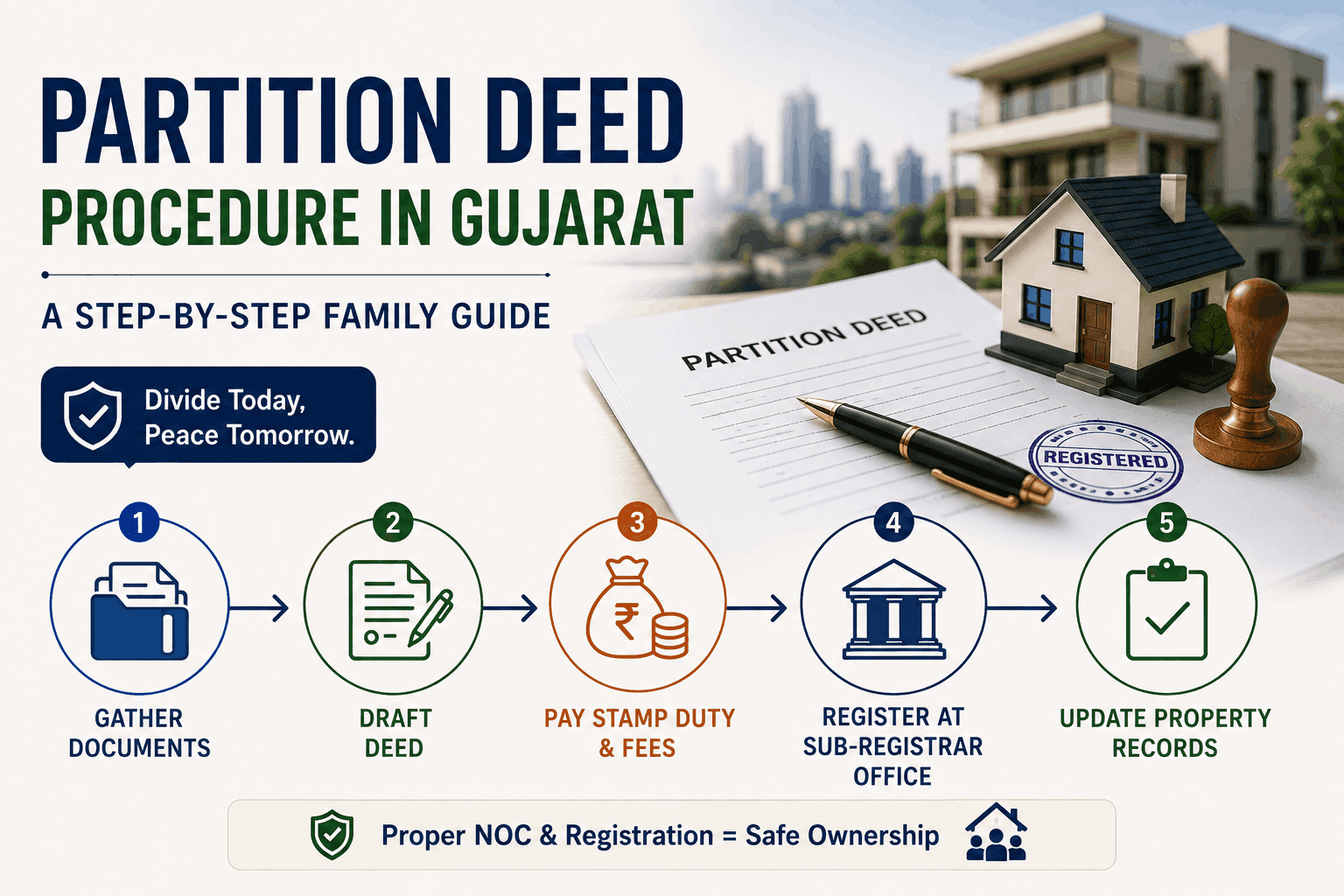
Step 1: Gather All Necessary Documents
The first step in the Partition Deed Procedure in Gujarat: A Step-by-Step Family Guide is documentation. Without proper papers, you cannot proceed.
Here is what you need:
- Title deed of the property (original sale deed or gift deed)
- Death certificate of the original owner (if applicable)
- Legal heir certificate from the local municipality or revenue department
- Proof of identity and address of all co-owners (Aadhaar, PAN, voter ID)
- Tax receipts and latest property tax paid receipt
- Encumbrance certificate from the sub-registrar office (shows no pending loans or disputes)
Take Ramesh, a first-time buyer from Ahmedabad. He wanted to partition a flat in Chandkheda with his sister. He forgot the encumbrance certificate. The sub-registrar rejected his application. He lost two weeks. Do not make that mistake.
Step 2: Draft the Partition Deed
Once documents are ready, you need a lawyer. In Gujarat, you cannot draft a partition deed yourself. It requires legal expertise.
A good lawyer will:
- Describe the property in detail (area, boundaries, survey number)
- List all co-owners and their shares
- Specify how the property will be divided (physical division or by value)
- Include a clause for future sale or transfer
What is the cost? Legal fees in Ahmedabad range from Rs 5,000 to Rs 15,000 depending on complexity. For properties in premium areas like Alkapuri, Vadodara, it may be higher. But trust me, it is worth every rupee.
Step 3: Pay Stamp Duty and Registration Fees
Here is where the government gets involved. In Gujarat, stamp duty for partition deeds is 2% of the market value of the share being transferred. For example, if your share is worth Rs 50 lakhs, stamp duty is Rs 1 lakh. Additionally, registration fees are 1% of the value, capped at Rs 30,000 for most properties.
But wait—there is a concession. If the partition is among family members (spouse, children, parents), the stamp duty is reduced to 1% in some cases. I personally recommend checking with the sub-registrar office in your district. For instance, in Rajkot's Kalawad Road area, many families get this benefit.
Step 4: Execute the Deed at the Sub-Registrar Office
Now, the actual registration. All co-owners must be present at the sub-registrar office. You will sign the deed in front of the registrar. Two witnesses are also required.
The process takes about 1-2 hours. But be prepared for queues. In Surat's Adajan office, I have seen people wait half a day. So, go early morning.
After registration, you get a registered copy. Keep it safe. This is your proof of ownership.
Step 5: Update Property Records
Many families stop at registration. Big mistake. The final step is updating the revenue records. In Gujarat, this means applying to the Talati or Mamlatdar for mutation in the 7/12 extract (for agricultural land) or property card (for urban land).
Without mutation, the government still shows joint ownership. This can cause problems when selling. For example, a buyer in Gotri, Vadodara, will insist on seeing the updated records.
Common Mistakes to Avoid
Over the years, I have seen families make the same errors. Here are the top three:
1. Not involving all heirs: If one sibling is left out, the deed can be challenged in court. Always include everyone.
2. Skipping the encumbrance certificate: This can hide an existing loan on the property.
3. Ignoring tax implications: A partition deed is not taxable as income. But if you sell later, capital gains tax applies. Plan accordingly.
Key Takeaways
- Start early: The process takes 2-4 weeks. Do not wait for a crisis.
- Hire a local lawyer: They know the sub-registrar office procedures in your city.
- Check RERA status: For under-construction flats, get the developer's NOC.
- Keep original documents: Make multiple copies for future reference.
- Cost estimate: Budget Rs 10,000-50,000 depending on property value.
Conclusion
Dividing family property is emotional. But with the right steps, it can be smooth. The Partition Deed Procedure in Gujarat: A Step-by-Step Family Guide is your roadmap. From gathering documents to updating revenue records, each step matters.
If you are in Ahmedabad, Surat, Vadodara, or anywhere in Gujarat, start today. Talk to a lawyer. Collect your papers. Do not let joint ownership become a burden.
Need help? Reach out to a RERA-registered consultant in your area. They can guide you through the entire process. Your family peace is worth it.