
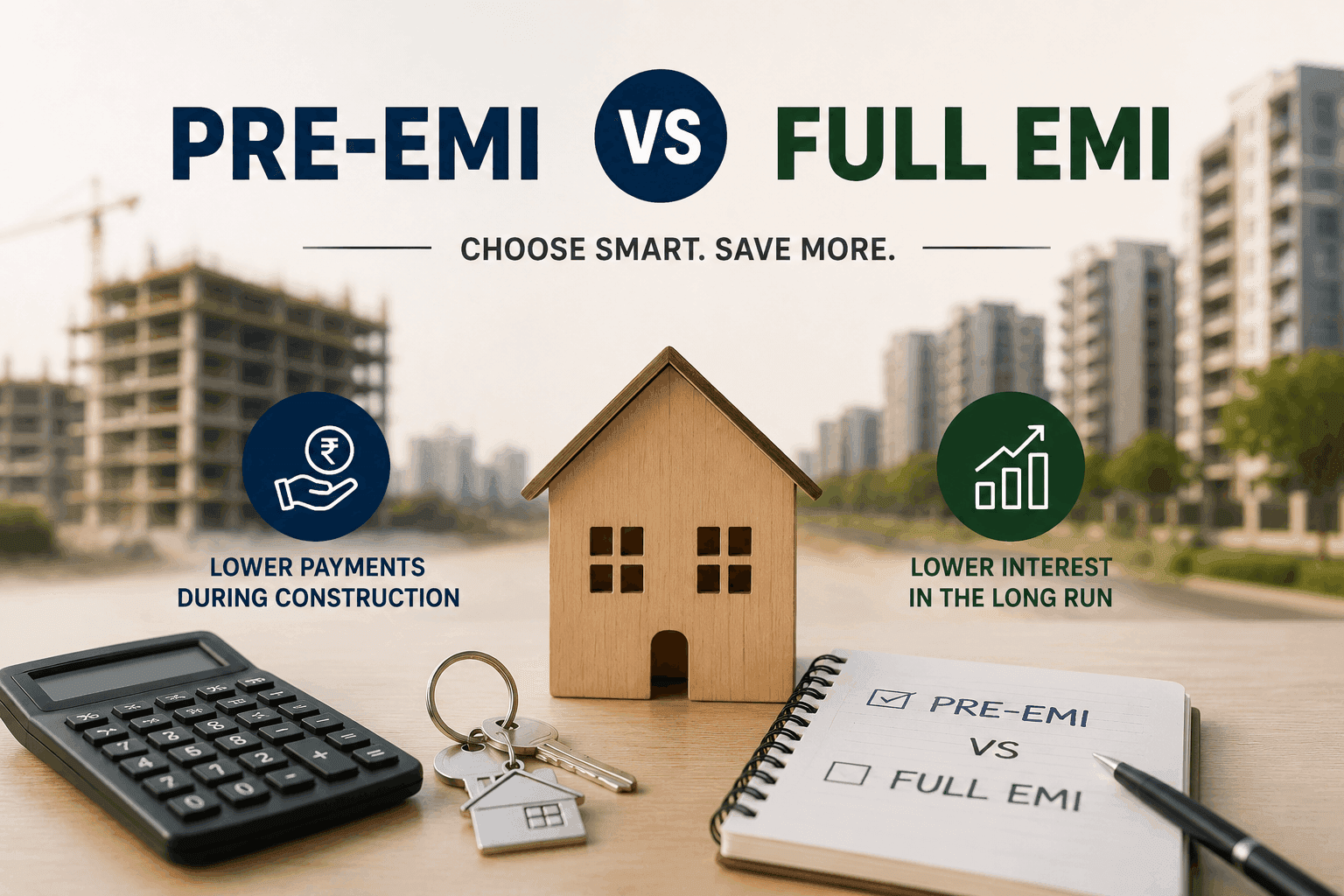
So, you've finally zeroed in on that dream apartment in Ahmedabad's SG Highway or a villa in Surat's Vesu. The location is perfect, the builder has a good track record, and the price—well, it's within your budget. But then comes the tricky part: how will you pay for it? Most under-construction properties offer two EMI options: Pre-EMI and Full EMI. And trust me, this decision can impact your finances by lakhs. In this comprehensive guide, I'll walk you through the Pre-EMI vs Full EMI on Under-Construction Property: Savings Calculator approach, helping you crunch the numbers like a pro. Let's dive in.
What Exactly Are Pre-EMI and Full EMI?
Before we get into the calculator, let's clarify the basics. When you take a home loan for an under-construction property, the lender disburses the loan in stages based on the construction progress. Here's how the two EMI options work.
Pre-EMI: Pay Interest Only
In a Pre-EMI plan, you only pay the interest on the amount disbursed so far. The principal repayment starts only after you get possession. So, if the bank has disbursed Rs 20 lakhs out of your Rs 50 lakh loan, you pay interest only on Rs 20 lakhs—not on the full loan amount. This keeps your monthly outgo lower during construction.
Full EMI: Pay Principal + Interest from Day One
In a Full EMI plan, you start paying both principal and interest on the entire loan amount from the very first disbursement. Even if only 30% of the loan is disbursed, the EMI is calculated as if the full loan has been given. This means higher monthly payments during construction but lower overall interest cost.
The Savings Calculator: Let's Do the Math
Now, let's get our hands dirty with numbers. I'll use a realistic example from Gujarat's real estate market.
Scenario:
- Property: A 3BHK flat in Bopal, Ahmedabad
- Property Price: Rs 75 lakhs
- Loan Amount: Rs 60 lakhs
- Interest Rate: 8.5% per annum
- Loan Tenure: 20 years
- Construction Period: 24 months
- Disbursement Schedule: Rs 15 lakhs every 6 months
Full EMI Calculation
Full EMI on Rs 60 lakhs at 8.5% for 20 years = Rs 52,080 per month
Total payment during construction (24 months) = Rs 52,080 × 24 = Rs 12,49,920
Out of this, principal repaid = Rs 1,52,000 (approx.), interest paid = Rs 10,97,920
Pre-EMI Calculation
For Pre-EMI, you pay interest only on the disbursed amount.
- Months 1-6: Disbursed Rs 15 lakhs, interest = (15,00,000 × 8.5% / 12) × 6 = Rs 63,750
- Months 7-12: Disbursed Rs 30 lakhs, interest = (30,00,000 × 8.5% / 12) × 6 = Rs 1,27,500
- Months 13-18: Disbursed Rs 45 lakhs, interest = (45,00,000 × 8.5% / 12) × 6 = Rs 1,91,250
- Months 19-24: Disbursed Rs 60 lakhs, interest = (60,00,000 × 8.5% / 12) × 6 = Rs 2,55,000
Total Pre-EMI during construction = Rs 6,37,500
The Difference
||Full EMI|Pre-EMI|
|---|---|---|
|Total payment during construction|Rs 12,49,920|Rs 6,37,500|
|Interest paid during construction|Rs 10,97,920|Rs 6,37,500|
|Principal repaid during construction|Rs 1,52,000|Rs 0|
Here is the thing: with Pre-EMI, you save Rs 6,12,420 in cash outflow during construction. But wait—that's not the whole story.
The Hidden Cost of Pre-EMI
While Pre-EMI saves you cash today, it increases your total interest cost over the loan tenure. Why? Because you haven't started repaying principal. In our example, with Full EMI, you've already paid off Rs 1.52 lakhs of principal. With Pre-EMI, that principal remains, and you'll pay interest on it for the remaining 18 years.
Total interest cost over full tenure:
- Full EMI: Rs 65.3 lakhs
- Pre-EMI: Rs 68.9 lakhs
Difference: Rs 3.6 lakhs extra interest with Pre-EMI
So, is Pre-EMI really a saving? It depends on your cash flow and investment discipline.
When Should You Choose Pre-EMI?
1. Tight Cash Flow
If you're like most first-time buyers, your monthly income is already stretched with rent, EMIs, and living expenses. Take the case of Ramesh, a software engineer in Ahmedabad. He was paying Rs 18,000 rent for a 2BHK in Chandkheda while his under-construction flat in Shela was being built. Choosing Full EMI would have meant Rs 52,080 + Rs 18,000 = Rs 70,080 per month—almost his entire salary. Pre-EMI kept his monthly outgo at Rs 25,000-30,000, manageable.
2. You Have Better Investment Options
If you can invest the saved Pre-EMI amount in stocks, mutual funds, or fixed deposits that yield more than 8.5%, you come out ahead. In my experience, disciplined investors often prefer Pre-EMI for this reason.
3. Builder Delays Are Common
Reality check: Many under-construction projects in Gujarat face delays. If your possession is delayed by 6-12 months, you'd have paid Full EMI for nothing. With Pre-EMI, you only pay interest on what's disbursed.
When Should You Choose Full EMI?
1. You Have Surplus Cash
If you have a high income or a second income in the family, Full EMI makes sense. You'll save on total interest and own the property faster.
2. You Want Tax Benefits Earlier
Under Section 24(b) of the Income Tax Act, you can claim up to Rs 2 lakhs deduction on home loan interest. With Full EMI, you start claiming this from year one. With Pre-EMI, you can claim this only after possession.
3. You Lack Investment Discipline
Here is what I tell my clients: if you're not going to invest the saved Pre-EMI amount, choose Full EMI. The Pre-EMI savings will likely be spent on lifestyle expenses, leaving you with a larger loan burden.
RERA Tip: Read the Fine Print
Under RERA Gujarat, builders must provide a clear payment schedule. But what many buyers overlook is that the bank's disbursement schedule may differ. Always ask your lender about the exact Pre-EMI vs Full EMI terms. Some banks charge processing fees for switching between plans.
Also, check if the builder offers a subvention scheme (where the builder pays the Pre-EMI until possession). While tempting, these schemes often inflate the property price by 5-10%. My advice: avoid subvention unless you're absolutely cash-strapped.
A Practical Actionable Tip
Here's something you can do today:
1. Get your loan sanction letter from at least 2-3 banks.
2. Ask each bank for a detailed amortization schedule for both Pre-EMI and Full EMI options.
3. Use a simple Excel sheet to compare total outflow over 5 years.
4. Factor in your expected rental savings (once you move in) and tax benefits.
Wondering where to invest in Gujarat right now? Areas like GIFT City in Gandhinagar and Vesu in Surat are seeing strong demand. But that's a topic for another day.
Key Takeaways
- Pre-EMI reduces your monthly outflow during construction but increases total interest cost by 5-8%.
- Full EMI is better if you have surplus cash and want to save on interest.
- Use the savings calculator approach to compare both options for your specific loan amount and tenure.
- Always check the builder's track record for timely possession—delays can make Pre-EMI more attractive.
- Tax benefits under Section 24(b) start earlier with Full EMI.
Conclusion: Which One Should You Choose?
There's no one-size-fits-all answer. The Pre-EMI vs Full EMI on Under-Construction Property: Savings Calculator we discussed shows that the difference can be substantial—over Rs 6 lakhs in cash flow during construction. But the right choice depends on your financial discipline, cash flow, and risk appetite.
I personally recommend Full EMI if you can afford it. You'll save on interest and build equity faster. However, if your monthly budget is tight, go for Pre-EMI but commit to investing the savings every month.
Now, I'd love to hear from you. Are you leaning towards Pre-EMI or Full EMI? Drop a comment below or reach out to me on LinkedIn. And if you found this helpful, share it with someone who's planning to buy a home in Gujarat. Happy house hunting!