
Why You Need to Understand Property Valuation Methods
Let's be honest — buying a flat or a house is likely the biggest financial decision you will ever make. And yet, most buyers in Ahmedabad, Surat, or Vadodara rely on what the builder tells them or what their cousin "heard from a friend." That is a recipe for overpaying.
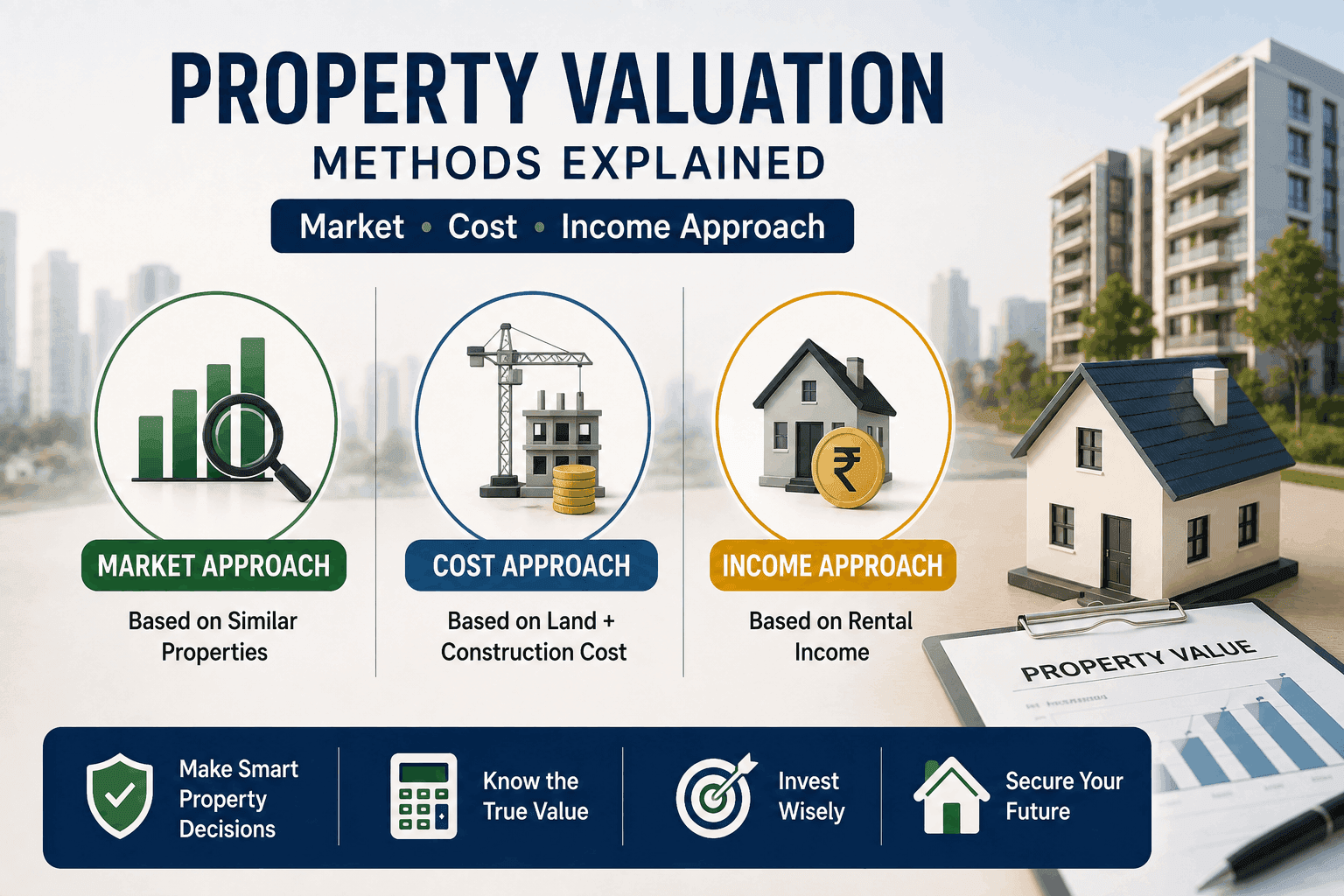
Property Valuation Methods Explained: Market, Cost, and Income Approach are the three pillars that professional valuers use to determine a property's true worth. Whether you are investing in a GIFT City apartment in Gandhinagar or a resale bungalow in Satellite, knowing these methods can save you lakhs of rupees.
In this post, I will break down each approach in plain Gujarati-English. No jargon. No fluff. Just actionable knowledge you can use today.
The Market Approach: What Are Similar Properties Selling For?
This is the most common method and the one most buyers intuitively understand. The market approach — also called the sales comparison approach — answers a simple question: *What are similar properties in the same area actually selling for?*
How It Works
A valuer will look at at least 3-5 recently sold properties that are comparable to yours. They compare:
- Location (e.g., Bopal vs. South Bopal — there is a real price difference)
- Size (super built-up vs. carpet area — always check carpet!)
- Age (new possession vs. 10-year-old society)
- Floor and facing (east-facing flats command a 5-8% premium in Ahmedabad)
- Amenities (swimming pool, clubhouse, security)
Example from my work: A 2-BHK in a good society on SG Highway (say, 1,100 sq. ft. carpet) might sell for Rs 65-75 lakhs. But a similar flat in a less-maintained society just 2 km away could be Rs 50-55 lakhs. The market approach captures these nuances.
When to Use This Method
- You are buying a resale flat in an established area like Satellite or Adajan (Surat)
- You want to sell your property and need a realistic listing price
- You are negotiating with a builder for a ready-to-move-in flat
Pro tip: In Gujarat, RERA-registered projects have to declare the carpet area and the agreement value. Use RERA Gujarat's website to check actual sale deeds of comparable flats. This is free data!
The Cost Approach: What Would It Cost to Build This Property Today?
Here is the thing — sometimes the market is irrational. A builder in Shela (Ahmedabad) might quote Rs 6,000 per sq. ft. for a project that, if you calculate the actual construction cost, should be Rs 3,500 per sq. ft. The cost approach cuts through the hype.
How It Works
This method calculates:
1. Land value — What would this plot cost if sold empty today?
2. Construction cost — Current rates for materials and labour (in Gujarat, Rs 1,800-2,500 per sq. ft. for quality construction)
3. Depreciation — If the building is 10 years old, subtract 1-2% per year
4. Developer profit — Typically 15-20% in Gujarat markets
Formula: Land Value + (Construction Cost – Depreciation) + Developer Profit = Property Value
Real-World Example
Take a 15-year-old independent house in Alkapuri, Vadodara. The land is worth Rs 1.5 crores (200 sq. yards). Rebuilding it today would cost Rs 60 lakhs. Depreciation at 1.5% per year for 15 years = 22.5% deduction on the building. So the building is worth about Rs 46.5 lakhs. Add a 15% developer profit margin, and the total comes to around Rs 2.25 crores. If the seller is asking Rs 3 crores, you know something is off.
When Cost Approach Makes Sense
- For new under-construction projects where you want to check if the price is justified
- For unique properties (heritage bungalows, farmhouses) with few comparable sales
- For insurance purposes — you need to know the replacement cost
My personal recommendation: If a builder quotes a price that is more than 30% above the cost approach value, walk away. In markets like Gota and Chandkheda, I have seen this gap often.
The Income Approach: The Investor's Favourite
Are you buying a property purely for rental income? Then the income approach is your best friend. *How much money can this property generate?* That is the core question.
How It Works
1. Estimate the net annual rental income (gross rent minus maintenance, property tax, vacancy losses)
2. Determine the capitalisation rate (cap rate) — in Gujarat, residential properties typically have cap rates of 3-5%, while commercial can be 6-9%
3. Divide the net income by the cap rate to get the property value
Formula: Net Annual Income ÷ Cap Rate = Property Value
Example from Surat
A 3-BHK flat in Vesu can fetch Rs 3.6 lakhs per year in rent (Rs 30,000 per month). After deducting 15% for expenses, net income is Rs 3.06 lakhs. If the prevailing cap rate in Vesu is 4.5%, the property value is Rs 3.06 lakhs ÷ 0.045 = Rs 68 lakhs. If the seller is asking Rs 85 lakhs, the rental yield is only 3.6% — not great for an investor.
When to Use Income Approach
- You are buying a commercial shop or office in a business district like CG Road or Infocity
- You are evaluating a rental property in student areas (near Gujarat University or Nirma)
- You are comparing two investment options — the one with a higher cap rate is usually better
Watch out: In low-yield markets like premium areas of Ahmedabad (e.g., Thaltej, Bodakdev), cap rates can be as low as 2.5-3%. You buy for appreciation, not rental income. Know your goal.
Which Method Should You Use? The Practical Guide
Now, you might be wondering: *Which one is the best?* The truth is, professional valuers use all three and triangulate the result. But here is a simple rule of thumb:
| Your Situation | Primary Method | Secondary Check |
|----------------|----------------|-----------------|
| Buying a resale flat | Market Approach | Cost Approach (to avoid overpaying) |
| Buying a new project | Cost Approach | Market Approach (check similar projects) |
| Buying for rental income | Income Approach | Market Approach (to ensure liquidity) |
| Buying land | Cost Approach (land value) | Market Approach (check recent land deals) |
A Quick Story
Take Ramesh, a first-time buyer from Ahmedabad. He wanted a 2-BHK in a new project on Sindhu Bhavan Road. The builder quoted Rs 85 lakhs. Ramesh used the cost approach and found the land cost was Rs 20 lakhs per flat, construction cost Rs 35 lakhs, and developer profit Rs 10 lakhs — total Rs 65 lakhs. He negotiated hard and settled at Rs 72 lakhs. *That is Rs 13 lakhs saved by knowing one valuation method.*
Legal and RERA Angle You Cannot Ignore
In Gujarat, RERA registration is mandatory for all new projects. But here is something many buyers overlook: The agreement value in the sale deed must match the RERA-registered price. If a builder asks you to pay cash over and above the agreement value (black money), that is illegal. And it affects your valuation.
Practical tip: When getting a home loan, banks will only finance up to the RERA-registered value or the market value (whichever is lower). If you overpay, you will need to bring more cash upfront. So always ask for the RERA-registered price before signing.
Key Takeaways: 3 Things to Do Today
1. Check recent sale deeds on the Gujarat RERA website or the local sub-registrar office for comparable properties in your target locality. This is free and takes 15 minutes.
2. Calculate the cost approach for any new project. Ask the builder for the land cost per sq. ft. and construction cost. If they dodge the question, be suspicious.
3. For rental properties, demand a minimum 4% yield in most Gujarat cities. Below that, you are banking only on appreciation — which is risky.
Conclusion
Property valuation is not rocket science. Property Valuation Methods Explained: Market, Cost, and Income Approach are tools that anyone can learn. The key is to use them together, not in isolation.
Whether you are buying your first home in Vastral, an investment flat in Piplod, or a commercial space in Alkapuri, take 30 minutes to run these numbers. It could save you lakhs of rupees and years of regret.
*Have you ever overpaid for a property? Or used one of these methods to negotiate a better deal? Share your experience in the comments below — I read every one.*