
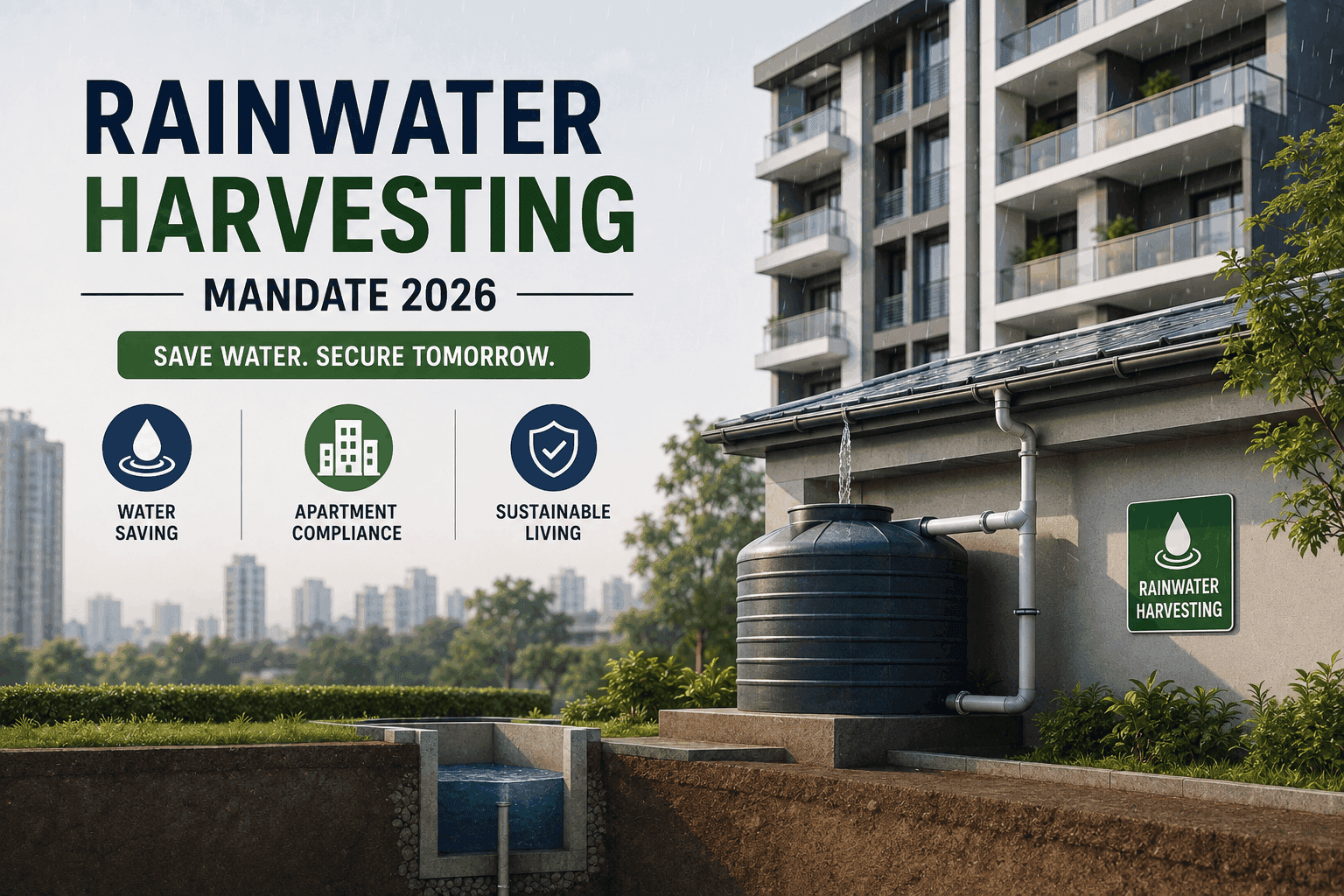
The year 2026 is shaping up to be a watershed moment for Gujarat's real estate sector. And no, that isn't just a pun. The Rainwater Harvesting Mandate in Apartments: City-Wise Rules 2026 is not a suggestion anymore—it’s the law. If you are planning to buy a flat in Ahmedabad, Surat, Vadodara, or Rajkot, you need to understand this. Because here is the thing: failing to comply could delay your possession or even invite penalties.
I have been covering Gujarat real estate for over 15 years. And in my experience, most buyers focus on the price per square foot, the location, and the builder's reputation. But what many overlook is the growing web of environmental compliance. The truth is, the Gujarat government, through its urban development authorities and RERA, is tightening the screws on water conservation. This is not just about saving the planet—it is about saving your hard-earned money.
Look, water scarcity is real. From the parched summers in Rajkot to the groundwater depletion in Ahmedabad's western suburbs, every city has its own crisis. The new rules, effective from January 1, 2026, mandate that every apartment complex with a plot area of 300 square meters or more must install a working rainwater harvesting system. But here is the kicker: the rules vary from city to city.
So, what does this mean for you? Let’s break it down city by city.
Why the 2026 Rainwater Harvesting Mandate Matters for Homebuyers
Let me be blunt. If you are buying a flat in a newly launched project, the builder has to include rainwater harvesting in the plan. This is not optional. The Ahmedabad Urban Development Authority (AUDA) and the Gujarat Pollution Control Board have made it a mandatory condition for obtaining the Commencement Certificate and the Occupancy Certificate.
But here is the real question: what about resale flats? If you are buying a ready-to-move-in apartment in, say, Bopal or Gota, you need to check if the society has already installed the system. If not, the society is legally bound to do it within six months of the rule coming into effect. Otherwise, the Ahmedabad Municipal Corporation (AMC) can impose a fine of up to Rs 5,000 per month. And that cost eventually falls on you, the owner.
I recall a case from 2024. A buyer named Ramesh bought a flat in a well-known society on SG Highway. He paid Rs 65 lakhs for a 2-BHK. Six months after moving in, the society passed a resolution to install a rainwater harvesting system. Each owner had to shell out Rs 12,000. Ramesh was furious because no one told him about this during the purchase. So, my advice? Always ask the seller for the society's compliance certificate.
City-Wise Rules 2026 for Rainwater Harvesting in Apartments
Ahmedabad: The Pioneer of Compliance
Ahmedabad is leading the charge. The AMC has mandated that all new apartment projects with a plot area of 300 sqm or more must have a rainwater harvesting system designed by a certified engineer. The system should capture at least 50% of the rooftop runoff. For existing societies, a joint inspection by the AMC and the Gujarat Water Supply and Sewerage Board (GWSSB) will be conducted.
In my view, the rules are strict but fair. For example, if your society is in Satellite or Vastrapur, the groundwater recharge requirement is higher because these areas have seen a rapid drop in water tables. The cost of installation ranges from Rs 1.5 lakhs to Rs 3 lakhs for a typical 50-unit apartment. But here is the good news: the AMC offers a 10% subsidy on the installation cost for societies that complete the work within the first year.
But what does this mean for property values? In my experience, apartments in societies with functional rainwater harvesting systems command a 5-7% premium in resale. Buyers are willing to pay more for lower maintenance costs and environmental compliance. Take the example of a project on Sindhu Bhavan Road. A 3-BHK there with a certified system sold for Rs 1.2 crores, while a similar flat without it in the same locality was listed at Rs 1.1 crores.
Surat: The Diamond City's Dual Challenge
Surat faces a unique problem: high groundwater salinity and rapid urbanisation. The Surat Municipal Corporation (SMC) has introduced a tiered system. For apartments in areas like Vesu and Adajan, where the water table is relatively good, the mandate requires a simple rooftop collection and filtration system. But for projects in Piplod and Althan, where salinity is high, the system must include a desalination pre-treatment unit.
This increases the cost. A standard system in Surat costs around Rs 2-2.5 lakhs. But with the pre-treatment unit, it can go up to Rs 4 lakhs. However, the SMC has partnered with local NGOs to provide technical assistance. I personally recommend that homebuyers in Surat check the 'Rainwater Harvesting Compliance' status on the SMC's online portal before signing the agreement. It is a simple step that can save you from future disputes.
Vadodara: The Cultural Capital Gets Technical
Vadodara's rules are more about innovation. The Vadodara Municipal Corporation (VMC) has mandated that all new apartments with a built-up area of 1,000 sqm or more must install a 'smart' rainwater harvesting system. This includes sensors to monitor water quality and automated diversion valves.
For buyers in Alkapuri or Akota, this is a boon. The system can be integrated with the building's fire-fighting water storage. In my opinion, this is the most forward-thinking rule in Gujarat. The cost is higher—around Rs 3-5 lakhs—but the long-term savings on water bills are substantial. A society in Sama saved Rs 1.2 lakhs annually on water tanker costs after installation.
Rajkot: The Emerging Hub Gets a Deadline
Rajkot is growing fast, especially along Kalawad Road and the 150 Feet Ring Road. The Rajkot Municipal Corporation (RMC) has given a deadline of December 31, 2026, for all existing societies to comply. New projects must have the system approved at the plan stage itself.
The RMC rules are simpler. They require a recharge pit of at least 3 meters depth for every 100 sqm of rooftop area. The cost is lower—around Rs 1-1.5 lakhs for a standard apartment complex. But enforcement is strict. I have seen cases where builders were asked to redo the entire system because the pit was not deep enough.
Gandhinagar: The GIFT City Exception
Gandhinagar, being the capital and home to GIFT City, has the most stringent rules. The Gandhinagar Urban Development Authority (GUDA) requires that rainwater harvesting systems be connected to the city's greywater recycling network. This is not just for apartments but for all commercial and residential buildings.
For buyers in Infocity or Sector 16, this means a higher upfront cost—around Rs 5 lakhs—but also a lower monthly water bill. In fact, some projects in GIFT City have achieved 'net-zero water' status, which is a huge selling point. If you are an investor, look for projects that advertise this. They tend to attract premium tenants.
Legal and RERA Implications of Non-Compliance
Here is the hard truth: if your builder or society does not comply with the Rainwater Harvesting Mandate in Apartments: City-Wise Rules 2026, you cannot get the Occupancy Certificate. And without the OC, you cannot legally occupy the flat. RERA Gujarat has also made it mandatory for builders to disclose the rainwater harvesting system details in the project's RERA registration.
RERA Tip: Before you pay the booking amount, ask the builder for the RERA registration number. Then, visit the RERA Gujarat website and check the 'Environmental Compliance' section. If it is blank, walk away. I have seen too many buyers get stuck because the builder skipped this step.
Practical Actionable Tip for Today
Do not wait for the society to act. If you are living in an apartment complex, take the initiative. Call a meeting of the managing committee. Get a quote from a certified installer. In Ahmedabad, companies like 'AquaSave Solutions' and 'GreenBuild Gujarat' offer free site inspections. The cost is recoverable within 2-3 years through reduced water bills.
Moreover, the Gujarat government has launched a 'Water Smart Society' certification. Societies that achieve this get a 5% rebate on property tax for three years. That is a direct saving for you.
Key Takeaways
- The Rainwater Harvesting Mandate in Apartments: City-Wise Rules 2026 applies to all new projects and existing societies with plot area ≥300 sqm.
- Costs vary: Ahmedabad (Rs 1.5-3 lakhs), Surat (Rs 2-4 lakhs), Vadodara (Rs 3-5 lakhs), Rajkot (Rs 1-1.5 lakhs), Gandhinagar (Rs 5 lakhs+).
- Non-compliance can delay possession and attract fines up to Rs 5,000 per month.
- Check RERA compliance before buying—it is your legal shield.
- Societies with working systems see 5-7% higher property values.
- Government subsidies and tax rebates are available—do not miss them.
Conclusion
The Rainwater Harvesting Mandate in Apartments: City-Wise Rules 2026 is not just a bureaucratic hurdle. It is an opportunity. An opportunity to save money, increase your property's value, and contribute to a sustainable Gujarat.
So, what should you do today? If you are buying, make compliance a non-negotiable part of your checklist. If you own, push your society to act. And if you are a builder, integrate it into your design from day one.
Gujarat's water future depends on all of us. And your apartment can be part of the solution.
*Have questions about specific city rules? Drop a comment below or reach out to me directly. I have helped hundreds of buyers navigate this, and I can help you too.*