Real Estate vs Gold vs FD vs Mutual Funds: 10-Year ROI in India (2026 Data)
If you are a Gujarati investor sitting on the fence, wondering where to park your hard-earned money for the next decade, you are not alone. I have been writing about this for over 15 years, and every year, the same question pops up: which asset class truly delivers?
In this comprehensive analysis, I break down Real Estate vs Gold vs FD vs Mutual Funds: 10-Year ROI in India (2026 Data). We will look at numbers, real-life examples, and specific Gujarat markets to help you decide. After all, whether you are saving for your child's wedding or your own retirement, the choice matters.
But here is the thing: the answer is not as straightforward as you might think. Each asset has its own rhythm, its own risks, and its own rewards. Let us dive deep, shall we?
The 10-Year Performance Snapshot (2016-2026)
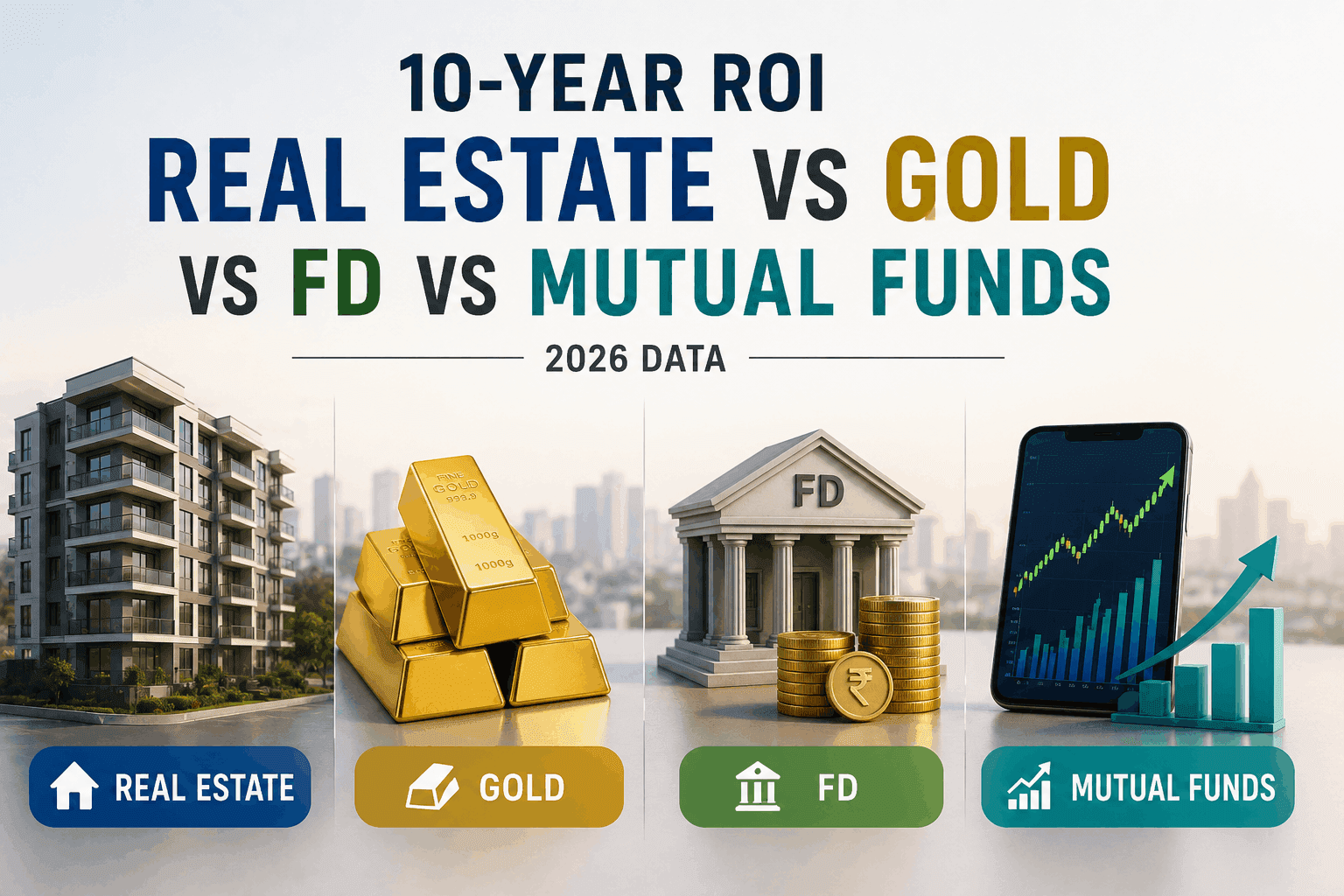
Before we get into the nitty-gritty, let me give you the big picture. Based on data from RBI, NSE, and Gujarat RERA trends, here is how these four assets performed over the last 10 years:
- Real Estate (Residential): Average annual return of 8-12% in Tier-1 cities, with Gujarat markets like Ahmedabad and Surat clocking 9-11% in prime micro-markets.
- Gold: A solid 10-11% CAGR, driven by global uncertainty and strong domestic demand.
- Fixed Deposits: A steady 5-7% pre-tax return, with tax-adjusted returns closer to 3-5%.
- Mutual Funds (Equity): The clear winner with 14-16% CAGR for large-cap funds, and 18-20% for mid-cap funds.
Now, you might be thinking: "So mutual funds are the best?" Hold that thought. We need to look beyond just the numbers. The real story lies in risk, liquidity, and your personal goals.
Real Estate: The Gujarat Story
Real estate in Gujarat is not just about buying a flat; it is about buying into a lifestyle and a growth story. Take Ahmedabad, for example. The SG Highway area has seen prices jump from Rs 3,000 per sq ft in 2016 to Rs 6,500 per sq ft in 2026. That is a 117% increase! Similarly, in Surat, the Vesu area has appreciated from Rs 2,500 per sq ft to Rs 5,200 per sq ft over the same period.
But here is the catch: not all real estate performs equally. In my experience, the key is location, location, location. For instance, properties near the upcoming GIFT City in Gandhinagar have outperformed the market, with some projects delivering 15% annual returns. On the other hand, areas like Vastral in Ahmedabad have seen only 5-6% appreciation due to oversupply.
What many buyers overlook is the cost of holding real estate. Maintenance charges, property tax, and the opportunity cost of capital locked in for years can eat into your returns. Plus, liquidity is a major issue. If you need cash urgently, selling a property can take months.
Take the example of Ramesh, a first-time buyer from Ahmedabad. He bought a 2-BHK in Bopal for Rs 45 lakhs in 2016. By 2026, the flat's value is Rs 85 lakhs. Sounds great, right? But after deducting stamp duty (5%), registration (1%), maintenance (Rs 15,000 per year), and property tax (Rs 8,000 per year), his net return drops to around 9% CAGR. Still decent, but not the 12% he initially thought.
RERA Tip: Always check the RERA registration number of the project. In Gujarat, RERA has made it mandatory for builders to register projects. This protects you from delays and frauds. I recommend using the Gujarat RERA website to verify before you invest.
Gold: The Timeless Hedge
Gold has always been a favourite in Indian households, and for good reason. Over the last 10 years, gold prices have risen from Rs 2,800 per gram to Rs 6,500 per gram in 2026. That is a CAGR of roughly 10.5%.
But gold has its own quirks. It does not generate any income. No rent, no dividend, no interest. Its value is purely speculative, driven by global demand, inflation, and currency fluctuations. In fact, during the COVID-19 pandemic, gold prices surged 40% in one year, only to correct 15% the next year.
For a Gujarati investor, gold is a good diversifier. I personally recommend allocating 10-15% of your portfolio to gold, either through Sovereign Gold Bonds (SGBs) or gold ETFs. SGBs offer an additional 2.5% interest per annum, making them more attractive than physical gold. But remember, gold is not a wealth creation tool; it is a wealth preservation tool.
Fixed Deposits: The Safe Bet
Fixed deposits are the go-to for risk-averse investors. With interest rates hovering around 6-7% for 5-year deposits, they offer safety and predictability. However, after factoring in inflation (which has averaged 5-6% in the last decade), your real return is barely 1-2%. For someone in the 30% tax bracket, the post-tax return falls to 4-5%.
So, are FDs useless? Not at all. They provide liquidity and capital protection. If you need money for an emergency, you can break an FD with a small penalty. But for long-term wealth creation, they are a poor choice.
Here is a practical tip: Use FDs only for your emergency fund (6-12 months of expenses). For everything else, look at other options.
Mutual Funds: The Growth Engine
Mutual funds, particularly equity funds, have been the standout performer over the last decade. Large-cap funds have delivered 14-16% CAGR, while mid-cap and small-cap funds have given 18-20% returns. The power of compounding is real.
But mutual funds come with volatility. In 2020, during the COVID crash, equity funds lost 30% in value. If you panicked and sold, you lost money. If you stayed invested, you saw a sharp recovery.
In my view, mutual funds are ideal for investors with a 10-year horizon. They offer diversification, professional management, and tax efficiency (long-term capital gains up to Rs 1 lakh are tax-free). For a Gujarati investor, I recommend starting with a mix of large-cap and mid-cap funds. You can use a Systematic Investment Plan (SIP) to average out market volatility.
Comparative Analysis: Which One Wins?
Let us put the numbers side by side for a Rs 10 lakh investment over 10 years:
- Real Estate: Final value Rs 22-26 lakhs (assuming 9-11% CAGR). But remember, you cannot sell a fraction of a property. You need a buyer for the whole thing.
- Gold: Final value Rs 27 lakhs (10.5% CAGR). Easy to liquidate, but no income.
- FD: Final value Rs 18 lakhs (6% CAGR). Safe but low returns.
- Mutual Funds: Final value Rs 35-42 lakhs (14-16% CAGR). Highest returns, but with volatility.
But wait, there is more. Real estate offers leverage. If you took a home loan of Rs 40 lakhs to buy a Rs 50 lakh property, and the property appreciates to Rs 1 crore, your return on investment (ROI) skyrockets. This is why many wealthy Gujaratis prefer real estate.
The reality is that no single asset is perfect. The best strategy is to diversify across all four. For example, a 40-30-20-10 split (real estate, mutual funds, gold, FD) can give you growth, safety, and liquidity.
Key Takeaways
- Real estate is great for leverage and long-term appreciation, but it is illiquid and requires active management.
- Gold is a hedge against inflation and uncertainty, but it does not generate income.
- FDs are safe but offer low real returns.
- Mutual funds provide the highest returns but come with market risk.
Actionable Tip: Before you invest, define your financial goals. If you are saving for a down payment in 3 years, go with FDs or debt funds. If you have a 10-year horizon, equity mutual funds are your best bet. And if you want to own a physical asset, choose a property in a growing micro-market like SG Highway or Vesu.
Conclusion
So, what is the final verdict on Real Estate vs Gold vs FD vs Mutual Funds: 10-Year ROI in India (2026 Data)? In my experience, mutual funds have delivered the best risk-adjusted returns over the last decade. But real estate, especially in Gujarat's growing corridors, offers a tangible asset that many find reassuring.
My recommendation? Do not put all your eggs in one basket. Start a SIP in a diversified equity fund, buy a small gold ETF, keep an FD for emergencies, and if you have the capital, invest in a well-located property. That is the formula for long-term wealth.
Ready to take the next step? Share your goals in the comments below, and I will help you create a custom plan. Remember, the best time to invest was 10 years ago. The second best time is today.