
Introduction
Are you torn between putting your money into a REIT or buying a physical flat in Ahmedabad's SG Highway? You are not alone. Every week, I speak with investors who are confused about the right path. The truth is, both options have their merits. But here is the thing: the game has changed in 2026. With RERA tightening norms and the rise of fractional ownership, the choice is no longer simple. In this post, I will break down the REITs vs Direct Real Estate Investment in India 2026: Returns Compared so you can make an informed decision.
What Are REITs and Why Do They Matter in 2026?
REITs (Real Estate Investment Trusts) are essentially mutual funds for real estate. You buy units in a trust that owns income-generating properties like office buildings, malls, or warehouses. In India, we have four major listed REITs: Embassy Office Parks, Mindspace Business Parks, Brookfield India, and Nexus Select Malls. In 2026, these are more accessible than ever. You can start with as little as Rs 10,000-15,000. Imagine that – you can own a slice of a premium commercial property in Bengaluru or Mumbai without needing crores.
But what does this mean for you? For starters, liquidity is a huge advantage. You can buy and sell REIT units on the stock exchange like any other share. No waiting months for a buyer. No stamp duty. No endless paperwork. In my experience, this is a game-changer for smaller investors.
Direct Real Estate Investment: The Traditional Route
On the other hand, direct real estate investment means buying a physical property – a flat in Vastral, Ahmedabad, or a villa in Vesu, Surat. This is the classic Indian dream. You get a tangible asset, a sense of ownership, and the potential for capital appreciation. In 2026, prices in prime Gujarat areas have seen steady growth. For example, a 2-BHK in Bopal, Ahmedabad, now costs Rs 75-90 lakhs, up from Rs 60-70 lakhs in 2022. Similarly, in Surat's Adajan, a 3-BHK can set you back by Rs 1.2-1.5 crores.
However, here is the catch: direct investment is illiquid. You cannot sell a flat overnight. Plus, you have maintenance costs, property tax, and the headache of dealing with tenants. Take Ramesh, a client from Vadodara. He bought a flat in Gotri in 2020 for Rs 50 lakhs. He spent Rs 5 lakhs on interiors and Rs 2 lakhs on registration. Now, in 2026, he is struggling to find a buyer at Rs 65 lakhs. His net returns? Barely 5% per annum. Compare that to REITs, which have historically delivered 8-12% annual returns through dividends and price appreciation.
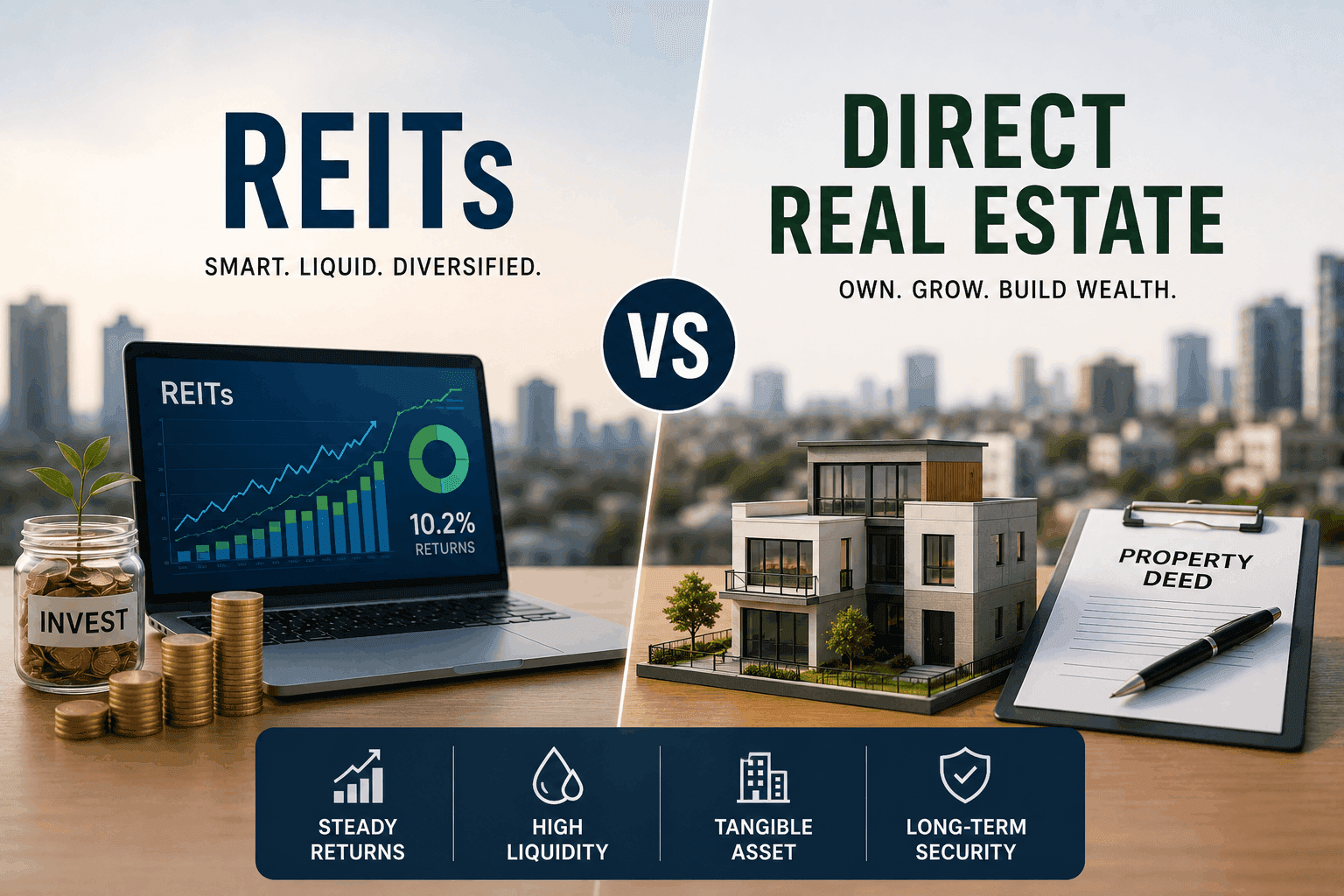
REITs vs Direct Real Estate Investment in India 2026: Returns Compared
Let us get into the numbers because that is what matters. The focus keyphrase here is REITs vs Direct Real Estate Investment in India 2026: Returns Compared. I will give you a realistic picture.
Returns from REITs
In 2026, listed REITs in India are yielding around 6-8% in dividends annually. Add to that capital appreciation of 3-5% from NAV growth. So, total returns are roughly 9-13% per year. For example, Embassy Office Parks has delivered a total return of 12% CAGR over the last five years. Mindspace has done 10% CAGR. These are consistent, tax-efficient returns. Dividends from REITs are taxed as per your income slab, but capital gains are lower (10% for long-term).
Returns from Direct Real Estate
Direct property returns are trickier to calculate. Rental yields in India are notoriously low – typically 2-4% in cities like Ahmedabad and Surat. For instance, a flat worth Rs 1 crore in Satellite might fetch Rs 25,000-30,000 per month in rent. That is a 3% yield. Capital appreciation depends on location. In high-growth areas like GIFT City, Gandhinagar, prices have risen 15% annually over the last three years. But in established areas like Alkapuri, Vadodara, growth is slower – around 5-7% per year.
Here is the thing: net returns from direct real estate often range from 5-10% per year, but that is before accounting for maintenance, property tax, and vacancy. When you factor those in, the effective return drops to 3-7%. In my view, REITs offer a more predictable and hassle-free return profile.
Liquidity and Entry Barriers: A Key Difference
One of the biggest differences between REITs and direct real estate is liquidity. REITs are as liquid as stocks. You can sell your units in minutes. Direct real estate? It can take months, even years, to find a buyer. This is especially true in Gujarat's secondary markets like Rajkot or Gandhinagar where demand is more seasonal.
Entry barriers also matter. To buy a decent flat in Ahmedabad's Shela, you need at least Rs 50-60 lakhs. For a REIT, you can start with Rs 10,000. That is democratization of real estate investment. In 2026, I personally recommend REITs for young professionals in their 20s and 30s who want real estate exposure without the burden of a home loan.
Tax Implications: What You Need to Know
Tax is where many investors slip up. Let me break it down simply.
REIT Taxation
- Dividends: Taxed as per your income slab (up to 30% for high earners).
- Capital gains: 10% for holding over 3 years (indexation benefit available).
- No stamp duty, no GST.
Direct Real Estate Taxation
- Rental income: Taxed as per your slab (after standard deduction of 30%).
- Capital gains: 20% with indexation for holding over 2 years.
- Stamp duty and registration: 5-7% of property value in Gujarat. That is a huge upfront cost.
Here is a RERA tip: If you buy a property from a developer, ensure it is RERA-registered. In Gujarat, RERA has made it mandatory. This protects you from delays and fraud. But it does not help with taxes.
Which One Should You Choose in 2026?
There is no one-size-fits-all answer. But I can give you a practical framework.
Choose REITs if:
- You want passive income with minimal effort.
- You have limited capital (under Rs 20 lakhs).
- You need liquidity.
- You are okay with market volatility.
Choose Direct Real Estate if:
- You want to live in or use the property.
- You have a long-term horizon (10+ years).
- You can handle maintenance and tenant issues.
- You want leverage through a home loan.
Key Takeaways
- REITs offer 9-13% returns with high liquidity and low entry cost.
- Direct real estate gives 3-7% net returns but with tangible ownership.
- In 2026, REITs are better for smaller investors; direct property suits those with capital and patience.
- Always factor in taxes, maintenance, and liquidity when comparing.
- For Gujarat investors, consider REITs for diversification and direct property for prime locations like GIFT City or Vesu.
Conclusion
The debate of REITs vs Direct Real Estate Investment in India 2026: Returns Compared is not about which is superior. It is about what fits your goals. I have seen too many investors buy a flat in a mediocre location just because they wanted to own something. That often leads to regret. On the other hand, REITs are not flashy – you do not get to show off a property card. But they work quietly.
My advice? Start with a small REIT investment to get exposure. Then, when you have enough capital, buy a direct property in a high-growth area like GIFT City or Surat's Vesu. That way, you get the best of both worlds. What do you think? Are you ready to make your move?