
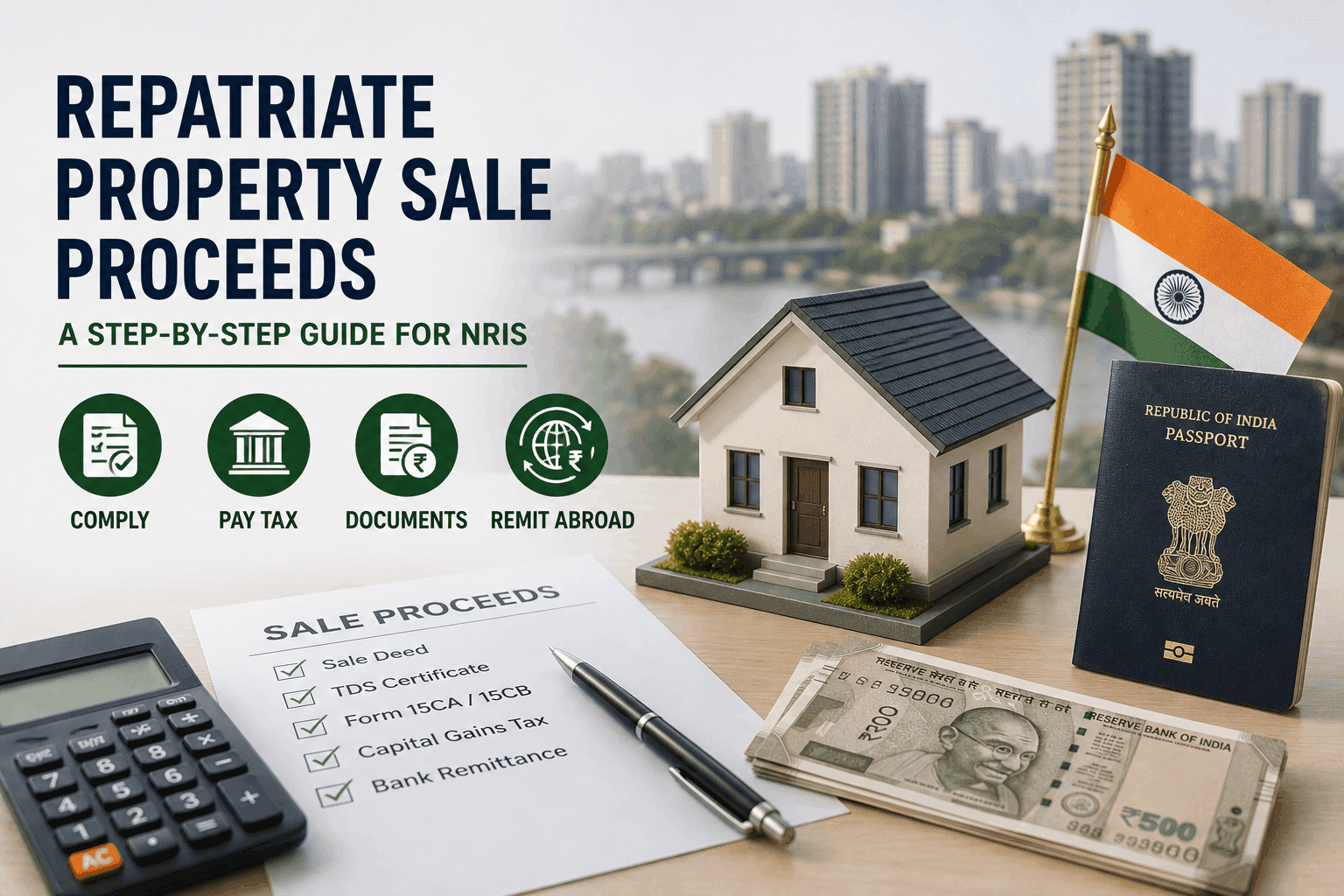
Selling a property in Gujarat is one thing. Getting the money back to your overseas bank account? That is a whole different ball game. I have seen too many NRIs from Ahmedabad, Surat, and Vadodara celebrate a successful sale, only to hit a wall when they try to repatriate the funds. The rules are strict, the paperwork is intimidating, and one wrong step can freeze the entire amount. But here is the good news: with the right plan, you can move your money legally, smoothly, and without unnecessary delays.
In this guide, I will walk you through every step of repatriating property sale proceeds from Gujarat. Whether you sold a flat in SG Highway or a bungalow in Vesu, these rules apply. Let us get your money home.
Understanding Repatriation Rules for NRIs: What You Must Know First
Before you even list your property, understand the legal framework. The Foreign Exchange Management Act (FEMA) governs how NRIs can move money out of India. For property sale proceeds, the key rule is this: you can repatriate up to USD 1 million per financial year, provided the property was acquired in compliance with FEMA.
But here is the catch: if you bought the property using funds from outside India (like NRE or FCNR accounts), you can repatriate the full sale amount. If you used local funds (like NRO accounts), only the amount equivalent to the original purchase price can be repatriated. The remaining profit must stay in an NRO account or be reinvested.
What Counts as a Qualifying Property?
In my experience, the most common mistake NRIs make is assuming all properties qualify. Only residential or commercial properties purchased with foreign funds are fully repatriable. Agricultural land, farmhouses, and plantation properties? Nope. You cannot repatriate proceeds from those at all.
Take Ramesh, a client from Surat who sold his flat in Althan. He had bought it in 2010 using his NRE account. He assumed he could take all the money out. But the bank asked for proof of original funding. He had lost the old statements. It took him three months to get duplicates. Do not be Ramesh.
Step 1: Get Your Paperwork Ready – The NRI Checklist
This is where most delays happen. You need documents that prove (a) you are an NRI, (b) you bought the property legally, and (c) you paid the right taxes. Here is your checklist:
- Passport and visa/OCI card – to prove NRI status
- Sale deed and purchase deed – original or certified copies
- Bank statements – showing the source of funds for the original purchase (NRE/FCNR statements are gold)
- Form 15CA and 15CB – these are mandatory for any remittance above Rs 5 lakhs. Form 15CA is self-declaration; Form 15CB is from a chartered accountant certifying tax compliance
- TDS certificates – Form 16B from the buyer showing TDS deduction (1% for property above Rs 50 lakhs, 20% if PAN not provided)
- Capital gains tax computation – you need to pay tax on the profit. Indexation benefit applies for long-term holdings (over 24 months)
A Practical Tip You Can Use Today
Right now, before you even talk to a buyer, open an NRO account if you do not already have one. The sale proceeds must first come into an NRO account. From there, you can initiate repatriation. Many NRIs skip this and then scramble. Do not be that person.
Step 2: The Sale Process – Ensuring Compliance at Every Stage
When you sell, the buyer will deduct TDS. For properties worth Rs 50 lakhs and above, the TDS rate is 1% if you provide PAN. If you do not, it jumps to 20%. Yes, you read that right. 20%.
I personally recommend you ensure the buyer deposits the TDS with the Income Tax Department and gives you the TDS certificate (Form 16B) within 15 days of deduction. Without this, you cannot file your tax return or get the clearance for repatriation.
What About Capital Gains Tax?
Here is the thing: you are liable to pay capital gains tax in India on the profit. For NRIs, the rate is 20% with indexation for long-term holdings. But you can also reinvest the gains in another residential property in India (under Section 54) or in specified bonds (Section 54EC) to save tax. Many Gujarati NRIs reinvest in properties in GIFT City or along the upcoming metro routes in Ahmedabad. Smart move.
Step 3: Filing Taxes – Get Your CA Involved Early
Do not wait until the last minute. Hire a chartered accountant who specializes in NRI taxation. In Gujarat, I have seen many CAs in Ahmedabad’s Navrangpura and Surat’s City Light area who handle this daily. They will prepare the capital gains computation, file your ITR, and issue the Form 15CB.
Key Tax Dates for NRIs
- ITR filing deadline – July 31 for the previous financial year
- TDS credit – ensure the buyer’s TDS reflects in your Form 26AS
- Form 15CA/15CB – must be filed online before each remittance
Step 4: The Remittance Process – Moving Money from NRO to Overseas Account
Once the sale is complete, the money sits in your NRO account. Now you want to move it. Here is the step-by-step process:
1. Visit your bank branch (or use online banking if supported) – most public sector banks in Gujarat, like Bank of Baroda or SBI, have dedicated NRI desks
2. Submit Form 15CA and 15CB – your CA will have these ready
3. Provide the sale deed and TDS certificates – the bank needs proof of the transaction
4. Fill the remittance application – specify the amount and overseas account details
5. Wait for approval – typically 3-7 working days. The bank will verify everything with the RBI portal
What If the Amount Exceeds USD 1 Million?
You can repatriate up to USD 1 million per financial year from all NRO accounts combined. If your sale proceeds exceed this, you have two options: (a) wait for the next financial year to send the remaining amount, or (b) keep the funds in India and use them for future investments.
In my view, option (a) is simpler. Just plan your remittances across two years. Many NRIs from Vadodara’s Alkapuri area do this when selling high-value properties.
Common Mistakes NRIs Make – And How to Avoid Them
Over the years, I have seen the same errors again and again. Here are the top three:
- Not maintaining original purchase documents – without proof of foreign funds, you cannot repatriate the full amount. Keep everything in a digital and physical file.
- Ignoring the 1% TDS rule – some buyers forget to deduct TDS, or they deduct it late. This delays your entire process. Insist on getting Form 16B.
- Using a local unregistered broker – they often give wrong advice on repatriation. Always work with a RERA-registered agent. In Gujarat, you can check RERA registration on the Gujarat RERA website.
A Real Example from Gota, Ahmedabad
A client of mine, Priya, sold her flat in Gota for Rs 65 lakhs. She had bought it for Rs 40 lakhs using her NRE account. She wanted to repatriate the entire Rs 65 lakhs. But the bank asked for proof that the original Rs 40 lakhs came from abroad. She had only a handwritten receipt from the builder. It took her two months to get a certified copy from the builder’s office. Meanwhile, the exchange rate moved against her. She lost about Rs 2 lakhs in the delay. Do not let this happen to you.
Key Takeaways for Gujarati NRIs
- Start the paperwork before you list the property
- Open an NRO account if you do not have one
- Ensure the buyer deducts TDS and gives you Form 16B
- Hire a CA with NRI expertise – ask for referrals in your local Gujarati community
- File your ITR on time to avoid penalties
- Plan remittances across financial years if the amount exceeds USD 1 million
- Keep digital copies of all documents – store them on cloud and with a family member in India
Conclusion: Your Money, Your Way – But Follow the Rules
Repatriating property sale proceeds from Gujarat is not rocket science. It is a process. A process that requires patience, documentation, and expert help. But once you have the system in place, it is smooth sailing.
Here is my final advice: treat this like a project. Create a checklist. Assign deadlines. Work with a RERA-registered agent and a qualified CA. And if you are selling in areas like SG Highway, Vesu, or Alkapuri, know that the prices are high, and the stakes are even higher.
Ready to start? Get your documents in order today. Your future self – and your bank balance – will thank you.