
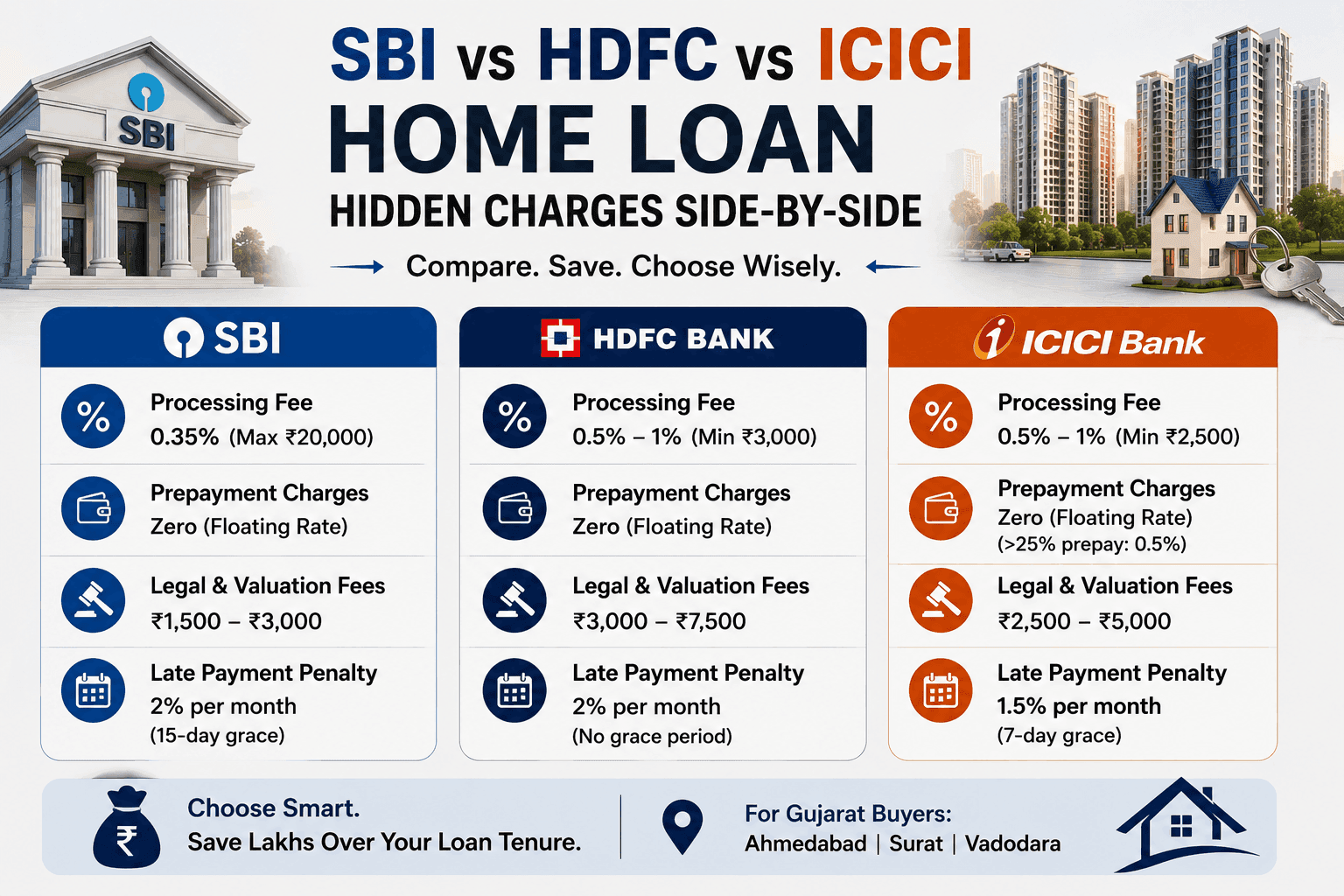
When you are hunting for a home loan, the interest rate usually grabs all the attention. But here is the thing: the real cost of borrowing often hides in the fine print. Processing fees, prepayment penalties, legal charges, and even the cost of a delayed EMI can quietly inflate your total outgo by lakhs over the loan tenure.
Take Ramesh, a first-time buyer from Ahmedabad. He zeroed in on a 30-lakh loan from HDFC because the rate was 8.5%—0.25% lower than SBI. But after factoring in HDFC's higher processing fee and a prepayment charge he didn't notice, his effective cost was actually higher. The truth is, a low rate is meaningless if the hidden charges eat up the savings.
In this post, I break down SBI vs HDFC vs ICICI home loan: hidden charges side-by-side, so you can compare apples to apples. We will look at processing fees, prepayment costs, legal charges, and other surprises that lenders slip into the agreement. By the end, you will know exactly which loan is cheaper for your specific situation—and how to negotiate like a pro.
SBI vs HDFC vs ICICI Home Loan: Hidden Charges Side-by-Side – The Big Picture
Let me give you the bird's-eye view first. All three lenders have similar headline rates—SBI's 8.50% to 9.15%, HDFC's 8.50% to 9.40%, and ICICI's 8.55% to 9.45% as of early 2025. But the devil is in the details.
Here is what I tell my clients: do not just look at the rate. Look at the total cost of borrowing, which includes:
- Processing fees (one-time upfront charge)
- Prepayment and foreclosure charges
- Legal and technical valuation fees
- Late payment penalties
- Administrative charges for document changes
- Insurance or add-on product costs (often bundled)
Now, let us dive into each of these for SBI, HDFC, and ICICI.
Processing Fees: The First Hidden Cost
SBI: SBI charges 0.35% of the loan amount plus GST, with a cap of Rs 10,000 for loans up to Rs 30 lakhs and Rs 20,000 for higher amounts. For a Rs 50-lakh loan, that is about Rs 17,500 plus GST—around Rs 20,650 all included. Not bad, but here is the catch: SBI sometimes waives this fee during festive offers. In my experience, if you apply in Diwali or Navratri, you can get it waived entirely.
HDFC: HDFC's processing fee is 0.5% to 1% of the loan amount, with a minimum of Rs 3,000 and a maximum of Rs 10,000 for standard cases. But for loans above Rs 75 lakhs, it can go up to 0.5% with no cap. For a Rs 50-lakh loan, you are looking at Rs 25,000 to Rs 50,000 plus GST. That is significantly higher than SBI. Moreover, HDFC often charges a separate 'documentation fee' of Rs 1,000 to Rs 2,000.
ICICI: ICICI charges 0.5% to 1% of the loan amount, with a minimum of Rs 2,500 and maximum of Rs 25,000 for most cases. For a Rs 50-lakh loan, that is about Rs 25,000 plus GST. However, ICICI has a nasty trick: they often bundle a 'processing and documentation fee' that includes legal charges, so you end up paying more than the headline number.
Winner: SBI, especially if you time it with a waiver offer.
Prepayment and Foreclosure Charges: The Big One
This is where many borrowers get burned. Prepayment charges apply if you pay off your loan early—either partially or fully—before the tenure ends.
SBI: For floating-rate loans, SBI charges zero prepayment penalty for both partial and full prepayment. This is a huge advantage. Why? Because if rates drop or you get a bonus, you can pay off the loan without any cost. I personally recommend SBI for this reason alone.
HDFC: HDFC also has zero prepayment charges for floating-rate loans. But here is the catch: if you take a fixed-rate loan or a hybrid loan, HDFC charges 2% to 3% of the outstanding amount. Most people take floating rates, so this is fine—but check your loan type.
ICICI: ICICI charges zero prepayment penalty for floating-rate loans as well. However, they have a quirky rule: if you prepay more than 25% of the principal in a year, they may charge 0.5% on the excess amount. This is rare, but it exists. So if you plan to make large lump-sum payments, ICICI is slightly less flexible.
Winner: SBI and HDFC are neck and neck, but SBI's complete absence of any prepayment charge gives it the edge.
Legal and Technical Valuation Fees
When you apply for a home loan, the bank sends a lawyer to verify the property title and a technical officer to value the property. Guess who pays? You.
SBI: SBI charges a flat Rs 1,500 to Rs 3,000 for legal and technical valuation, depending on the property location. For a flat in Shela, Ahmedabad, you might pay Rs 2,000. For a bungalow in Alkapuri, Vadodara, it could be Rs 3,500. This is one of the lowest in the industry.
HDFC: HDFC charges Rs 3,000 to Rs 7,500 for legal and valuation fees, plus GST. For a property in Vesu, Surat, expect Rs 5,000. Moreover, they often insist on a 'technical report' from their empanelled architect, which can cost extra.
ICICI: ICICI charges Rs 2,500 to Rs 5,000 for legal and valuation. However, they have a hidden charge: if the property is in a new development or under-construction project, they may require a 'structural audit' costing Rs 5,000 to Rs 10,000. This is common for projects on SG Highway or Bopal.
Winner: SBI, by a clear margin.
Late Payment Penalties
Life happens. You might miss a month's EMI. What do these banks charge?
SBI: SBI charges 2% per month on the overdue amount, which works out to 24% per annum. That is steep. But they give you a 15-day grace period before levying the penalty.
HDFC: HDFC charges 2% per month on the overdue amount, with no grace period. Yes, you read that right. If your EMI is due on the 5th and you pay on the 6th, you pay a penalty. This is aggressive. I have seen clients in Naroda, Ahmedabad, get hit with Rs 1,000 penalty for a single day's delay.
ICICI: ICICI charges 1.5% per month (18% per annum) on the overdue amount, with a 7-day grace period. This is the most lenient of the three. For a Rs 50-lakh loan, a one-day delay might cost you Rs 200-300 versus HDFC's Rs 800-1,000.
Winner: ICICI, for the lower rate and grace period.
Administrative Charges: The Small Print
These are charges for things like changing the loan tenure, swapping the property, or getting a duplicate statement.
SBI: SBI charges Rs 500 to Rs 1,000 for most administrative changes. For a duplicate loan statement, it is Rs 200. For changing the tenure, it is Rs 500. Reasonable.
HDFC: HDFC charges Rs 1,000 to Rs 2,500 for administrative changes. For a simple change of address, they may charge Rs 500. For a tenure change, Rs 1,500. These add up over time.
ICICI: ICICI charges Rs 750 to Rs 1,500 for most changes. They also charge Rs 300 for a duplicate statement. However, ICICI has a sneaky charge: if you want to switch from a floating to a fixed rate, they charge 0.5% of the outstanding loan amount. That could be Rs 25,000 on a Rs 50-lakh loan.
Winner: SBI, for the lowest fees.
Insurance and Add-On Products
All three banks push home loan insurance or 'loan protection plans' as a condition for approval. But you can refuse.
SBI: SBI offers a 'SBI Life Home Loan Protection Plan' that costs 0.3% to 0.5% of the loan amount per year. For a Rs 50-lakh loan, that is Rs 15,000 to Rs 25,000 annually. They do not force it, but they will ask.
HDFC: HDFC bundles a 'Home Suraksha' plan that costs 0.4% to 0.6% of the loan amount per year. They are more aggressive in selling it. In my experience, if you do not take it, your processing fee may not be waived.
ICICI: ICICI offers a 'ICICI Pru Home Shield' plan at 0.35% to 0.55% of the loan amount. They are less pushy, but they will still try to upsell.
Tip: You do not need to buy the bank's insurance. You can get a term life plan from any insurer at a lower cost. This is a common mistake buyers make.
Hidden Charges Specific to Gujarat Locations
Now, let me get specific. If you are buying a flat in Gota, Ahmedabad (where prices range from Rs 35-55 lakhs for a 2BHK), or a villa in Piplod, Surat (Rs 80 lakhs to Rs 1.5 crores), these charges matter.
SBI: For properties in GIFT City, Gandhinagar, SBI offers a special 'GIFT City Home Loan' with zero processing fee and 0.25% lower rate. But they charge a higher legal fee of Rs 5,000 because of the special economic zone status.
HDFC: For properties in Adajan, Surat, HDFC often charges a 'location premium' of Rs 2,000 to Rs 5,000 in valuation fees because of the high-demand area. This is not disclosed upfront.
ICICI: For properties in Alkapuri, Vadodara, ICICI charges a 'high-value property fee' of 0.1% of the loan amount if the property is valued above Rs 1 crore. That is an extra Rs 10,000 on a Rs 1-crore loan.
RERA Tip: Check the Project's RERA Registration
Before you sign any loan agreement, verify that the project is registered under RERA Gujarat. If it is not, the bank may not approve the loan, or they may charge a higher legal fee for due diligence. For example, many projects in Chandkheda and Vastral, Ahmedabad, are RERA-registered, but some older ones are not. Always ask for the RERA number.
Quick Tips: How to Minimize Hidden Charges
Based on my years of covering this space, here is what I recommend:
- Negotiate the processing fee: Ask for a waiver. SBI and HDFC often waive it during festive seasons. ICICI rarely does.
- Choose a floating rate loan: This ensures zero prepayment penalty across all three.
- Do not buy the bank's insurance: Get a standalone term plan. It is cheaper.
- Ask for a detailed fee breakup: Before you sign, get a written list of all charges. If they refuse, walk away.
- Compare the total cost: Use an online EMI calculator and add all fees to see the real cost.
Key Takeaways
- SBI has the lowest processing fee (0.35% capped at Rs 20,000) and the lowest legal/valuation fees.
- HDFC has higher processing fees (0.5% to 1%) but zero prepayment penalty on floating rates.
- ICICI has the most lenient late payment penalty (1.5% per month) but charges for rate switches.
- For Gujarat buyers, SBI is best for budget homes in Gota, Shela, or Vastral. HDFC works for premium properties in Piplod or Alkapuri. ICICI is good if you expect occasional late payments.
- Always verify RERA registration to avoid extra legal fees.
Conclusion
So, which loan should you choose? The answer depends on your specific situation. If you are a disciplined payer who plans to prepay quickly, SBI is the clear winner. If you need flexibility with late payments, ICICI is better. If you want a premium service and are okay paying a bit more, HDFC works.
But here is the bottom line: do not be like Ramesh. Do not let a 0.25% lower rate blind you to hidden charges that could cost you lakhs. Take this side-by-side comparison, sit down with your lender, and ask for every charge in writing. Your future self will thank you.
Now, go out there and make an informed decision. And if you have questions about a specific locality in Gujarat—be it Kalawad Road in Rajkot or Infocity in Gandhinagar—drop a comment below. I am here to help.