
Introduction: The Capital Gains Dilemma Every Home Buyer Faces
Selling a property can be a bittersweet experience. On one hand, you have a nice lump sum in your bank account. On the other, the taxman is waiting with open arms. But here is the good news: the Income Tax Act gives you two powerful tools to save tax—Section 54 and Section 54F. The question is, Section 54 vs 54F Capital Gains Exemption: Which One Saves You More?
I have seen countless buyers in Ahmedabad, Surat, and Vadodara struggle with this choice. Take Ramesh, a client from Satellite who sold his ancestral flat for Rs 85 lakhs. He was confused—should he buy a new flat under Section 54 or invest in a different property under 54F? The difference in tax saved was nearly Rs 8 lakhs. Let me break it down for you so you don't leave money on the table.
Understanding the Basics: Section 54 vs 54F Capital Gains Exemption
What is Section 54?
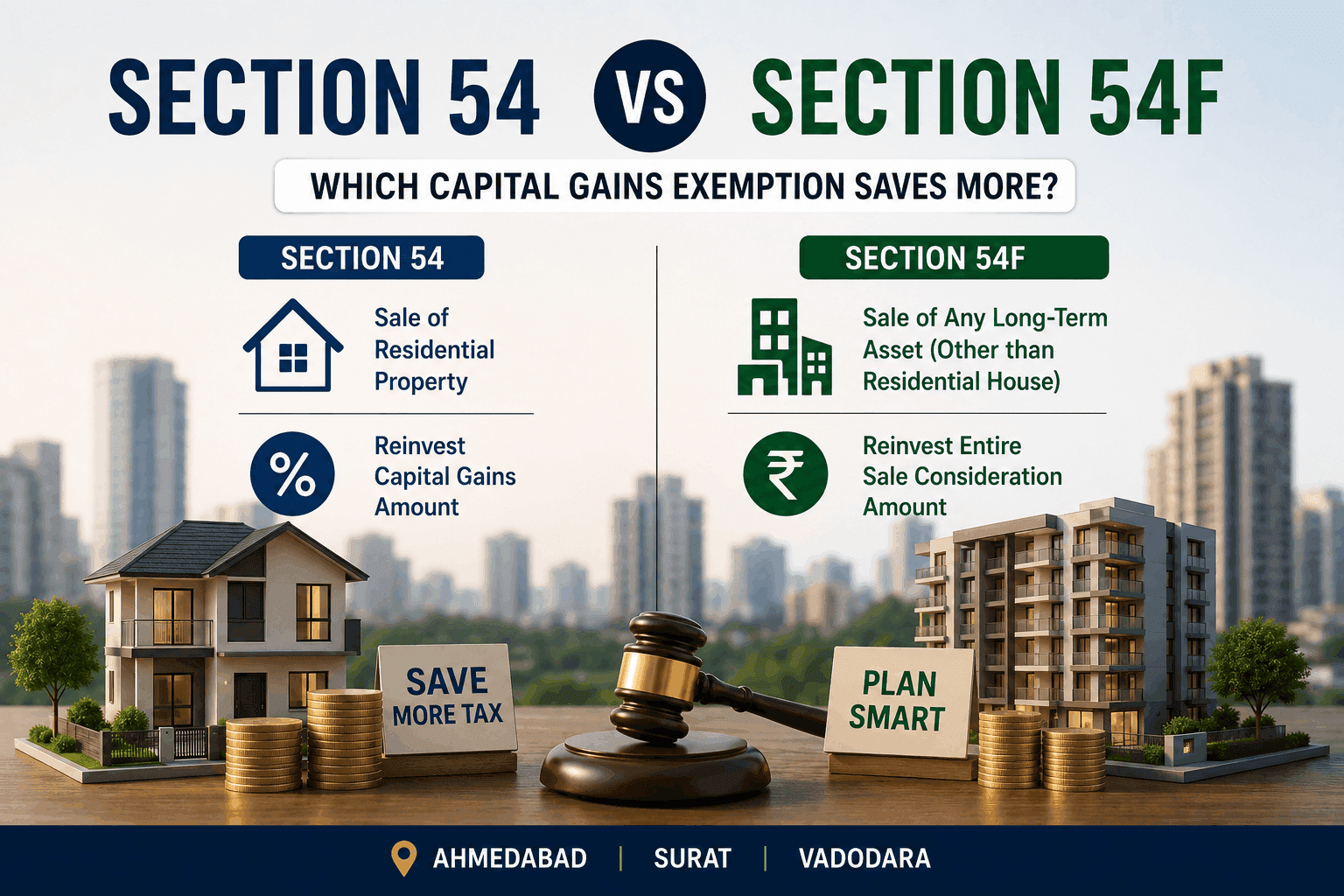
Section 54 applies when you sell a long-term capital asset that is a residential house property. The exemption is available if you reinvest the capital gains (not the entire sale proceeds) into a new residential house. The key point: you must buy the new house within one year before or two years after the sale, or construct it within three years.
What is Section 54F?
Section 54F is broader. It applies when you sell any long-term capital asset (land, commercial property, gold, shares) other than a residential house. To claim exemption, you must invest the entire net sale consideration (not just the gains) into a residential house. This is a critical difference that most people miss.
Which One Saves You More? The Real Numbers
Let me give you a practical comparison. Suppose you sell a residential flat in Bopal, Ahmedabad, for Rs 1.2 crores with a cost of acquisition of Rs 40 lakhs. Your long-term capital gain is Rs 80 lakhs.
Under Section 54: You only need to invest Rs 80 lakhs (the gain) into a new house. The remaining Rs 40 lakhs is tax-free in your pocket.
Under Section 54F: You must invest the entire Rs 1.2 crores into a new residential house. If you invest only Rs 80 lakhs, the exemption is proportionately reduced.
So, which saves more? In most cases, Section 54 is more generous because it only requires reinvestment of gains. But wait—there is a catch. Section 54 is only for sale of residential property. If you are selling a plot, commercial property, or shares, you are stuck with 54F.
Critical Differences You Must Know
1. Type of Asset Sold
- Section 54: Only for residential house property.
- Section 54F: Any long-term capital asset except residential house.
2. Amount to Reinvest
- Section 54: Only the capital gains amount.
- Section 54F: The entire net sale consideration.
3. Ownership of New House
- Section 54: You can own more than one house after purchase.
- Section 54F: You must not own more than one residential house on the date of sale, and you cannot buy another house within one year or construct within three years.
4. Lock-in Period
Both require you to hold the new house for at least three years. Sell earlier, and the exemption is reversed.
Real-Life Example: Ahmedabad vs Surat
Consider a buyer in Surat who sold a commercial shop in Vesu for Rs 2 crores (cost Rs 50 lakhs, gain Rs 1.5 crores). Under Section 54F, he must invest the full Rs 2 crores in a residential flat. He buys a 3-BHK in Adajan for Rs 1.8 crores. His exemption is proportionately reduced: (1.8/2) * 1.5 = Rs 1.35 crores exempt. He pays tax on Rs 15 lakhs gain.
Now, if he had sold a residential flat instead, Section 54 would let him invest only Rs 1.5 crores of gain, buy a flat for Rs 1.5 crores, and save full tax. The difference is significant.
Common Mistakes and How to Avoid Them
Mistake #1: Assuming Section 54F is easier because it applies to any asset. The truth is, the reinvestment requirement is much stricter.
Mistake #2: Not opening a Capital Gains Account Scheme (CGAS) if the new house is under construction. You have to deposit the gains in a PSU bank before the due date of filing ITR. I have seen many buyers in Gandhinagar lose exemption because they missed this step.
Mistake #3: Buying a house in a different name. The new house must be in your name or jointly with your spouse. Buying in your child's name won't work.
RERA and Legal Tip
Here is something most articles won't tell you: Under RERA Gujarat, if you buy an under-construction property, the possession date must be within three years from the sale of old property. If the builder delays beyond three years, you lose the exemption. Always check RERA registration number and possession timeline. For example, projects in Gota or Shela often have delays—be careful.
Key Takeaways
- Section 54 is better if you are selling a residential house—less reinvestment required.
- Section 54F is mandatory for non-residential assets but requires full reinvestment.
- Time limits: 1 year before/2 years after for purchase, 3 years for construction.
- CGAS account is your safety net for under-construction properties.
- Ownership restriction: Under 54F, you cannot own more than one house on sale date.
Practical Actionable Tip
Before you sell any property, calculate your gains and decide which section applies. Then, open a CGAS account immediately. Visit your bank—SBI, HDFC, or Axis—and deposit the gains within the ITR due date. This simple step can save you lakhs in taxes.
Conclusion: Your Next Step
So, Section 54 vs 54F Capital Gains Exemption: Which One Saves You More? The answer depends on what you are selling. For residential property, Section 54 wins hands down. For other assets, 54F is your only option, but it comes with strings attached.
My personal recommendation: Consult a chartered accountant before the sale. The tax saved can be the difference between buying a 2-BHK in Chandkheda or a 3-BHK in Satellite. Don't let confusion cost you.
If you found this helpful, share it with someone planning to sell property. And if you have questions, drop them in the comments—I reply to every one.