Introduction
Living in a housing society in Gujarat comes with its own set of joys and challenges. You pay your maintenance charges every month, trusting the managing committee to use them wisely. But what happens when that trust is broken?
Here is the thing: maintenance fund embezzlement is more common than you think. From a small society in Vastral, Ahmedabad, to a high-end complex on SG Highway, I have seen cases where committee members siphoned off lakhs of rupees. The victims? Ordinary residents like you and me.
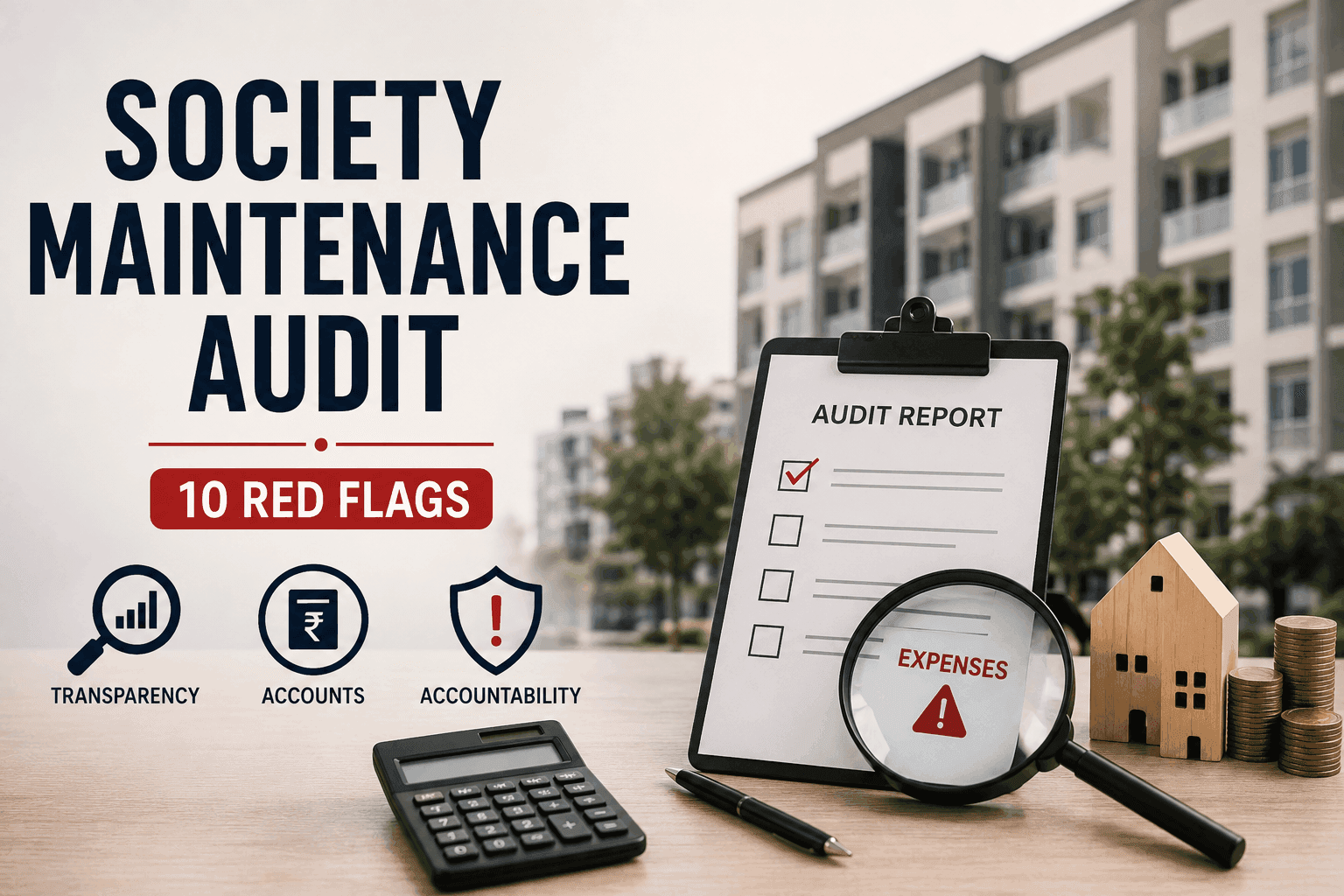
In this post, I will walk you through Society Maintenance Audit: How to Spot Embezzlement (10 Red Flags). These are practical, actionable signs that something is wrong. By the end, you will know exactly what to look for and how to protect your hard-earned money.
Why a Maintenance Audit Matters
Let me be direct: without a proper audit, your society is sitting on a ticking time bomb. Most residents assume the committee is honest. But in reality, even well-intentioned people can slip into bad habits.
Take the case of a 200-flat society in Bopal, Ahmedabad. For three years, the maintenance fund showed a healthy balance. But when a new treasurer took over, he discovered that Rs 15 lakhs had been diverted to a personal account. The culprit? The former secretary, who had been using the money for his son's wedding.
This is not a rare story. In fact, I have personally advised societies in Surat's Vesu area and Vadodara's Alkapuri where similar issues surfaced. The common thread? Lack of transparency.
So, what can you do? Start by understanding the red flags. Let's dive into the 10 warning signs that scream 'embezzlement'.
10 Red Flags You Cannot Ignore
1. Unexplained Increase in Common Area Maintenance Bills
If your society's electricity or water bills suddenly spike by 20-30% without any reason, ask questions. This is often a sign that someone is padding the bills.
In one society on 150 Feet Ring Road, Rajkot, the maintenance charges jumped from Rs 2,500 to Rs 3,200 per month in six months. When residents demanded an audit, they found that the committee was paying 'ghost vendors' for services never rendered.
What to do: Demand itemised bills from the committee. Compare them with previous months. If the increase seems arbitrary, call for a special audit.
2. Missing or Delayed Audit Reports
Every society registered under RERA Gujarat must conduct an annual audit. If your committee is delaying the report or providing a vague summary, that is a major red flag.
I remember a society in Gota, Ahmedabad, where the audit report was 'lost' for two years. When a resident filed an RTI, it turned out the committee had been paying themselves 'honorariums' without approval.
Pro tip: Under RERA, the audit report must be shared with all members within 30 days of completion. If it is not, escalate to the RERA authority.
3. Cash Payments Without Receipts
Most societies now accept maintenance via digital payments like UPI or bank transfer. But if your committee insists on cash, be wary.
In a society in Piplod, Surat, the treasurer collected Rs 50,000 in cash from residents for 'emergency repairs'. When the work was never done, residents discovered the money had been pocketed.
Actionable tip: Insist on a receipt for every payment. Better yet, push for a digital-only collection system.
4. Favouring Certain Contractors
Does your society always hire the same plumber or electrician, even if their rates are higher than the market? This could be a kickback arrangement.
In a society on Kalawad Road, Rajkot, the committee awarded a painting contract worth Rs 8 lakhs to a friend's company. The actual market rate was Rs 5.5 lakhs. The difference? The committee member got a 'commission'.
What to look for: Compare quotes from at least three vendors for any work above Rs 50,000. If the committee resists, that is a red flag.
5. Frequent 'Emergency' Fund Requests
Every society faces emergencies—a broken lift, a leaking roof. But if your committee is asking for emergency contributions every quarter, something is off.
I have seen societies in Chandkheda, Ahmedabad, where the committee raised 'emergency' funds five times in a year. Total collection: Rs 12 lakhs. Actual work done: Rs 3 lakhs.
Rule of thumb: Emergency funds should be used sparingly. If your society has a healthy maintenance reserve, why are they asking for more?
6. Bank Statements That Do Not Match
Your society's bank account should mirror the maintenance collections. If the balance is lower than expected, there is a leak.
In a 300-flat society in Althan, Surat, the bank statement showed a balance of Rs 2.5 lakhs, but the committee claimed they had Rs 8 lakhs in hand. The difference? The secretary had been withdrawing cash for 'petty expenses'.
How to check: Request a copy of the bank statement for the last six months. Cross-check it with the maintenance register. If they refuse, that itself is a red flag.
7. No Regular General Body Meetings
RERA mandates at least one Annual General Meeting (AGM) per year. If your committee is avoiding meetings, they are hiding something.
In a society in Gotri, Vadodara, the committee did not hold an AGM for three years. When residents finally forced one, they discovered that Rs 20 lakhs was missing from the sinking fund.
Your right: As a member, you can demand a special general body meeting if 10% of members sign a petition. Use this power.
8. Reluctance to Share Documents
Transparency is the hallmark of a honest committee. If your committee refuses to share the maintenance register, audit report, or meeting minutes, they have something to hide.
I once advised a society in Shela, Ahmedabad, where the committee locked the records in a cupboard and 'lost' the key. The residents had to file a complaint with the cooperative department to access them.
Legal tip: Under the Gujarat Ownership of Flats Act, residents have the right to inspect all society records. Do not take no for an answer.
9. Disproportionate Salaries for Staff
Security guards and housekeeping staff typically earn between Rs 10,000 and Rs 15,000 per month in Gujarat. If your society's payroll shows salaries of Rs 25,000 for a guard, someone is inflating numbers.
In a society in Akota, Vadodara, the committee was paying Rs 30,000 per month to a 'security supervisor' who was actually the secretary's cousin.
What to check: Ask for the attendance register and cross-check it with the salary slips.
10. Unexplained Loans or Advances
Does your society have a loan on its books? Or has the committee given an 'advance' to a contractor? These are classic embezzlement tactics.
In a society in GIFT City, Gandhinagar, the committee took a Rs 10 lakh loan from a private lender at 18% interest. The money was never used for society work. Instead, it went into a committee member's personal business.
Warning: Any loan or advance should be approved by a general body meeting. If it is not, it is illegal.
How to Conduct a Society Maintenance Audit
Now that you know the red flags, here is a step-by-step guide to conducting an audit.
Step 1: Form a Sub-Committee
Get three to five trusted residents who are not part of the managing committee. This ensures impartiality.
Step 2: Collect All Documents
Request the following:
- Bank statements (last 12 months)
- Maintenance collection register
- Audit reports (last three years)
- Meeting minutes
- Vendor contracts
Step 3: Compare Receipts and Payments
Match the total maintenance collected with the bank deposits. Any discrepancy is a red flag.
Step 4: Verify Major Expenses
For any expense above Rs 50,000, ask for three quotes. If the committee chose the highest one, demand an explanation.
Step 5: Hire a Professional Auditor
If the committee resists, hire a chartered accountant to do a forensic audit. This costs Rs 10,000-20,000 but can save you lakhs.
Legal Recourse in Gujarat
If you find embezzlement, do not stay silent. Here is what you can do:
- File a complaint with RERA Gujarat: For societies registered under RERA, you can file a complaint online. The authority can impose penalties.
- Approach the Cooperative Department: For cooperative housing societies, the District Registrar can intervene.
- Lodge an FIR: Embezzlement is a criminal offence under Section 408 of the IPC. In Gujarat, the police have a special cell for economic offences.
My recommendation: Start with a formal notice to the committee. If they do not cooperate, escalate to RERA. In my experience, most committees settle when they know you are serious.
Key Takeaways
- Always demand transparency. If the committee hides documents, something is wrong.
- Regular audits are non-negotiable. Insist on an annual audit by a certified CA.
- Use digital payments. This leaves a trail that is hard to fake.
- Attend AGMs. Your presence keeps the committee accountable.
- Form a resident welfare association (RWA). This gives you collective bargaining power.
Conclusion
Let me be blunt: embezzlement in housing societies is not a victimless crime. It affects your property value, your peace of mind, and your children's future. But here is the good news—you have the power to stop it.
By watching out for these 10 red flags, you can protect your society from financial fraud. Start today. Talk to your neighbours. Demand a Society Maintenance Audit: How to Spot Embezzlement (10 Red Flags) is not just a checklist—it is your shield.
Remember, a transparent society is a happy society. Do not let a few bad apples ruin it for everyone.
Wondering where to start? Share this post with your society's WhatsApp group. The first step is awareness. The next is action.
If you have faced similar issues in your society in Ahmedabad, Surat, Vadodara, or Rajkot, drop a comment below. I would love to hear your story.