
You are thinking of buying a home in 2026, and the first question that comes to mind is: where will my money go the farthest? The answer often lies in one critical number—stamp duty. In fact, the Stamp Duty in Gujarat vs Maharashtra vs Karnataka: 2026 Comparison is a conversation I have with clients almost every week. The difference between paying 4% and 7% on a Rs 1 crore property is a staggering Rs 3 lakhs. That is a fully furnished kitchen, or maybe a down payment for a car. So, let us break it down, state by state, with real numbers, real localities, and a dose of practical advice.
Why Stamp Duty Matters More Than You Think
Here is the thing: most buyers obsess over the property price, but stamp duty is the silent killer of budgets. In Gujarat, Maharashtra, and Karnataka, the rates vary not just by state but also by gender, property type, and even the city within the state. For instance, in Gujarat, a woman buying a flat in Ahmedabad's SG Highway pays just 4% stamp duty, while a man pays 4.9%. That is a difference of Rs 90,000 on a Rs 1 crore flat.
But what about Maharashtra? In Mumbai, the stamp duty is a flat 5% for men and 4% for women, plus a 1% metro cess. So on a Rs 1.5 crore flat in Thane, you are looking at 6% total. Karnataka, on the other hand, has a uniform 5% for men and 4% for women, but no additional cess. So which one wins? Let me tell you, it is not always the lowest rate—it is the total cost including registration, cess, and legal fees.
The Gujarat Advantage: Low Rates, High Value
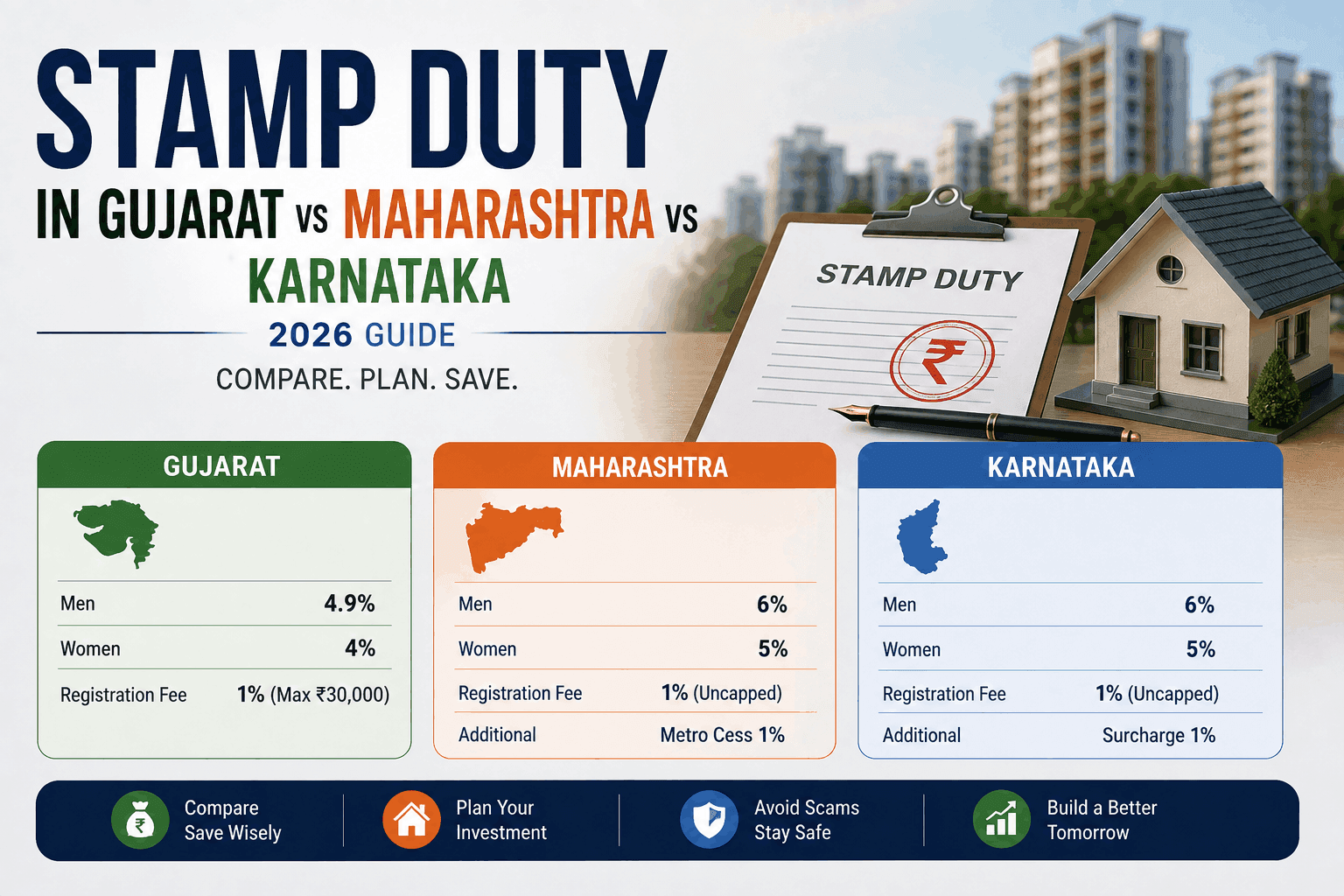
Gujarat has always been a buyer-friendly state. The stamp duty in Gujarat is among the lowest in India, especially for women. Here is the breakdown for 2026:
- Men: 4.9% of the agreement value
- Women: 4% (if the property is registered in her name)
- Joint ownership (male + female): 4.5%
Now, add registration fee of 1% (max Rs 30,000) and a small legal fee of Rs 1,000-2,000. So, for a flat worth Rs 80 lakhs in Bopal, Ahmedabad, your total cost is around Rs 4.72 lakhs (4.9% + 1% registration). That is a steal compared to other states.
Take the example of Ramesh, a first-time buyer from Surat. He was looking at a 2-BHK in Vesu, priced at Rs 65 lakhs. He registered it jointly with his wife. The stamp duty came to Rs 2.92 lakhs (4.5%). He saved nearly Rs 26,000 compared to if he had registered it solely in his name. My advice? Always consider joint ownership if you are married—it not only reduces the duty but also builds a shared asset.
Maharashtra: Higher Rates, But More Options
Maharashtra, especially Mumbai, Pune, and Thane, has a different story. The stamp duty in Maharashtra for 2026 is:
- Men: 5% (plus 1% metro cess in Mumbai, Thane, and Pune)
- Women: 4% (plus 1% metro cess)
- Joint ownership: 5% for the male share, 4% for female share (average ~4.5%)
So, if you are buying a flat in Pune's Hinjewadi for Rs 1.2 crores, a male buyer pays 6% (5% + 1% cess) = Rs 7.2 lakhs. A female buyer pays 5% (4% + 1% cess) = Rs 6 lakhs. That is a saving of Rs 1.2 lakhs.
But here is the catch: Maharashtra has a higher registration fee of 1% (capped at Rs 30,000 in some areas, but in Mumbai it is uncapped). Plus, there is a 0.1% to 0.5% fee for the Maharashtra Real Estate Regulatory Authority (MahaRERA). So, the effective cost can be 6.5% to 7% for men in Mumbai.
Wondering whether it is worth it? If you are a working professional in IT, the job market in Pune or Mumbai may justify the higher cost. But for pure investment, Gujarat wins hands down.
Karnataka: The Middle Ground
Karnataka, led by Bengaluru, offers a balanced approach. The stamp duty in Karnataka for 2026:
- Men: 5% (plus 1% surcharge for properties above Rs 45 lakhs)
- Women: 4% (plus 1% surcharge)
- Joint ownership: 5% for male, 4% for female
So, for a flat in Whitefield, Bengaluru, priced at Rs 1 crore, a male buyer pays 6% (5% + 1% surcharge) = Rs 6 lakhs. A female buyer pays 5% (4% + 1% surcharge) = Rs 5 lakhs. Registration fee is 1% (capped at Rs 20,000 for properties up to Rs 20 lakhs, but for higher values it is 1% uncapped).
Here is what many buyers overlook: Karnataka has a higher circle rate (guidance value) in many areas. So even if you negotiate a good price, stamp duty is calculated on the higher of the agreement value or circle rate. In areas like Sarjapur Road or Electronic City, the circle rate can be 10-15% higher than market value. That can inflate your duty significantly.
Quick Tips for Buyers
- Check circle rates online: Before you sign anything, visit the state's stamp duty portal and check the circle rate for the locality. In Gujarat, you can use the e-Dhara portal. In Maharashtra, use IGR Maharashtra. In Karnataka, use Kaveri Online.
- Consider women as co-owners: In all three states, a female co-owner reduces the effective duty by 0.5% to 1%. This is a no-brainer.
- Negotiate registration charges: Some builders offer to split the registration fee. Ask for it.
- Use a home loan wisely: The interest paid on home loan is deductible under Section 24(b) up to Rs 2 lakhs per annum. The principal repayment is deductible under Section 80C up to Rs 1.5 lakhs. So, a higher stamp duty in Maharashtra or Karnataka can be offset partially through tax savings.
The Bottom Line: Which State is Best in 2026?
| State | Effective Stamp Duty (Men) | Effective Stamp Duty (Women) | Registration Fee | Unique Charges |
|-------|---------------------------|-----------------------------|------------------|----------------|
| Gujarat | 4.9% | 4% | 1% (max Rs 30,000) | Low legal fee |
| Maharashtra | 6% (5% + 1% cess) | 5% (4% + 1% cess) | 1% (uncapped in Mumbai) | MahaRERA fee |
| Karnataka | 6% (5% + 1% surcharge) | 5% (4% + 1% surcharge) | 1% (uncapped) | Higher circle rates |
In my view, if you are looking at pure affordability, Gujarat is the clear winner. A Rs 1 crore flat in Ahmedabad's Shela costs you about Rs 5.9 lakhs in stamp duty and registration, while the same flat in Bengaluru's Whitefield costs Rs 7 lakhs. That is a difference of Rs 1.1 lakhs. Over a 20-year home loan, that extra amount could have been part of your down payment or invested in mutual funds.
But here is the reality: you cannot just look at stamp duty alone. Consider the job opportunities, infrastructure, and quality of life. For instance, GIFT City in Gandhinagar is booming with finance jobs, and the stamp duty there is just 4.9% for men. Meanwhile, a similar job in Mumbai's BKC will cost you 6% duty but offer higher salaries. So, it is a trade-off.
Key Takeaways
- Gujarat: Lowest stamp duty overall. Best for budget-conscious buyers, retirees, and investors looking at cities like Ahmedabad, Surat, Vadodara, and Rajkot.
- Maharashtra: Higher duty but more job opportunities. Good for working professionals in Mumbai, Pune, and Thane. Women buyers get a 1% concession.
- Karnataka: Middle ground. Good for tech professionals in Bengaluru. But watch out for circle rate inflation.
- Actionable tip: Before you finalize any property, get a stamp duty estimate from a local lawyer or use online calculators from each state's registration department. Do not rely solely on the builder's word.
Conclusion: Your Next Step
So, what is the final verdict? If you are a couple in your 30s looking for a home near Ahmedabad's SG Highway or Surat's Vesu, go for Gujarat. You will save money upfront. If you are a single woman professional in Bengaluru, Karnataka offers a decent deal with a 4% rate. And if you are a family moving to Mumbai for a career leap, Maharashtra is worth the extra cost.
Remember, the Stamp Duty in Gujarat vs Maharashtra vs Karnataka: 2026 Comparison is not just about percentages—it is about your life goals. I recommend you sit down with a calculator, enter your property price, and see the actual numbers. You might be surprised at how much you can save by choosing the right state.
Have questions? Drop a comment below or reach out to me directly. I have helped hundreds of buyers navigate this maze, and I can help you too.