
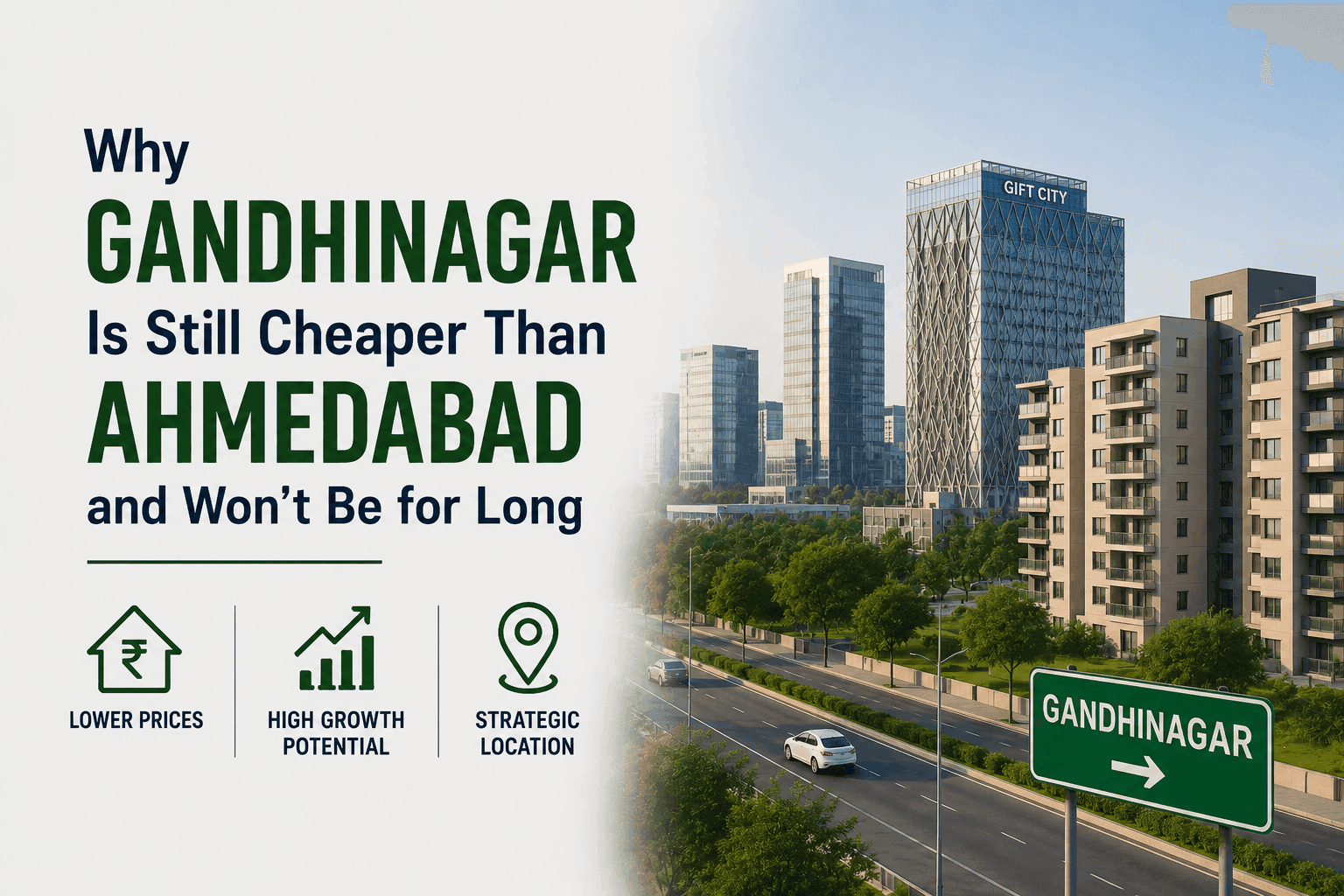
Let me tell you something that might surprise you. Gandhinagar, the capital of Gujarat, has always lived in the shadow of its bigger, flashier neighbor—Ahmedabad. But here is the thing: that gap is closing fast. In fact, if you are looking for a smart investment with serious upside potential, Why Gandhinagar Is Still Cheaper Than Ahmedabad and Won't Be for Long is the story you need to understand right now.
I have been covering Gujarat real estate for over 15 years, and I can tell you—this is not just another market rumor. The numbers, the infrastructure, the demand—everything points to a massive price correction in favor of Gandhinagar. But before we dive into the details, let me share a quick story.
Take Ramesh, a first-time buyer from Ahmedabad. He was torn between buying a 2-BHK in a mid-range society on SG Highway for Rs 65 lakhs, or a spacious 3-BHK in Gandhinagar's Sector 28 for just Rs 48 lakhs. He chose Gandhinagar. Two years later, his flat is worth Rs 62 lakhs. The SG Highway property? Still stuck at Rs 68 lakhs. The lesson? Sometimes, the smarter move is to look beyond the obvious.
Now, let's break down exactly why Gandhinagar is still a bargain—and why that won't last.
Why Gandhinagar Is Still Cheaper Than Ahmedabad: The Current Price Reality
The truth is simple: Gandhinagar offers significantly more square footage for your rupee. Here is a quick comparison based on current market data (2024-25):
- Ahmedabad (SG Highway, Satellite): Rs 5,500 - Rs 8,000 per sq. ft for a decent apartment.
- Ahmedabad (Bopal, Shela): Rs 4,500 - Rs 6,500 per sq. ft.
- Gandhinagar (Sectors 1-30, Infocity area): Rs 3,200 - Rs 4,800 per sq. ft.
That is a 30-40% price differential. But here is the kicker: the quality of life in Gandhinagar is arguably better. Wider roads, less traffic, more green spaces, and better civic amenities. Yet, the prices are lower. Why?
The Historical Disconnect
For decades, Gandhinagar was seen as a government town—bureaucrats, politicians, and their families. The private sector stayed away. Ahmedabad, on the other hand, was the commercial hub. Jobs, colleges, malls, nightlife—all in Ahmedabad. Naturally, buyers followed the jobs.
But that dynamic is shifting. And fast.
What Is Driving the Price Surge in Gandhinagar?
Here are the three biggest factors that will make Gandhinagar unaffordable for many within 3-5 years:
1. GIFT City: The Game Changer
Gujarat International Finance Tec-City (GIFT City) is not just another business park. It is India's first operational International Financial Services Centre (IFSC). And it is located right on the border of Gandhinagar and Ahmedabad. In fact, most of GIFT City's residential catchment falls within Gandhinagar's limits.
What many buyers overlook is that GIFT City is now attracting global banks, fintech startups, and insurance giants. We are talking about thousands of high-paying jobs. And where do these professionals want to live? In clean, green, and well-planned Gandhinagar.
2. Infrastructure Boom
The Ahmedabad-Gandhinagar Metro is already operational. Travel time between the two cities has dropped to under 30 minutes. The new Delhi-Mumbai Expressway passes through Gandhinagar. The city is also getting a new international airport near Dholera, which is barely 40 km away.
In my experience, whenever a metro line opens, property prices within 1 km of the stations rise by 15-25% within two years. We are already seeing this near the Akshardham and Infocity metro stations.
3. Limited Land Supply
Unlike Ahmedabad, which has expanded in all directions (SG Highway, Bopal, Shela, Vastral, Naroda), Gandhinagar is a planned city with strict zoning laws. You cannot just build anywhere. Most available land is in the newer sectors (Sector 24-30) and the Infocity area. Once these are sold out, prices will jump.
Specific Localities to Watch in Gandhinagar
If you are serious about investing, here are the areas I personally recommend:
- Infocity (Sector 24-27): The IT hub. Prices are already rising—expect Rs 4,000-5,000 per sq. ft within 2 years.
- Sector 28-30: Newer sectors with good layouts. Rs 3,500-4,200 per sq. ft today. Great for long-term holding.
- GIFT City residential zone: Upcoming projects by reputed builders like Adani and Shivalik. Premium pricing but massive appreciation potential.
- Koba (near GIFT City): An emerging hotspot. Prices are still Rs 3,000-3,800 per sq. ft. A hidden gem.
RERA Tip for Buyers
Always check the RERA registration number of any project you consider. In Gandhinagar, many smaller builders have not yet registered their projects. If a builder hesitates to show you the RERA number, walk away. Also, verify the project's status on the Gujarat RERA website. It takes only 5 minutes, and it can save you from years of legal trouble.
The Price Gap Will Shrink—Here Is the Math
Let me give you a simple projection based on current trends. Assume Gandhinagar prices grow at 12% annually (conservative estimate given the infrastructure push) and Ahmedabad grows at 8% (still strong, but slowing due to saturation).
| Year | Gandhinagar (per sq. ft) | Ahmedabad (SG Highway) | Gap |
|------|--------------------------|------------------------|-----|
| 2024 | Rs 4,000 | Rs 6,500 | 38% |
| 2026 | Rs 5,017 | Rs 7,588 | 34% |
| 2028 | Rs 6,293 | Rs 8,859 | 29% |
| 2030 | Rs 7,894 | Rs 10,344 | 24% |
See the pattern? The gap narrows every year. In fact, I believe we will see Gandhinagar touching Rs 5,500-6,000 per sq. ft in prime areas by 2026-27. That is a 50% jump from today's levels.
But Is There Any Risk?
Look, no investment is without risk. Here are a few things to consider:
- Liquidity: Gandhinagar's resale market is thinner than Ahmedabad's. If you need to sell quickly, you might have to wait 3-6 months.
- Rental Yield: Currently, rental yields are around 2.5-3% in Gandhinagar, compared to 3-4% in Ahmedabad. But this will improve as GIFT City matures.
- Distance from Work: If your job is in central Ahmedabad (e.g., Navrangpura or Ashram Road), the daily commute can be 45-60 minutes each way. Not ideal for everyone.
That said, for long-term investors (5+ years), the risk-reward ratio is heavily in favor of Gandhinagar.
Key Takeaways: Quick Tips for Buyers
- Act before 2026: Once the GIFT City residential zones are fully developed and the new airport is operational, prices will be 30-40% higher.
- Focus on metro connectivity: Properties within walking distance of metro stations (Infocity, Akshardham, Sector 28) will appreciate fastest.
- Choose a reputed builder: In Gandhinagar, stick with names like Adani Realty, Shivalik Group, or local developers with a strong track record.
- Negotiate hard: Many sellers in Gandhinagar are still open to negotiation. Do not accept the first price. Offer 10-15% less and work from there.
- Check the floor plan: Gandhinagar apartments tend to be larger. A 3-BHK here might be 1,400 sq. ft, while in Ahmedabad it might be 1,100 sq. ft. Make sure you are comparing apples to apples.
Conclusion: The Window Is Closing
So, here is my honest take. Why Gandhinagar Is Still Cheaper Than Ahmedabad and Won't Be for Long is not just a catchy headline—it is a market reality. The city has everything going for it: world-class infrastructure, a thriving financial hub, and a quality of life that Ahmedabad can only dream of.
But the window of opportunity is closing. In the next 2-3 years, as more people discover this hidden gem, prices will rise sharply. If you wait too long, you will end up paying Ahmedabad-level prices for a Gandhinagar property.
My advice? Visit Gandhinagar this weekend. Walk around Sector 28 or the Infocity area. Talk to a few local brokers. And then decide. Because in real estate, the best time to buy was yesterday. The second best time is today.
What do you think? Are you ready to make the move, or do you still have doubts? Drop your questions in the comments—I read every single one.