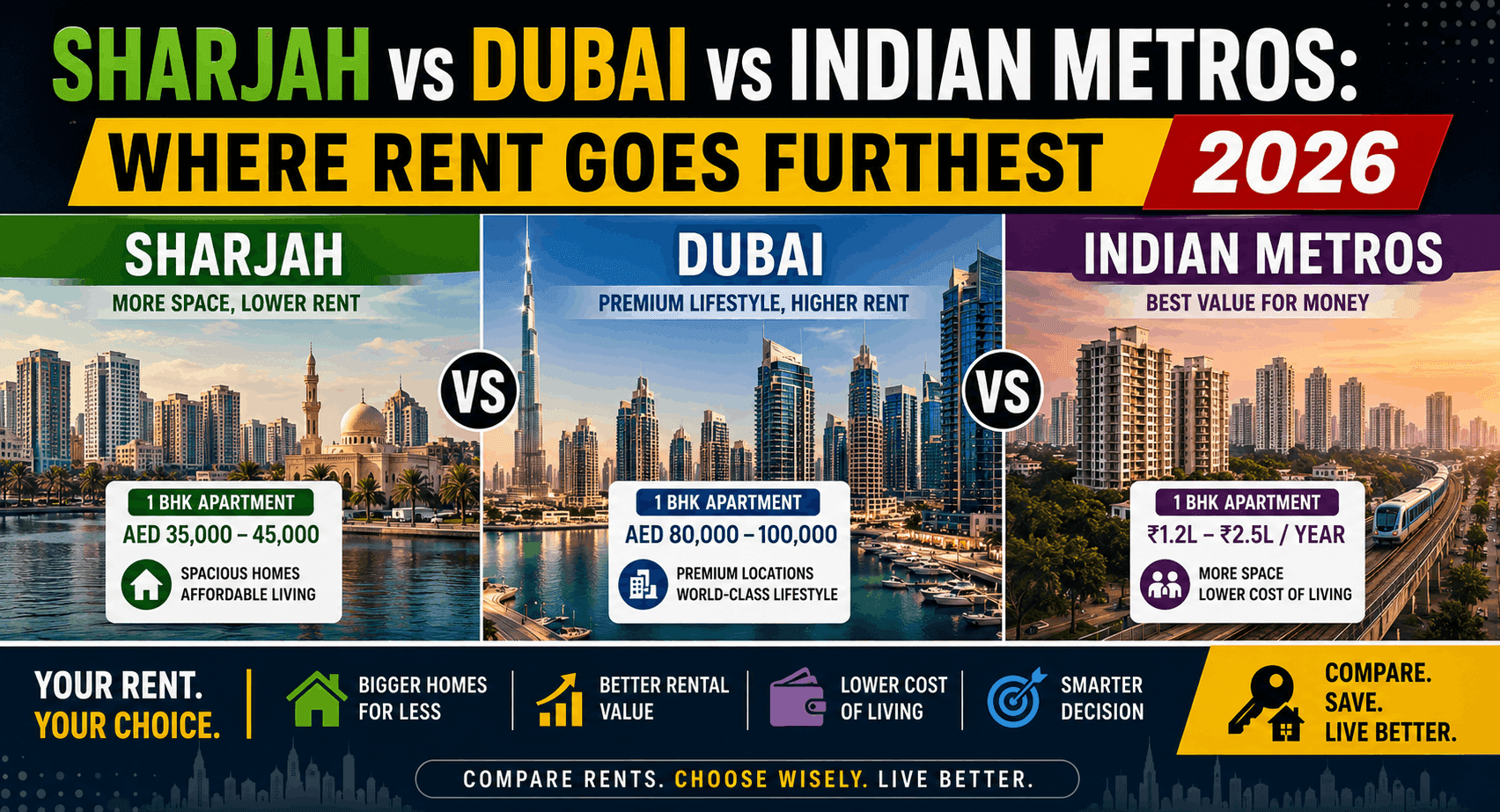

So you have Rs 2 crore to invest in real estate. That is a solid amount—enough to build a portfolio that balances safety, returns, and future growth. But here is the real question: should you put all your eggs in one basket? Or split it between India and Dubai? In this Splitting 2 Crore Between India and Dubai Property: Portfolio Guide, I will walk you through the pros, cons, and a practical strategy that works for investors like you.
Let me tell you a story. Last year, my client Ramesh from Ahmedabad had Rs 2 crore. He wanted to buy a luxury flat on SG Highway but was also tempted by Dubai's tax-free rental yields. We sat down, crunched numbers, and decided on a 60-40 split: Rs 1.2 crore in India and Rs 80 lakh in Dubai. Today, his Indian property near the upcoming metro station has appreciated 12%, while his Dubai studio near Dubai Marina fetches a 7% rental yield. That is the power of a balanced approach.
Why Consider Splitting 2 Crore Between India and Dubai Property?
The truth is, no single market offers everything. India gives you capital appreciation, emotional attachment, and tax benefits. Dubai gives you high rental yields, zero property tax, and a safe haven for foreign currency. When you split Rs 2 crore, you get the best of both worlds.
The India Advantage
India—especially Gujarat—is a growth story. Take Ahmedabad: areas like Bopal, Shela, and Gota have seen 15-20% price jumps in the last 3 years. A 3-BHK flat in a premium society like Shivalik Highrise costs Rs 1.2-1.5 crore. With RERA Gujarat ensuring timely possession, you are safer than ever. Plus, you can claim home loan interest up to Rs 2 lakh under Section 24(b) and principal repayment under Section 80C.
But what about rental yield? In India, it is modest—2-3% for residential properties. That is where Dubai steps in.
The Dubai Edge
Dubai's real estate market is investor-friendly. No property tax, no capital gains tax, and rental yields of 6-8% in areas like Dubai Marina, JLT, and Business Bay. A studio apartment for Rs 80 lakh (AED 350,000) can fetch you Rs 5-6 lakh annually in rent. Plus, with the UAE's 10-year golden visa for property investors, you get residency benefits. However, be cautious—Dubai's market is cyclical, and currency fluctuations matter.
How to Split Rs 2 Crore: A Practical Framework
Here is what I recommend to my clients. But remember: your risk appetite, age, and goals matter. Let me break it down.
Option 1: 60% India, 40% Dubai (Balanced Growth)
- India (Rs 1.2 crore): Buy a 3-BHK in a growing Gujarat locality. For example, in Surat's Vesu area, a premium flat in a project like Safal Parisar costs Rs 1.1-1.3 crore. Or in Vadodara's Akota, a 3-BHK in a gated society like Kirti Stellar is Rs 1-1.2 crore.
- Dubai (Rs 80 lakh): A studio or 1-BHK in Dubai Sports City or JVC. These areas offer good rental demand and moderate appreciation.
Option 2: 50% Each (Equal Split)
- India (Rs 1 crore): Two budget-friendly flats in emerging areas. For instance, Rs 50 lakh each in Gandhinagar's GIFT City area (near the new metro) and Rajkot's Kalawad Road. Both have strong infrastructure push.
- Dubai (Rs 1 crore): A 1-BHK in Dubai Creek Harbour or a townhouse in Damac Hills. These offer lifestyle and rental upside.
Option 3: 70% India, 30% Dubai (Conservative)
- India (Rs 1.4 crore): A single luxury property in Ahmedabad's SG Highway—like a 4-BHK in the new project by Adani Realty. Or two properties: one in Bopal and one in Chandkheda.
- Dubai (Rs 60 lakh): A studio in International City or a serviced apartment in Barsha Heights. Lower entry, decent yield.
Key Considerations for Your Portfolio
RERA and Legal Safety
In India, always check RERA registration. In Gujarat, every project must have a RERA number. For Dubai, ensure the developer is registered with the Dubai Land Department (DLD). I have seen buyers lose money on off-plan projects that never completed.
Tax Implications
- India: Capital gains tax on sale after 2 years is 20% with indexation. Rental income is taxed as per your slab.
- Dubai: No tax on rental income or capital gains. But if you are an Indian resident, you need to report global income. However, India-UAE double taxation treaty helps.
Currency Risk
Dubai properties are in AED. If the rupee strengthens against the dirham, your returns in INR may dip. Hedge this by investing only what you can afford to hold long-term.
Actionable Tips for Today
1. Start with a consultation with a RERA-registered agent in Gujarat and a Dubai-based broker. I personally recommend talking to Square Yards or PropTiger for cross-border advice.
2. Check the rental market in your target locality. In Ahmedabad's Shela, a 3-BHK rents for Rs 25,000-35,000/month. In Dubai Marina, a studio rents for AED 60,000-80,000/year.
3. Plan your exit. In India, hold for 5-7 years for maximum appreciation. In Dubai, 3-5 years is enough for capital gains.
4. Use a home loan for the Indian portion to leverage tax benefits. For Dubai, many banks offer 75-80% LTV for non-residents.
Quick Tips for Your Portfolio
- Diversify within India too: Don't put all Rs 1.2 crore in one property. Split into two: one in a metro-connected area (like Gota) and one in a commercial hub (like GIFT City).
- Look for under-construction projects in Dubai for better pricing. But avoid projects with less than 20% completion.
- Check the visa rules: A Dubai property worth AED 2 million (Rs 4.5 crore) qualifies for a golden visa. For Rs 80 lakh, you get a 2-year investor visa.
- Consider REITs for smaller exposure. But for Rs 2 crore, direct ownership is better.
Conclusion
Splitting Rs 2 crore between India and Dubai is not just smart—it is necessary. The Indian market gives you stability, appreciation, and tax benefits. Dubai gives you high yield, tax-free income, and global diversification. The key is to choose the right localities, builders, and timing.
Wondering if this is the right time? Look at the data: Gujarat's real estate is booming with the metro and GIFT City. Dubai is recovering post-pandemic with new visa reforms. So yes, now is a great time.
Ready to build your portfolio? Start by researching one locality from this guide. Talk to a local agent in Bopal or a Dubai broker. And remember: the best portfolio is one you can sleep well at night. Good luck!