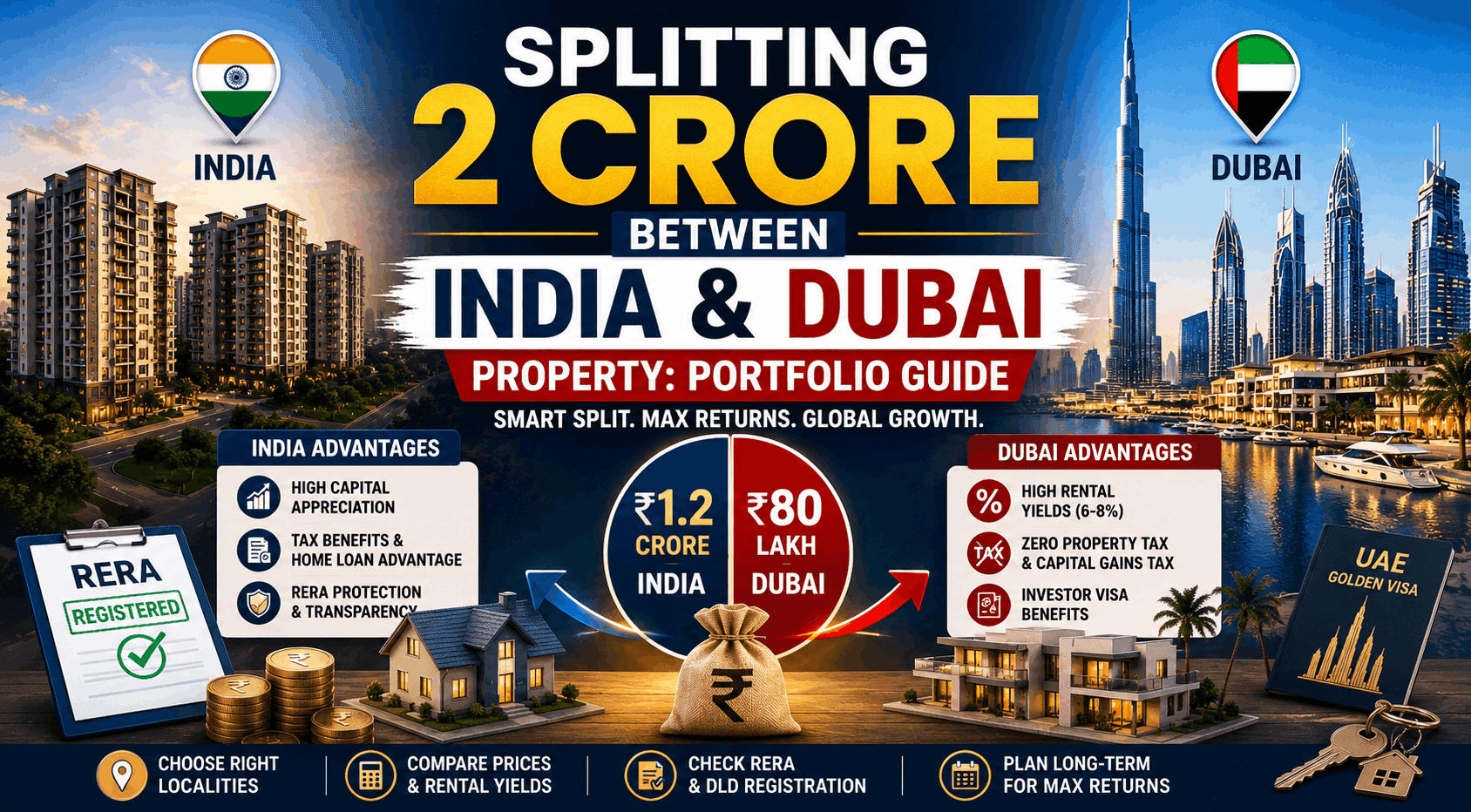

Is your dream home in Mumbai or Dubai? For many high-net-worth individuals from Gujarat, the question is no longer just about location—it is about value. A budget of Rs 10 crore opens doors to the pinnacle of luxury real estate. But what does that actually buy you? In Mumbai, you might get a 2,000 sq ft apartment in a prime tower. In Dubai, that same Rs 10 crore (around AED 4.5 million) could secure a sprawling villa on Palm Jumeirah or a penthouse with skyline views. This post breaks down exactly what Rs 10 crore gets you in both cities, from space and amenities to long-term returns. Let us dive into the 10 Crore Luxury Property: Mumbai vs Dubai - What You Actually Get.
The Space Equation: Square Feet vs Square Miles
Here is the first shocker. In Mumbai, Rs 10 crore typically buys you 1,800 to 2,500 sq ft of carpet area in a luxury tower in Worli, Bandra Kurla Complex (BKC), or Lower Parel. Think Lodha World Towers or Omkar 1973. You get three to four bedrooms, a decent living room, and a balcony that fits a chair or two. The view? It is either the Arabian Sea or a sea of other towers. In contrast, in Dubai, the same budget buys you 4,000 to 6,000 sq ft of built-up area. That is a villa with private garden, pool, and multiple parking spots in Emirates Hills or Palm Jumeirah. The space difference is staggering. But wait—there is more.
What About the Quality of Finishes?
In Mumbai luxury projects, finishes are top-tier: Italian marble, German fittings, branded modular kitchens. Builders like Oberoi Realty and Hiranandani deliver impeccable quality. However, for Rs 10 crore, you are still in a high-rise with shared amenities. In Dubai, luxury villas come with private pools, landscaped gardens, and smart home systems. The finishing is equally premium, but the exclusivity is higher. For example, a 5-bedroom villa in Tilal Al Ghaf by Majid Al Futtaim offers lagoon access, private beach, and clubhouse—all for under Rs 10 crore.
The Lifestyle and Amenities: What You Actually Use
Now, let us talk about the lifestyle. In Mumbai, Rs 10 crore gets you access to world-class amenities: infinity pools, gyms, spas, concierge services, and sometimes a private cinema. But here is the catch—these are shared with hundreds of other residents. During peak hours, the pool is crowded. The gym has a queue. In Dubai, many luxury communities like Dubai Hills Estate or Al Barari offer private amenities within your villa. You have your own pool, your own garden, and your own gym. The community facilities—golf courses, parks, retail—are exclusive to residents but less crowded. The truth is, for the same price, Dubai offers a more private, spacious lifestyle.
The Rental Yield Factor
This is where numbers matter. In Mumbai, luxury rental yields hover around 2-3% annually. A Rs 10 crore apartment in BKC might fetch Rs 1.5-2 lakh per month rent. That is decent, but not great. In Dubai, rental yields for luxury villas range from 5-7% annually. A villa in Palm Jumeirah costing Rs 10 crore can easily rent for AED 25,000-30,000 per month (Rs 5.5-6.5 lakh). The difference is nearly 3x. For investors from Gujarat, this is crucial. Why? Because many NRIs from Ahmedabad and Surat own property in Dubai purely for rental income. I have seen clients from SG Highway reinvesting their Surat textile profits into Dubai villas for better returns.
Legal and Regulatory: RERA vs Dubai Land Department
In India, RERA Gujarat ensures buyer protection. Projects must be registered, and developers cannot change plans arbitrarily. For a Rs 10 crore property, this is a safety net. However, possession delays are common. In Mumbai, many luxury towers face 2-3 year delays. In Dubai, the Real Estate Regulatory Agency (RERA equivalent) also protects buyers. The Dubai Land Department (DLD) mandates escrow accounts and project registration. But here is the twist: Dubai has a 4% transfer fee on property purchase, while in Maharashtra, stamp duty is 5-6% plus registration. So the upfront cost is lower in Dubai. Also, for NRIs, Dubai offers 100% foreign ownership in designated areas, while Indian law restricts foreign ownership in some Mumbai projects.
A Real Buyer Story: Ramesh from Ahmedabad
Take Ramesh, a diamond trader from Ahmedabad who owns a flat in Satellite. In 2022, he had Rs 10 crore to invest. He looked at a 3BHK in Oberoi Garden City, Worli, Mumbai—2,100 sq ft, Rs 9.8 crore. Then he saw a 5-bedroom villa in Dubai Hills Estate for AED 4.2 million (Rs 9.5 crore). The villa had a private pool, garden, and a view of the golf course. He chose Dubai. Today, his rental yield is 6.2%, and the property has appreciated 15% in two years. His Mumbai friend, who bought the Oberoi flat, gets 2.5% yield and the flat is still under construction. Ramesh says, "The space and returns are incomparable." This is not an isolated case.
Taxation and Exit Strategy: What You Keep Matters
Tax is a silent killer of returns. In India, long-term capital gains on property held over 2 years is taxed at 20% with indexation. For a Rs 10 crore property, selling after 5 years could mean a tax bill of Rs 1-2 crore. Plus, TDS on rent is 10% if rent exceeds Rs 2.4 lakh per annum. In Dubai, there is zero capital gains tax and zero property tax. No wealth tax either. For NRIs from Gujarat, this is a game-changer. However, if you are an Indian resident, you must pay Indian tax on global income. But here is the practical tip: If you buy in Dubai and never sell, the tax benefit is permanent. For those planning to exit in 10 years, Dubai is far more tax-efficient.
The Hidden Costs: Maintenance and Community Fees
In Mumbai, maintenance for a luxury apartment is Rs 15-25 per sq ft per month. For 2,000 sq ft, that is Rs 30,000-50,000 monthly. In Dubai, service charges for villas are AED 5-12 per sq ft annually (Rs 10-25 per sq ft per year). For a 5,000 sq ft villa, annual service charge is AED 25,000-60,000 (Rs 5.5-13 lakh per year). At first glance, Dubai seems higher. But here is the catch: Dubai maintenance includes security, landscaping, pool cleaning, and common area upkeep. In Mumbai, you pay extra for parking, gym, and pool usage. Also, Dubai has no property tax, while Mumbai has municipal taxes of 0.5-1% of property value annually. So the total holding cost is often lower in Dubai.
Key Takeaways: Quick Comparison
- Space: Dubai offers 2-3x more built-up area for Rs 10 crore.
- Rental Yield: Dubai: 5-7% vs Mumbai: 2-3%.
- Taxes: Dubai: zero property tax, zero capital gains. Mumbai: stamp duty 5-6%, capital gains 20% with indexation.
- Lifestyle: Dubai: private villa with pool. Mumbai: high-rise with shared amenities.
- Regulation: Both have strong buyer protection. RERA Gujarat and DLD are reliable.
- Exit: Dubai resale is faster due to global demand. Mumbai luxury resale can take 6-12 months.
What Should You Do? A Practical Actionable Tip
If you are a Gujarat-based investor with Rs 10 crore, here is my personal recommendation: Do not rush. First, define your goal. Is it primary residence? Rental income? Capital appreciation? For primary residence in Mumbai, go ahead if you need to be in the city for work or family. But if you are looking at pure investment or second home, Dubai wins hands down. Visit both cities. Spend a week in Dubai's luxury communities—Palm Jumeirah, Dubai Hills, Emirates Hills. Then visit Mumbai's Worli or BKC. Compare the space, the crowd, the returns. I have seen too many buyers from Ahmedabad and Surat regret buying a cramped Mumbai flat when they could have owned a Dubai villa. The choice is yours, but the data is clear.
Conclusion: Your Rs 10 Crore, Your Decision
So, what do you actually get? In Mumbai, you get a prestigious address in India's financial capital, with world-class amenities but limited space and moderate returns. In Dubai, you get sprawling luxury, higher rental income, tax-free gains, and a global lifestyle. The 10 Crore Luxury Property: Mumbai vs Dubai - What You Actually Get boils down to your priorities. For NRIs and investors from Gujarat, Dubai often offers better value. But if you value connectivity to family and Indian roots, Mumbai is irreplaceable. My advice? Let your portfolio decide. Diversify. Buy a smaller flat in Mumbai for emotional reasons and a villa in Dubai for financial growth. That is the smartest move. Ready to explore? Start by checking RERA Gujarat for Mumbai projects and Dubai Land Department for Dubai listings. The market is waiting.