
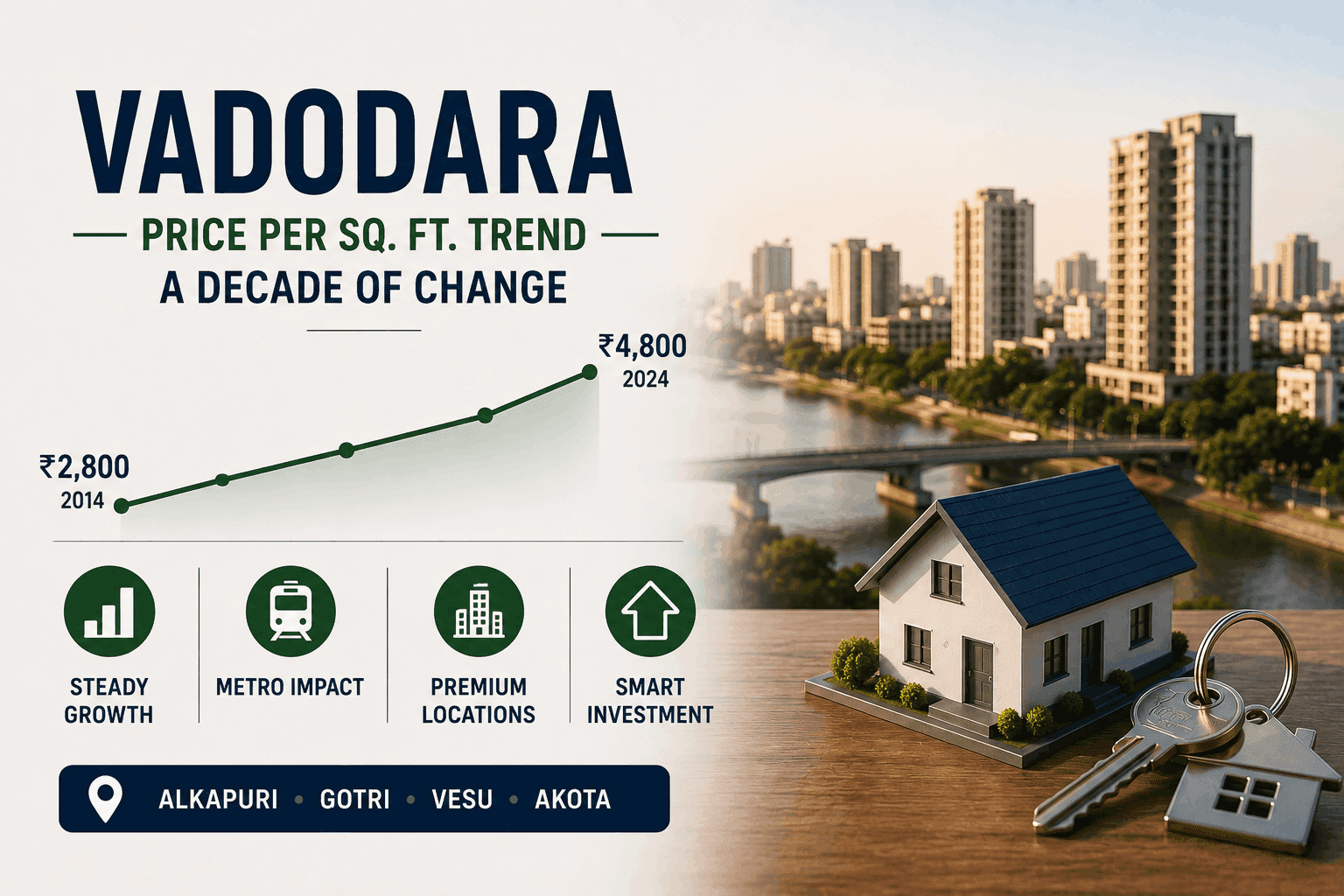
If you have been tracking Vadodara's real estate market, you have likely noticed one thing: prices have moved. But how much? And more importantly, where are they headed? Let me take you through the average per square foot trend in Vadodara over the last decade – a journey that reveals shifting buyer preferences, infrastructure booms, and surprising value pockets.
I still remember chatting with a friend back in 2014. He was looking for a 2BHK in Alkapuri. The rate then? Around Rs 3,500-4,000 per square foot. Fast forward to 2024, and that same flat would cost you Rs 6,500-7,500 per sq ft. But here is the thing: not all areas followed the same trajectory. Some zoomed ahead, while others stayed surprisingly affordable.
The Big Picture: Average Per Square Foot Trend in Vadodara Over the Last Decade
Let us start with the numbers. Between 2014 and 2024, the city-wide average price per square foot jumped from roughly Rs 2,800 to Rs 4,800. That is a 70% increase. But this average hides a lot of variation. For instance, premium localities like Alkapuri and Akota saw prices double, while emerging areas like Gotri and Sama saw more modest gains of 40-50%.
What drove this? Three things, in my view. First, the arrival of the Vadodara Metro project in 2018 sent ripples across the market. Second, the RERA Act (2016) brought transparency, which boosted buyer confidence. And third, the post-pandemic shift towards larger homes pushed demand for spacious 3BHKs in suburbs.
The Pre-RERA Era (2014-2016): A Buyer's Market
Back in 2014, the market was largely unregulated. Developers often quoted rates in a range – "Rs 3,200-3,800 per sq ft" – and you had to haggle. The average per square foot trend in Vadodara was flat, hovering around Rs 2,800-3,000. Why? Because supply was high, especially in areas like Fatehgunj and Nizampura. Many projects were stuck due to legal issues.
But here is a lesson: those who bought in 2014-15 in areas like Alkapuri or Akota made a killing. Prices there have since appreciated by 80-90%. Wondering if you missed the boat? Not necessarily – we will get to that.
The RERA Effect (2017-2019): Transparency and Price Correction
RERA changed everything. Suddenly, developers had to register projects, disclose delivery timelines, and maintain escrow accounts. This weeded out fly-by-night builders. The immediate effect? A temporary dip in prices as inventory cleared. In 2017, the average per square foot trend in Vadodara actually fell by 3-5% in some areas like Sama and Gotri.
But the long-term impact was positive. Buyers felt safer. By 2019, prices stabilised and began rising. For example, a 2BHK in Alkapuri that cost Rs 45 lakhs in 2016 was now Rs 55 lakhs. The per sq ft rate moved from Rs 4,000 to Rs 4,800.
Localities That Defied the Trend
Not all areas followed the city average. Let me break down the winners and laggards.
Alkapuri and Akota: The Premium Corridor
These are Vadodara's most expensive areas. In 2014, you could buy a flat here for Rs 4,000-4,500 per sq ft. Today, that same flat costs Rs 7,000-8,000 per sq ft. The reason? Limited land, high-end amenities, and proximity to the railway station and airport. In fact, I personally recommend these areas for investors looking for capital appreciation. But here is the catch: rental yields are low – around 2-3%.
Gotri and Sama: The Mid-Income Sweet Spot
This is where the action is. In 2014, Gotri had rates of Rs 2,200-2,800 per sq ft. Today, they are Rs 3,800-4,500. That is a 60% increase – decent but not spectacular. What makes these areas attractive is affordability. You can still find a 3BHK under Rs 50 lakhs. The metro line extension to Gotri has further boosted demand.
Fatehgunj and Nizampura: Stagnant but Stable
These older localities saw minimal growth – only 20-30% over the decade. Why? Because they are already built-up. No new land, no major infrastructure. The average per square foot trend here has been flat at Rs 3,000-3,500. For end-users, this is fine. For investors, look elsewhere.
The Post-Pandemic Surge (2020-2024): A New Normal
COVID-19 turned the market upside down. Suddenly, everyone wanted bigger homes with balconies and home offices. This pushed up demand for 3BHKs in suburbs. In 2020, prices dipped briefly by 5-8% due to uncertainty. But by 2021, they rebounded sharply. The average per square foot trend in Vadodara jumped from Rs 3,800 in 2020 to Rs 4,500 in 2022.
Take the example of Rakesh, a software professional who bought a flat in Gotri in 2021. He paid Rs 3,900 per sq ft. Today, similar flats are selling for Rs 4,800. That is a 23% gain in three years. Not bad, right?
What About the Metro?
The Vadodara Metro project, with Phase 1 connecting Karelibaug to Manjalpur, has been a game-changer. Areas near metro stations – like Alkapuri, Karelibaug, and Gotri – have seen 10-15% higher appreciation than non-metro areas. In my view, if you are buying today, look for properties within 1 km of a planned metro station.
Key Takeaways: What the Numbers Mean for You
Let me give you a quick summary of what this decade tells us:
- City-wide average: From Rs 2,800 to Rs 4,800 per sq ft (70% growth).
- Best performers: Alkapuri, Akota, Gotri (80-100% growth).
- Worst performers: Fatehgunj, Nizampura (20-30% growth).
- Best time to buy: 2014-15 or 2020 (post-COVID dip).
- Current opportunity: Emerging areas like Manjalpur and Tarsali, where rates are still Rs 3,200-3,800 per sq ft.
A RERA Tip for You
Always check the RERA registration number of any project you consider. You can verify it on the Gujarat RERA website. This protects you from delays and fraud. In fact, I have seen buyers lose crores because they skipped this step.
Quick Tips for Buyers in 2024
- For end-users: Look in Gotri or Sama. You get good schools, hospitals, and metro access. A 2BHK will cost you Rs 35-45 lakhs.
- For investors: Focus on Alkapuri or Akota for long-term capital gains. But be ready for a high entry price – Rs 70 lakhs+ for a 2BHK.
- Avoid: Older areas with no new infrastructure. They may not appreciate much.
- Negotiate: In today's market, you can often get 5-10% off the listed price. Do not hesitate.
Looking Ahead: The Next Decade
Will the average per square foot trend in Vadodara continue to rise? I believe yes, but at a slower pace – maybe 5-7% annually. The city's growth is driven by industrial development (Gujarat's petrochemical hub) and education (MSU, Parul University). However, oversupply in some segments could cap prices.
My advice? If you are planning to buy, do it within the next 12 months. Interest rates are still reasonable, and prices have not yet peaked. Remember, real estate is a long-term game. Do not expect 20% annual returns. But 8-10% is realistic.
Conclusion: Your Move
So, what is the takeaway from this decade-long journey? The average per square foot trend in Vadodara over the last decade tells a story of steady growth, with bursts of excitement in select pockets. Whether you are a first-time buyer or a seasoned investor, the key is to do your homework. Look at the data, visit the site, and talk to locals.
Ready to start your search? Check out current listings in Gotri or Alkapuri. And if you need help with RERA verification or loan calculations, just ask. I am here to help.
*This article is based on data from Gujarat RERA, real estate portals, and personal experience. Prices mentioned are indicative and may vary.*