
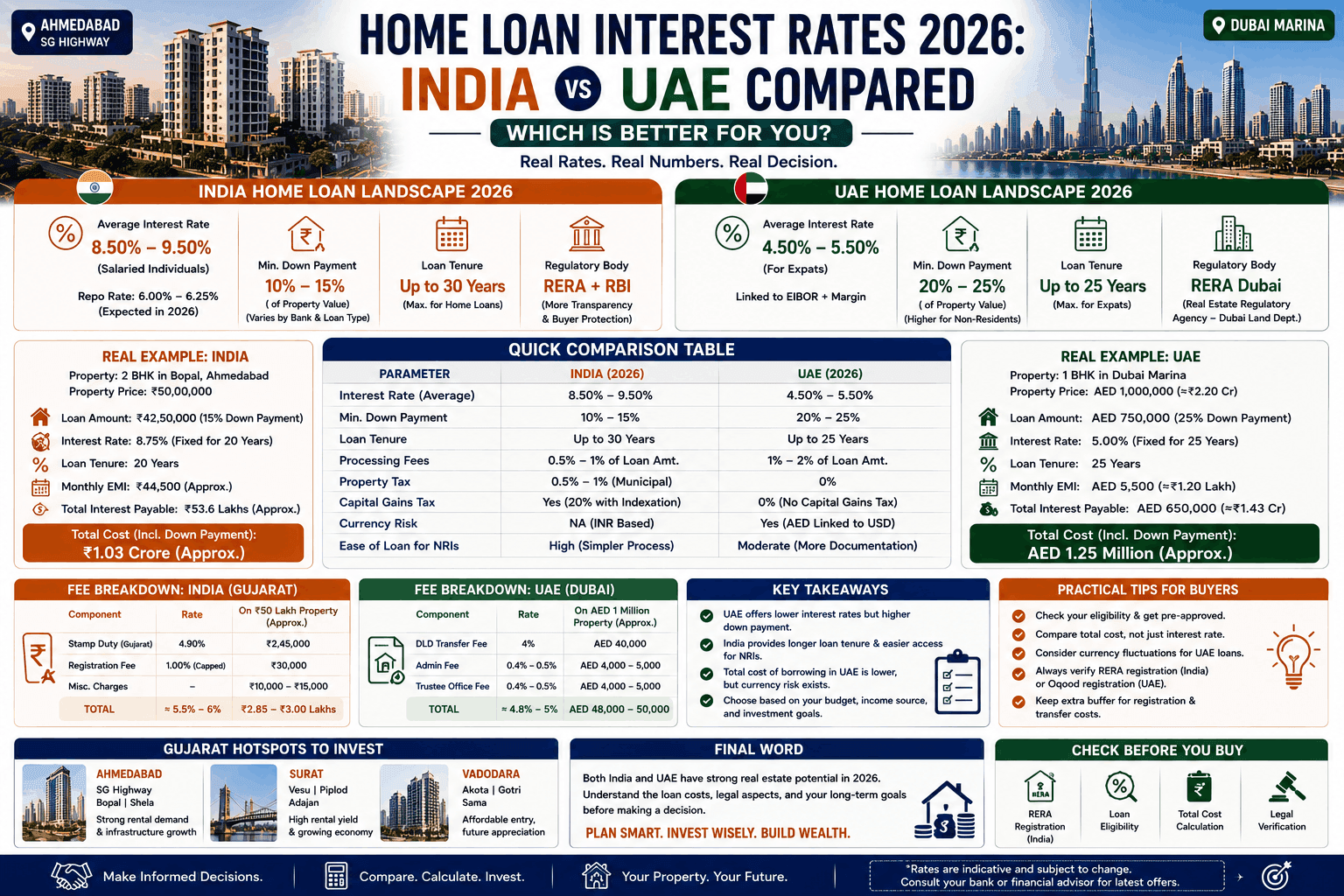
The real estate market is always buzzing, but one question keeps popping up in my conversations with buyers across Gujarat: "Should I invest in India or the UAE?" And the heart of that decision often boils down to Home Loan Interest Rates 2026: India vs UAE Compared. I get it. You are looking at a flat in SG Highway, Ahmedabad, or a villa in Dubai South, and the financing costs can make or break your dream. Let me walk you through the numbers, the trends, and the hidden factors that most advisors won't tell you.
Home Loan Interest Rates 2026: India vs UAE Compared – The Big Picture
Here is the thing: interest rates are not just numbers on a screen. They determine your EMI, your total repayment, and ultimately, your peace of mind. In 2026, both markets are showing distinct trends.
India's Rate Landscape
In India, the repo rate is expected to stabilize around 6.00-6.25% by mid-2026, with home loan rates ranging from 8.50% to 9.50% for salaried individuals. Public sector banks like SBI and HDFC are offering competitive rates, but the real story is in the finer print. For instance, a Rs 50 lakh loan for a flat in Bopal or Shela, Ahmedabad, at 8.75% over 20 years means a monthly EMI of approximately Rs 44,500. That is manageable, but watch out for processing fees and prepayment charges.
UAE's Rate Dynamics
Over in the UAE, interest rates are typically linked to the Emirates Interbank Offered Rate (EIBOR) plus a margin. In 2026, expect rates between 4.50% and 5.50% for expats. Yes, the headline rate is lower. But here is the catch – UAE banks often require a 20-25% down payment for non-residents, and the loan tenure is capped at 25 years. A Dh 1 million (approx Rs 2.2 crore) property in Dubai Marina would have an EMI around Dh 5,500 (Rs 1.2 lakh) at 5% for 25 years. That sounds good, but factor in the currency risk and transfer costs.
Quick Comparison Table
| Parameter | India (2026) | UAE (2026) |
|-----------|--------------|------------|
| Average Interest Rate | 8.5% - 9.5% | 4.5% - 5.5% |
| Down Payment (Min) | 10-15% | 20-25% |
| Loan Tenure | Up to 30 years | Up to 25 years |
| Processing Fees | 0.5% - 1% | 1% - 2% |
Why Interest Rates Alone Don't Tell the Full Story
Look, I have seen many buyers get dazzled by the lower UAE rates. But what many overlook is the total cost of borrowing, including hidden charges. In India, the RERA Act has brought transparency. For example, a project by Savvy Group in SG Highway must disclose all costs upfront. In the UAE, the Real Estate Regulatory Agency (RERA) there also protects buyers, but legal fees and registration costs can add 4-7% to the property price.
A Real Example from Vadodara
Take Ramesh, a software engineer from Vadodara. He was considering a flat in Akota for Rs 60 lakhs. In India, his EMI at 9% for 20 years would be Rs 54,000. He also looked at a studio in Dubai Silicon Oasis for AED 500,000 (Rs 1.1 crore). The UAE EMI at 5% for 25 years was AED 2,900 (Rs 64,000). But here is the kicker – Ramesh had to pay 20% down payment in UAE (Rs 22 lakhs) versus 15% in India (Rs 9 lakhs). Plus, the currency fluctuation risk made him nervous. In the end, he chose the Indian option because of lower upfront costs and the comfort of being near family.
Home Loan Interest Rates 2026: India vs UAE Compared – Impact on Gujarat Markets
Now, how does this affect your buying decision in Gujarat? Let's break it down by city.
Ahmedabad: The Steady Performer
Ahmedabad's real estate is on a roll. With the metro expansion and GIFT City growth, areas like Chandkheda, Vastral, and Bopal are seeing 10-15% annual appreciation. A 2-BHK in Bopal costs Rs 45-55 lakhs. At 8.75% interest, the EMI is around Rs 39,000 for a 20-year loan. If you are an NRI earning in UAE, you might be tempted by the lower rates there. But remember, repatriation rules in India allow you to bring money home easily under the Liberalised Remittance Scheme. For a Gujarati NRI, buying in Ahmedabad is often more practical.
Surat: The Diamond City's Appeal
Surat is booming, especially in Vesu and Adajan. A 3-BHK in Vesu costs Rs 70-80 lakhs. The demand is driven by local businessmen and NRIs. If you compare home loan rates, India's 9% might seem high, but the rental yield in Surat is 3-4%, while in Dubai it's 5-6%. However, the property tax in Gujarat is lower than UAE's annual maintenance fees (which can be 1-2% of property value). So net returns can be similar.
Rajkot and Vadodara: Emerging Hotspots
In Rajkot, the 150 Feet Ring Road area is developing fast. A plot there costs Rs 30-40 lakhs. Construction loans in India are available at 9.5% for under-construction projects. In UAE, you cannot get a loan for land – only for completed units. That is a key difference.
Key Takeaways for Buyers
- For NRIs: If you are earning in UAE, consider the currency risk. The Indian rupee has been volatile. A 5% depreciation can wipe out the interest rate benefit.
- For Local Buyers: Stick with India. The emotional and logistical benefits outweigh the rate difference. You can negotiate with banks – I have seen SBI offer 8.50% for women borrowers.
- For Investors: Look at rental yields. In GIFT City, Gandhinagar, commercial properties yield 8-10%, while residential in Dubai yields 5-6%. But capital appreciation in India is more predictable.
Practical Actionable Tip: Use a Home Loan Calculator
Before you sign anything, use a home loan calculator. Compare the total interest paid over the loan tenure. For a Rs 50 lakh loan at 9% for 20 years, total interest is Rs 58 lakhs. At 5% for 25 years, total interest is Rs 38 lakhs. But the loan amount in UAE is higher due to property prices. Do the math yourself. I recommend using the RBI's bank rate calculator or the UAE Central Bank's loan calculator.
RERA Tip for Gujarat Buyers
Always check RERA registration. In Gujarat, every project must have a RERA number. For example, a project by Adani Realty in Shela must be registered. This ensures timely possession and quality. In UAE, the equivalent is the Dubai Land Department's Oqood system. Both are good, but India's RERA is more consumer-friendly.
Conclusion: Which One Wins?
There is no one-size-fits-all answer. If you are a non-resident Gujarati with a stable income in UAE, buying in India might be better for long-term family goals. If you are a high-net-worth investor looking for diversification, UAE offers lower rates and a global market. But for 90% of my clients, I recommend India. The transparency, lower upfront costs, and emotional connection are priceless.
So, what is your next step? Start by getting pre-approved for a home loan in India. Talk to your bank manager. Ask about special schemes for NRIs. And remember, the best time to buy is when you are ready – not when rates are lowest. Good luck!
*Disclaimer: Interest rates are indicative and subject to change. Consult a financial advisor before making a decision.*