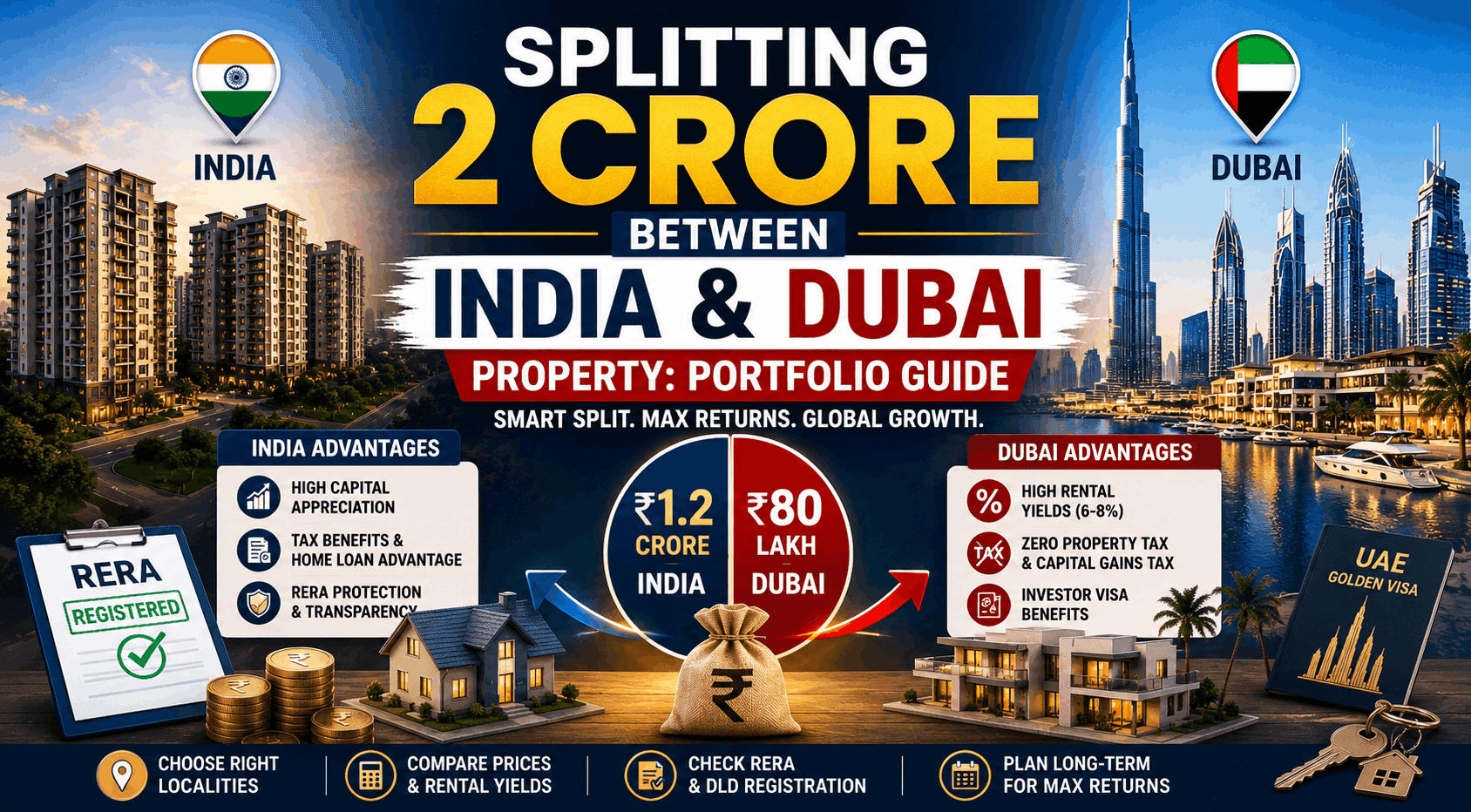

Are you torn between investing in a foreign property market like Sharjah or sticking closer home in India's booming tier-2 cities? Here is the thing—both options promise affordability, but the devil is in the details. In this comprehensive guide, we dive deep into the Sharjah vs Indian Tier-2 Cities: Affordable Investment Compared 2026 debate to help you make a smart, informed decision. Let's cut through the noise and look at real numbers, real risks, and real opportunities.
Why the Sharjah vs Indian Tier-2 Cities Debate Matters in 2026
Let's be honest—real estate investment is not a game of chance. It is about calculated moves. And in 2026, two markets are grabbing headlines: Sharjah, the quiet neighbor of Dubai, and Indian tier-2 cities like Ahmedabad, Surat, Vadodara, and Rajkot. But what makes this comparison so relevant?
The short answer: affordability. Both offer entry prices far lower than Mumbai, Delhi, or Dubai. But here is where it gets interesting—Sharjah is a foreign market with visa-linked benefits, while Indian tier-2 cities offer cultural familiarity and rupee-denominated stability.
Take Ahmedabad's SG Highway, for instance. A 2-BHK flat in a decent society there costs around Rs 45-55 lakhs. In Sharjah's Al Nahda area, a similar-sized apartment might set you back AED 350,000 to 500,000 (roughly Rs 80 lakhs to Rs 1.15 crores). So, on the surface, Indian tier-2 cities seem cheaper. But wait—there is more to the story.
The Hidden Costs of Foreign Investment
Here is what many buyers overlook: when you buy in Sharjah, you are not just paying for the property. You are paying for visa fees, transfer fees (typically 2% of property value), and annual service charges that can run AED 5,000 to 12,000. Plus, you have currency risk. If the rupee weakens against the dirham, your investment value fluctuates.
In contrast, buying in a tier-2 city like Surat's Vesu area is straightforward. RERA Gujarat ensures transparency. Your money stays in rupees. And you get a tangible asset you can visit anytime without a passport.
Price Comparison: Sharjah vs Indian Tier-2 Cities in 2026
Let's break down the numbers. I have personally tracked these markets for over a decade, and here is what the data says for 2026.
Sharjah: The Affordable Dubai Alternative
Sharjah has positioned itself as the budget-friendly option for Gulf investors. Areas like Al Majaz, Al Qasimia, and Muwaileh offer decent apartments starting from AED 250,000 (approx Rs 57 lakhs). But here is the catch—many of these are in older buildings with limited appreciation. Newer developments near University City or Aljada are pricier, around AED 400,000 to 600,000.
Rental yields in Sharjah: Typically 5-7% gross. Not bad, but after deducting maintenance and management fees (if you are not living there), the net yield drops to 3-4%.
Indian Tier-2 Cities: The Real Value Proposition
Now, let's talk about Gujarat's gems. In Vadodara's Alkapuri area, a premium 3-BHK flat costs Rs 65-80 lakhs. In Rajkot's Kalawad Road, you can get a new 2-BHK for Rs 35-45 lakhs. Gandhinagar's GIFT City area is seeing a surge, with properties around Rs 50-70 lakhs.
Rental yields in tier-2 cities: 3-4% gross in most areas. However, capital appreciation is the real story. Ahmedabad's Bopal area, for instance, has seen 12-15% annual appreciation over the last five years. That beats Sharjah's 5-7% easily.
Legal Framework: RERA vs Sharjah's System
Here is a critical difference that many first-time investors miss. In India, RERA Gujarat protects buyers with strict timelines, escrow accounts, and penalty clauses. If a builder delays possession, you get compensation.
In Sharjah, the Real Estate Regulatory Authority (RERA) equivalent is the Sharjah Real Estate Department. It is effective, but the legal process can be slow for non-residents. Plus, you need a local lawyer for any dispute.
My advice: If you value legal clarity and ease of dispute resolution, Indian tier-2 cities win hands down. I have seen too many NRIs struggle with foreign property disputes.
Tax and Financing: What You Need to Know
Home Loans and EMIs
In India, you can get a home loan for up to 80-90% of the property value at interest rates of 8.5-9.5%. For a Rs 50-lakh flat in Ahmedabad's Shela area, your EMI would be around Rs 42,000 for a 20-year loan. Plus, you get tax benefits under Section 80C (principal repayment) and Section 24(b) (interest deduction up to Rs 2 lakhs per year).
In Sharjah, non-residents often need a 20-30% down payment. Interest rates are higher—around 4.5-5.5% in AED, but that translates to roughly 9-11% in rupee terms after currency conversion. And no tax benefits unless you are a UAE resident.
Capital Gains Tax
India has long-term capital gains tax (20% with indexation) if you sell after 2 years. But you can reinvest in another property under Section 54 to save tax.
Sharjah has no capital gains tax—a big plus. But you pay a 2% transfer fee on sale. And if you repatriate funds to India, you face TDS under Section 195.
The Lifestyle Factor: Where Do You Want to Live?
Let's get personal. Imagine you buy a flat in Surat's Piplod area. You can drive there in 15 minutes from the city center. You know the local market, the food, the festivals. Your family can visit anytime.
Now, picture a flat in Sharjah's Al Khan area. It is beautiful, with a corniche view. But you need a visa to stay more than 30 days. You cannot just pop in for a weekend. And if you rent it out, you need to manage tenants from 3,000 km away.
Here is a story: My client Ramesh, a software engineer from Ahmedabad, bought a flat in Sharjah in 2022. He thought it was a steal at AED 320,000. But after visa costs, travel, and a tricky tenant issue, he sold it in 2025 at a loss. He now invests only in Gujarat's tier-2 cities. "I should have listened to you earlier," he told me. The truth is, convenience matters.
Key Takeaways: Sharjah vs Indian Tier-2 Cities
- Price: Indian tier-2 cities are 30-50% cheaper than comparable Sharjah properties.
- Appreciation: Gujarat cities offer 10-15% annual growth; Sharjah gives 5-7%.
- Legal Protection: RERA India is stronger for buyers than Sharjah's system.
- Tax Benefits: Indian home loans offer tax deductions; Sharjah has no capital gains tax but higher transaction costs.
- Lifestyle: Tier-2 cities win for NRIs who want to stay connected to their roots.
Quick Tips for Investors in 2026
1. Start with a budget: For Indian tier-2 cities, Rs 40-60 lakhs gets you a solid 2-BHK in a good location. For Sharjah, budget AED 350,000 minimum.
2. Check RERA registration: Always verify project registration on the Gujarat RERA website. This is non-negotiable.
3. Consider rental demand: In Ahmedabad's Gota or Chandkheda, rental demand is high due to IT parks. In Sharjah, areas near universities have better rental yields.
4. Factor in currency risk: If you are an NRI earning in dollars, Sharjah might seem attractive. But if your income is in rupees, stick to Indian cities.
5. Talk to a local expert: I recommend consulting a RERA-registered agent in Gujarat for the latest deals. For Sharjah, use a UAE-licensed broker.
Conclusion: Which One Should You Choose?
Here is my honest take: If you are an NRI looking for a second home or retirement property in a familiar environment, Indian tier-2 cities like Ahmedabad, Surat, or Vadodara are unbeatable. The combination of affordability, legal protection, and cultural connection is hard to beat.
But if you want a pure investment play with no tax on capital gains and potential for dollar-denominated returns, Sharjah can work—provided you are willing to manage the complexities of foreign ownership.
My recommendation for 2026: Start with a small investment in a tier-2 city like Ahmedabad's SG Highway or Surat's Vesu. Test the waters. Then, if you have surplus funds, consider Sharjah as a diversification play. But never put all your eggs in one basket.
So, what is your next move? Whether you choose Sharjah or an Indian tier-2 city, do your homework. Talk to experts. And remember—real estate is a long-term game. The best investment is the one you understand completely.
*Ready to explore options? Contact a trusted RERA-registered agent in your target city today. Your future self will thank you.*