
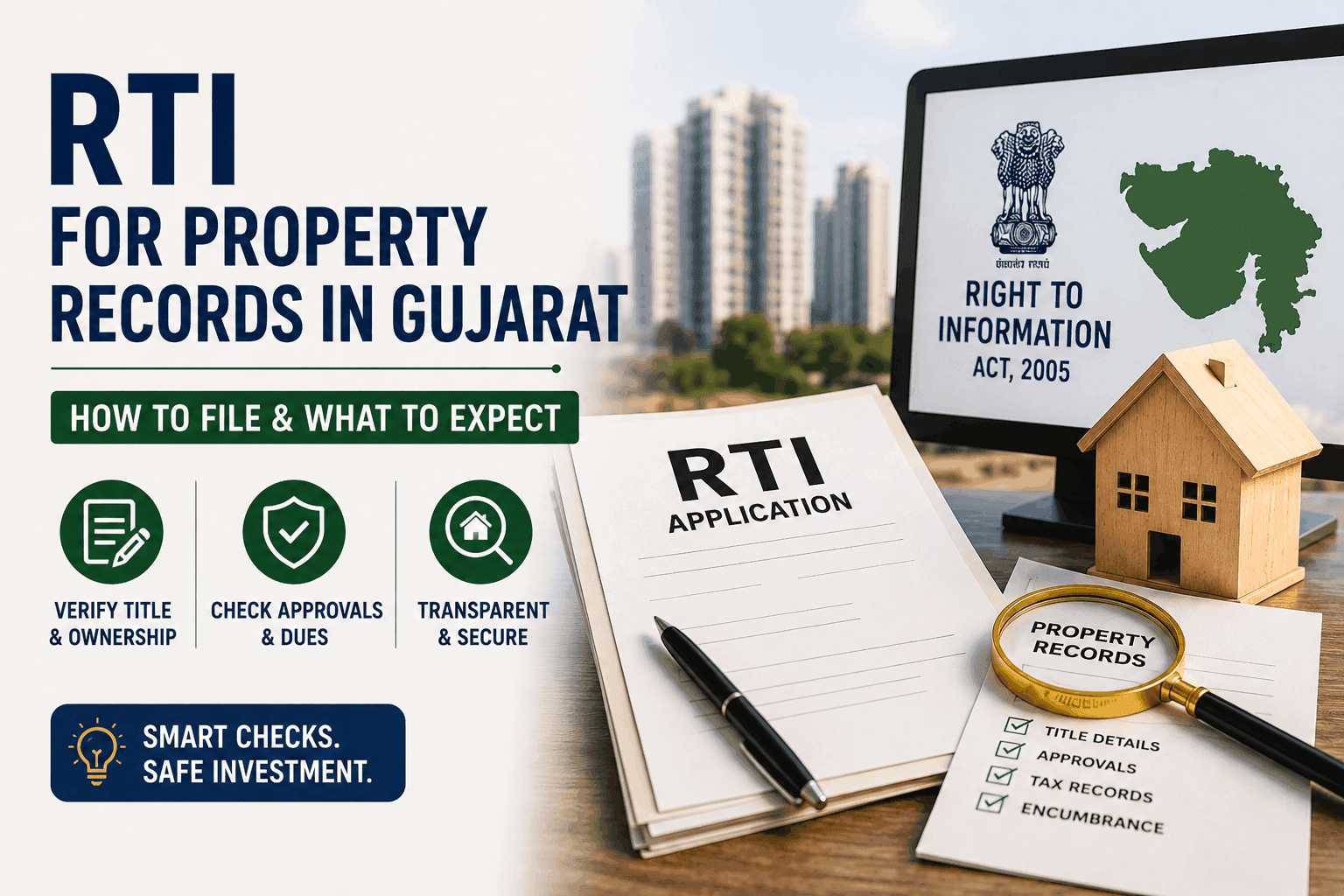
RTI for Property Records in Gujarat: How to File and What to Expect
Buying a flat in Ahmedabad or a row house in Surat is a big deal. You are likely putting your life savings into it. But have you ever wondered if the property title is clean? Or if the developer has paid all dues to the local authority?
This is where RTI for Property Records in Gujarat becomes your best friend. The Right to Information Act, 2005 is not just for government babus. It is a powerful tool for homebuyers, investors, and even tenants.
In this guide, I will walk you through exactly how to file an RTI for property records in Gujarat, what kind of information you can get, and what to expect after you file it. Let me also give you real examples from localities like SG Highway, Vesu, and Gotri.
Why Use RTI for Property Records?
Here is the thing: property records in Gujarat are maintained by multiple government departments. The Sub-Registrar office has sale deeds. The local municipal corporation (Ahmedabad Municipal Corporation, Surat Municipal Corporation, etc.) has building plan approvals. The revenue department has land records and 7/12 extracts.
A single RTI can help you get all this information in one place. Think of it as a due diligence shortcut.
What many buyers overlook is that developers sometimes hide crucial facts. For example, a project might be built on land that was meant for agricultural use. Or the developer might have taken a loan against the land without telling you.
By filing an RTI, you can uncover these red flags before you sign the agreement. In fact, I personally recommend every buyer file at least two RTI applications before making a down payment.
What Information Can You Get?
You would be surprised how much is publicly available. Here is a quick list:
- Property title details: Who owns the land? Are there any disputes?
- Encumbrances: Is there a mortgage or lien on the property?
- Building plan approvals: Was the plan sanctioned by the municipal corporation?
- Completion certificate: Has the project received an occupancy certificate?
- Tax receipts: Have property taxes been paid?
- Land use: Is it residential, commercial, or agricultural?
- Litigation history: Are there any court cases related to the property?
For instance, if you are looking at a flat in Bopal, Ahmedabad, you can get the 7/12 extract from the Mamlatdar office. This will tell you if the land title is clear. Similarly, for a project in Vesu, Surat, you can check the building plan approval status from Surat Municipal Corporation.
How to File an RTI Application in Gujarat
Now, let me give you a step-by-step process. It is simpler than you think.
#### Step 1: Identify the Right Public Information Officer (PIO)
First, you need to figure out which department holds the information you need. Here is a quick guide:
- Sub-Registrar office: For sale deeds, encumbrances, and registration details.
- Local municipal corporation: For building plan approvals, property tax records, and completion certificates.
- Revenue department (Mamlatdar office): For 7/12 extracts, land records, and mutation entries.
- Gujarat RERA: For project registration details and developer compliance.
#### Step 2: Draft Your Application
Your RTI application must be in writing. You can write it in English, Hindi, or Gujarati. Here is a simple format:
```
To,
The Public Information Officer,
[Department Name, Address]
Subject: Request for Information under RTI Act, 2005
Dear Sir/Madam,
I, [Your Name], a citizen of India, request the following information under the RTI Act, 2005:
1. Provide a certified copy of the 7/12 extract for survey number [XYZ] in village [Name].
2. Provide details of any encumbrances registered against property bearing [address/plot number].
3. Provide a copy of the building plan approval for [project name].
4. Provide details of property tax paid for the last 5 years for [property address].
I am willing to pay the prescribed fee. Please provide the information within 30 days as per the Act.
Thank you,
[Your Name]
[Your Address]
[Phone Number]
```
#### Step 3: Submit and Pay Fee
You can submit the application in person, by post, or online via the Gujarat RTI portal (rti.gujarat.gov.in). The fee is Rs. 10 per application. You can pay via cash, demand draft, or online payment.
#### Step 4: Wait for Response
By law, the PIO must respond within 30 days. If the information is voluminous, they may take up to 45 days. In my experience, most departments in Gujarat respond within 2-3 weeks for simple requests.
What to Expect After Filing
Look, the process is not always smooth. Here is what you can realistically expect:
- Complete information: Many times, you will get exactly what you asked for. For example, I helped a client in Gandhinagar get the 7/12 extract for a plot near GIFT City within 20 days.
- Partial information: Sometimes, the department may claim that some information is exempt under Section 8 of the RTI Act. For instance, they might not share personal details of the seller without consent.
- Rejection: If your request is too vague or asks for third-party information, it may be rejected. That is why you need to be specific.
If you are not satisfied with the response, you can file a first appeal within 30 days. The first appellate authority is usually a senior officer in the same department. If that fails, you can go to the Gujarat Information Commission.
Real-Life Example: How RTI Saved a Buyer in Ahmedabad
Let me tell you about Ramesh, a first-time buyer from Ahmedabad. He was about to book a flat in a new project on SG Highway. The price was attractive – Rs 65 lakhs for a 2 BHK. But something felt off.
Ramesh filed an RTI with the Ahmedabad Municipal Corporation. He asked for the building plan approval and completion certificate. Two weeks later, he got a shock. The developer had only received approval for a ground plus four floors. But the project was selling flats on the fifth floor!
He immediately backed out. Later, he found out the developer was in legal trouble. The RTI saved him from a potential nightmare.
Wondering if you should do the same? The answer is a clear yes. I personally recommend filing an RTI for any property above Rs 50 lakhs.
Key Takeaways
- RTI is a low-cost (Rs 10) way to verify property records in Gujarat.
- You can get title details, encumbrance records, building plan approvals, and tax receipts.
- File with the Sub-Registrar, municipal corporation, or Mamlatdar office depending on your need.
- Be specific in your request. Vague questions lead to vague answers.
- If denied, use the first appeal process. It is effective in most cases.
Common Mistakes to Avoid
- Not paying the fee: Without the Rs 10 fee, your application is invalid.
- Asking for opinions: RTI is for factual information, not for opinions or legal advice.
- Not keeping copies: Always keep a copy of your application and fee receipt.
- Expecting instant results: The law gives 30 days. Be patient.
Conclusion
Buying property in Gujarat is exciting but risky. The market is hot in areas like Shela, Gota, and Althan. Prices are rising. But you cannot afford to skip due diligence.
RTI for Property Records in Gujarat is your shield. It gives you transparency. It protects your hard-earned money.
So, before you sign that agreement, take 30 minutes. Write an RTI. Pay Rs 10. Get the truth.
Have you ever used RTI for property verification? Share your experience in the comments below. And if you need help drafting an application, feel free to reach out. I am happy to guide you.
Disclaimer: This article is for informational purposes only. It does not constitute legal advice. For specific legal concerns, consult a property lawyer in Gujarat.