
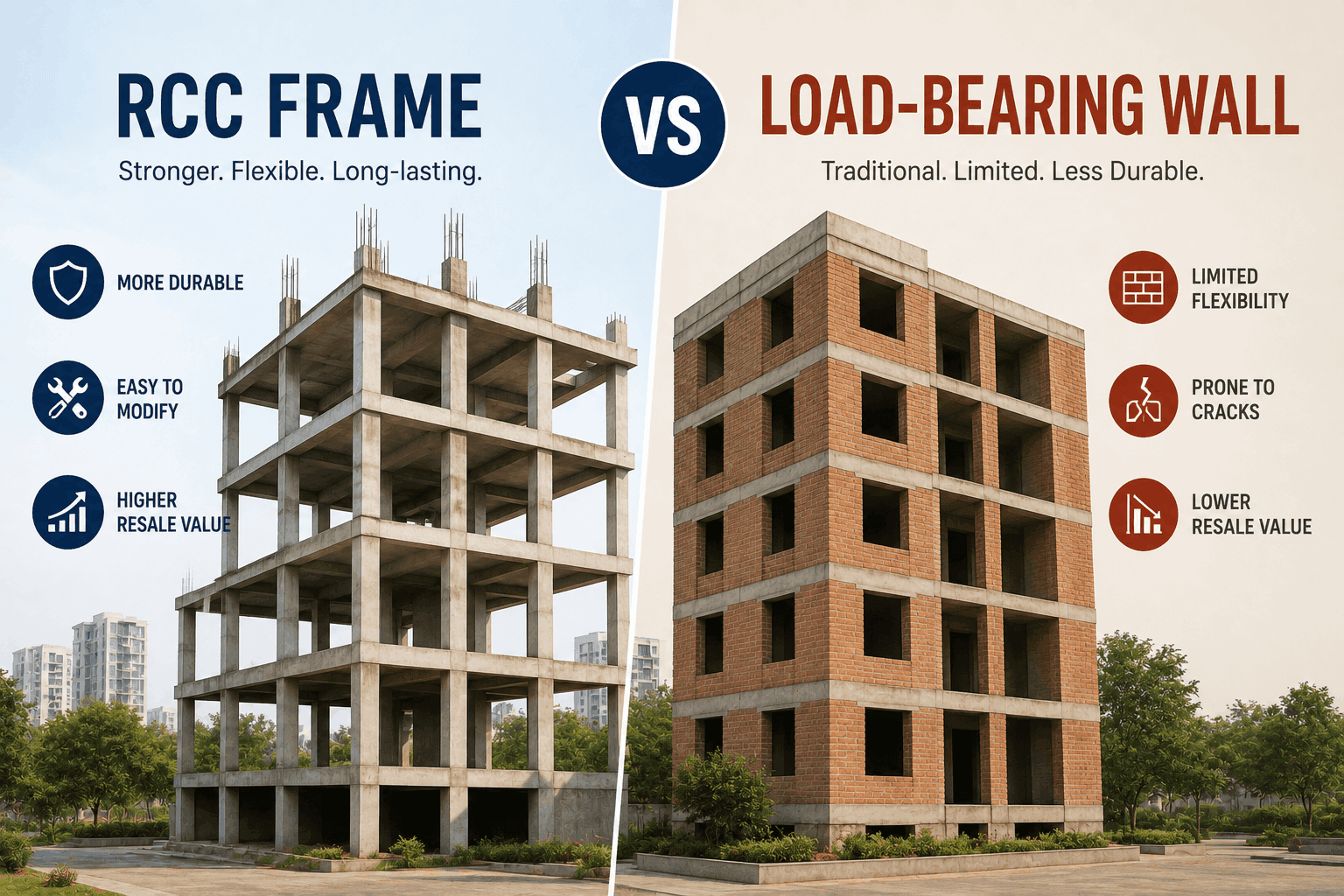
RCC Frame vs Load-Bearing Wall: Which Apartment Lasts Longer?
Are you planning to buy a flat in Ahmedabad or Surat and wondering which construction method will give you a safer, longer-lasting home? The choice between an RCC frame structure and a load-bearing wall system isn't just about engineering jargon—it directly impacts your home's durability, resale value, and even your renovation options. In this comprehensive guide, I'll break down everything you need to know about RCC frame vs load-bearing wall: which apartment lasts longer.
What is an RCC Frame Structure?
An RCC (Reinforced Cement Concrete) frame structure is the modern standard for multi-storey apartments. Think of it as a skeleton made of columns, beams, and slabs. The concrete frame carries all the weight—both the building's own mass and the live loads from furniture, people, and even Gujarat's monsoon rains. Walls here are just fillers, not load-bearers.
Advantages of RCC Frame
- Flexibility in design: You can change room layouts later without worrying about structural stability. Want to knock down a wall between your living room and kitchen? Go ahead—it's non-load-bearing.
- Earthquake resistance: In seismic zones like parts of Gujarat, RCC frames with proper reinforcement absorb and dissipate energy better. The columns and beams act like shock absorbers.
- Longer spans: You get larger, column-free spaces—ideal for modern open-plan living. Many SG Highway apartments in Ahmedabad use this method for spacious balconies and living areas.
- Faster construction: Pre-cast elements and modern formwork speed up the building process.
Disadvantages of RCC Frame
- Higher initial cost: You're paying for more steel and concrete. For a 2-BHK flat in Bopal, expect a 10-15% premium over load-bearing construction.
- Requires skilled labour: Poor workmanship can lead to honeycombing (voids in concrete) or reinforcement corrosion. Always check the builder's track record.
- Potential for column protrusions: Columns inside rooms can eat into usable space. Some buyers in Satellite find this annoying.
What is a Load-Bearing Wall Structure?
A load-bearing wall structure is the traditional method where walls themselves support the building's weight. The walls are thicker—typically 9 inches or more—and made of brick, stone, or concrete blocks. The roof and floors transfer loads directly to these walls.
Advantages of Load-Bearing Walls
- Lower material cost: Less steel and concrete required. This can reduce construction costs by 15-20%.
- Better sound insulation: Thick brick walls naturally dampen noise. In dense areas like Naroda or Vastral, this is a big plus.
- Thermal comfort: Brick walls have good thermal mass, keeping interiors cooler in Gujarat's summers.
- Simplicity: Easier to build with local labour, especially in smaller towns.
Disadvantages of Load-Bearing Walls
- Limited design flexibility: You cannot easily remove or modify walls. Want to combine two rooms? That's a structural nightmare.
- Restricted floor plans: Spans are limited—usually max 12-15 feet between walls. You'll see more columns and narrower rooms.
- Poor earthquake performance: Load-bearing walls are brittle. In a quake, they can crack and collapse suddenly. Many older buildings in Rajkot's Kalawad Road area suffered damage in the 2001 earthquake.
- Difficult to add floors: You can't easily build additional storeys without major reinforcement.
RCC Frame vs Load-Bearing Wall: Which Apartment Lasts Longer?
Here's the straight answer: RCC frame structures last longer—typically 60-100 years with proper maintenance, while load-bearing buildings have a lifespan of 30-50 years. The reason? RCC frames are more flexible, can withstand movement, and are less prone to moisture damage. But let's dig deeper.
Durability Factors
1. Moisture resistance: Load-bearing brick walls absorb moisture, leading to dampness and efflorescence (white salt deposits). In Surat's high-humidity areas like Adajan, this is a common problem. RCC frames, with proper waterproofing, fare better.
2. Crack resistance: RCC structures allow for controlled cracking (hairline cracks in slabs or beams) that don't compromise safety. Load-bearing walls develop wider, more dangerous cracks.
3. Foundation settlement: All buildings settle over time. RCC frames can accommodate differential settlement better because the frame redistributes loads. Load-bearing walls can crack if one corner settles more than another.
Real-World Example
Take the case of a 15-year-old apartment complex in Vastrapur, Ahmedabad. The building with an RCC frame showed minor plaster cracks but no structural issues. A similar-age load-bearing complex in the same area had visible diagonal cracks in several walls—a sign of distress. The RCC building was easier to repair and had better resale value.
What About Renovation and Resale?
This is where the difference really hits your pocket. RCC frame apartments are easier to renovate and have higher resale value. Here's why:
- Renovation freedom: In an RCC flat, you can remove a wall to create an open kitchen, add a new door, or even combine two bedrooms. In a load-bearing flat, any wall removal requires structural engineers and costly steel beams.
- Resale premium: Buyers in cities like Vadodara (Akota, Alkapuri) prefer RCC frame apartments. They know they can customize later. Load-bearing flats often sell at a 10-15% discount.
- Future additions: Want to add a floor to your bungalow? RCC frame makes it possible. Load-bearing? Not without major work.
What I Tell My Clients
Personally, I recommend RCC frame for any apartment above 3 floors. For a 2-3 storey building in a low-seismic zone, a well-built load-bearing structure can still be a good budget option. But if you're buying in GIFT City, Gandhinagar, or any area with potential for high-rise development, go RCC.
Cost Comparison: RCC Frame vs Load-Bearing Wall
Let's talk numbers. For a 1200 sq. ft. 3-BHK flat in Shela, Ahmedabad:
- RCC frame construction cost: Rs 1,800-2,200 per sq. ft. That's Rs 21.6-26.4 lakhs for the structure alone.
- Load-bearing wall construction cost: Rs 1,500-1,800 per sq. ft. That's Rs 18-21.6 lakhs.
But don't just look at initial cost. Factor in:
- Maintenance: RCC needs less frequent repairs. Load-bearing walls may need repointing and waterproofing every 10-15 years.
- Resale value: Over 20 years, an RCC flat can fetch 15-20% more than a comparable load-bearing one.
- Insurance: Some insurers offer lower premiums for RCC frame buildings due to better earthquake performance.
RERA and Legal Considerations
Under RERA Gujarat, builders must disclose the construction methodology in the project details. When you visit a site, check the RERA registration number and ask for the structural design drawings. Tip: If a builder offers a "load-bearing" flat in a 10-storey building, run away—it's not structurally sound and may violate building codes.
What Buyers Often Overlook
Many first-time buyers in Chandkheda or Gotri focus only on price. They forget that a load-bearing flat may have lower EMI but higher long-term costs. Here's what I tell them: "Your home is your biggest investment. Don't save 2-3 lakhs upfront and lose 10 lakhs later in resale."
Key Takeaways
- RCC frame apartments last 60-100 years vs 30-50 years for load-bearing.
- RCC offers design flexibility—you can change walls, add rooms, renovate easily.
- Load-bearing is cheaper upfront but costs more in maintenance and lower resale.
- For high-rises (4+ floors), RCC is mandatory in most Gujarat cities.
- Always verify the builder's RCC compliance through RERA documentation.
- In earthquake-prone zones, RCC frame is non-negotiable.
Quick Tips for Buyers
1. Visit the site during construction: See if columns and beams are visible. If you only see thick brick walls, it's likely load-bearing.
2. Ask for the structural drawings: A good builder will share them. If they hesitate, that's a red flag.
3. Check for RERA registration: All projects must be registered. Use the Gujarat RERA portal to verify.
4. Talk to existing residents: In a completed project, ask about cracks, dampness, and renovation experiences.
5. Don't ignore the soil report: In areas with black cotton soil (common in parts of Ahmedabad), RCC frames with deep foundations are essential.
Conclusion
So, which apartment lasts longer? The answer is clear: RCC frame structures are superior in durability, flexibility, and long-term value. While load-bearing walls have their place in small, low-rise buildings, they are not ideal for modern apartments. If you're investing in a home in Gujarat—whether in Ahmedabad's SG Highway, Surat's Vesu, or Vadodara's Gotri—choose an RCC frame. Your future self will thank you.
Ready to make an informed decision? Start by checking the construction method of any flat you shortlist. Ask your builder directly: "Is this an RCC frame or load-bearing structure?" If they can't answer confidently, move on. Your home's longevity depends on it.